

Published Sep 22, 2026 | 8:48 PM ⚊ Updated Sep 22, 2026 | 8:48 PM

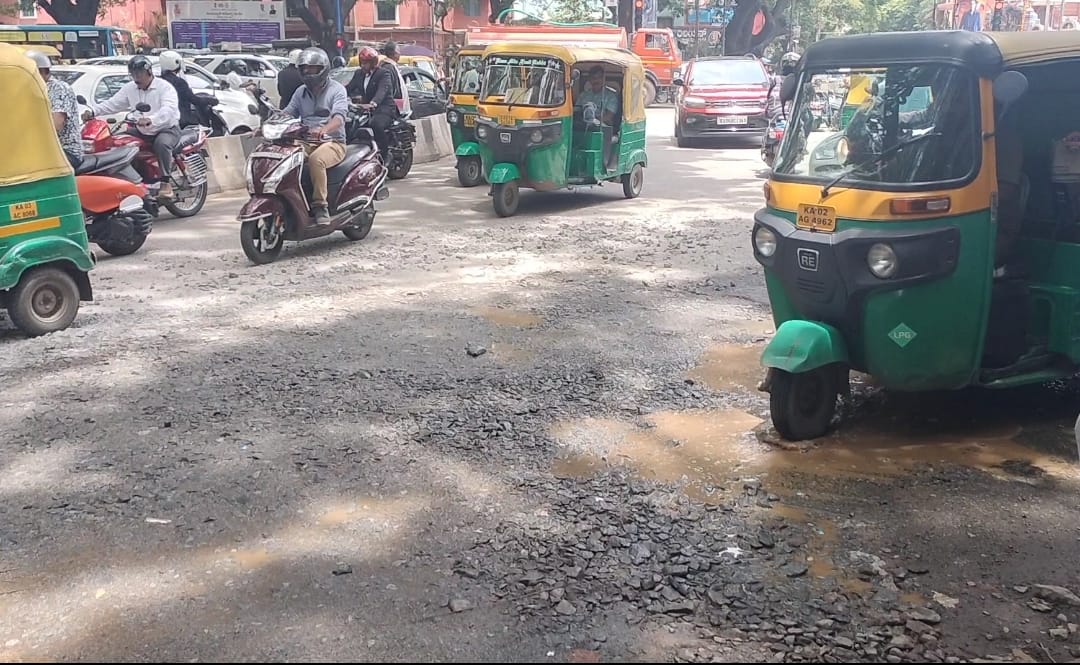
One of the major CAG findings concerned the PWD's preparation of road estimates.

Synopsis: The Comptroller and Auditor General (CAG) has flagged inflated road estimates and underutilised public investment in industrial areas (IA) between April 2019 and March 2024. It flagged several instances of undue financial benefits to contractors, pointing to weaknesses in planning, estimation and deviation from established guidelines.
A Comptroller and Auditor General (CAG) report flagged incorrect rates and specifications that inflated road costs, and industrial areas developed without adequate land readiness and basic facilities failed to deliver their intended economic benefits.
Karnataka Chief Minister DK Shivakumar tabled the Compliance Audit report for the years April 2019 – March 2024 in the State Assembly on Monday, 21 September.
The findings were detailed at a media conference in Bengaluru on Tuesday, 22 September. Ashok Sinha, Principal Accountant General (Audit-II), Jahangir Imandar, Accountant General (Audit-I), and Senior Deputy Accountant General Subbaiah S attended the conference.
The report presented in the Assembly was divided into three chapters: the first chapter introduced the government departments.
The second chapter covered compliance audit observations on the department’s road-work estimates and the Karnataka Industrial Areas Development Board’s (KIADB) development and maintenance of industrial areas during the specified period.
The final chapter contained 12 compliance audit paragraphs relating to PWD, Electronics, Information Technology and Biotechnology, Industries and Commerce, and others.
Also Read: Governor asks CM DK Shivakumar to reconsider order limiting Vande Mataram rendition
One of the major findings concerned the Public Works Department’s (PWD) preparation of road estimates.
The CAG found that the department used a density of 1.5 tonnes per cubic metre instead of 1.8 tonnes while arriving at rates for road metal in its Schedule of Rates (SoR), resulting in an additional burden of ₹24.07 crore across 239 works.
The audit also adopted a higher building-work rate instead of the applicable road-work rate for PCC M40 concrete, adding ₹3.74 crore across 18 works.
Incorrect items or rates inflated estimates by another ₹34.93 crore across 186 works.
The audit noted that such errors meant road projects were estimated at more than necessary and resulted in avoidable additional expenditure.
“Even small changes in the SoR could have a significant cumulative impact on the state exchequer as they could otherwise have been used for other development works,” Imandar said.
Separately, overlapping chainages of 925 metres in road works undertaken by the Yadgir division resulted in what the CAG termed “fraudulent payments” of ₹1.33 crore to contractors for work not carried out.
In Kalaburagi and Chamarajanagar divisions, manual execution rates were paid for work carried out mechanically, giving contractors an undue benefit of ₹5.04 crore.
“This was an undue payment as manual excavation rates are higher than mechanical rates,“ Imandar said.
Similarly, a 501-day delay in finalising another tender reduced the project scope and created a liability of ₹5.08 crore.
Also Read: Karnataka BJP offers support to govt to oppose Kasturirangan report
The CAG also flagged weaknesses in the development and maintenance of industrial areas by KIADB, the statutory body responsible for providing infrastructure facilities in industrial areas. Issues flagged included projects proceeding without adequate land readiness or required environmental clearances.
Of 22 industrial areas developed after the 2006 Environment Impact Assessment (EIA) notification, four lacked environmental clearances despite 1,046.72 acres being allotted to 474 units.
KIADB also invested ₹281.34 crore in development activities in Kitnur, Balekundri and Aerospace Park Sub-layout 11 despite the absence of litigation-free land, leaving the public investment underutilised.
Basic water facilities were unavailable in 24 of 41 industrial areas test-checked, necessitating the digging of 201 borewells. Sewage and Effluent Treatment Plants could also not be operated despite expenditure of ₹31.49 crore.
The audit said the absence of such facilities discouraged or delayed industrial activity, while vacant or non-functional units meant industrial areas could not fully deliver their intended economic benefits.
This left sections of the population deprived of their intended benefits.
Also Read: After Tulu, SDPI seeks additional official language status for Urdu in Karnataka
Separately, delays in completing a KIADB office building resulted in avoidable rental expenditure amounting to ₹48.6 crore.
A land-related decision contrary to government directions extended an undue benefit of ₹31.90 crore. In comparison, alternative land allotment without following the required negotiation process resulted in an undue benefit of at least ₹3.88 crore.
In the Minor Irrigation and Ground Water Development Department, the audit found that price adjustments made contrary to tender conditions gave contractors an undue financial benefit of ₹9.52 crore.
It also found that weak supervision led to irregular payments of ₹3.22 crore for works whose execution was doubtful.
Meanwhile, inadequate provisions for handling quantity variations in lump-sum contracts resulted in a further financial loss of ₹26 crore.
A lift irrigation scheme awarded before the required land was acquired left ₹58.85 crore blocked as the project could not be completed.
“These audit findings are communicated to the government and respective departments, whose responses, justifications and clarifications are recorded as part of the process,” Imandar said.
The audit has placed deviations before the government and the Assembly, following which necessary action can be taken, he added.
(Edited by Majnu Babu).



