

Published Jun 22, 2026 | 10:54 AM ⚊ Updated Jun 22, 2026 | 10:55 AM

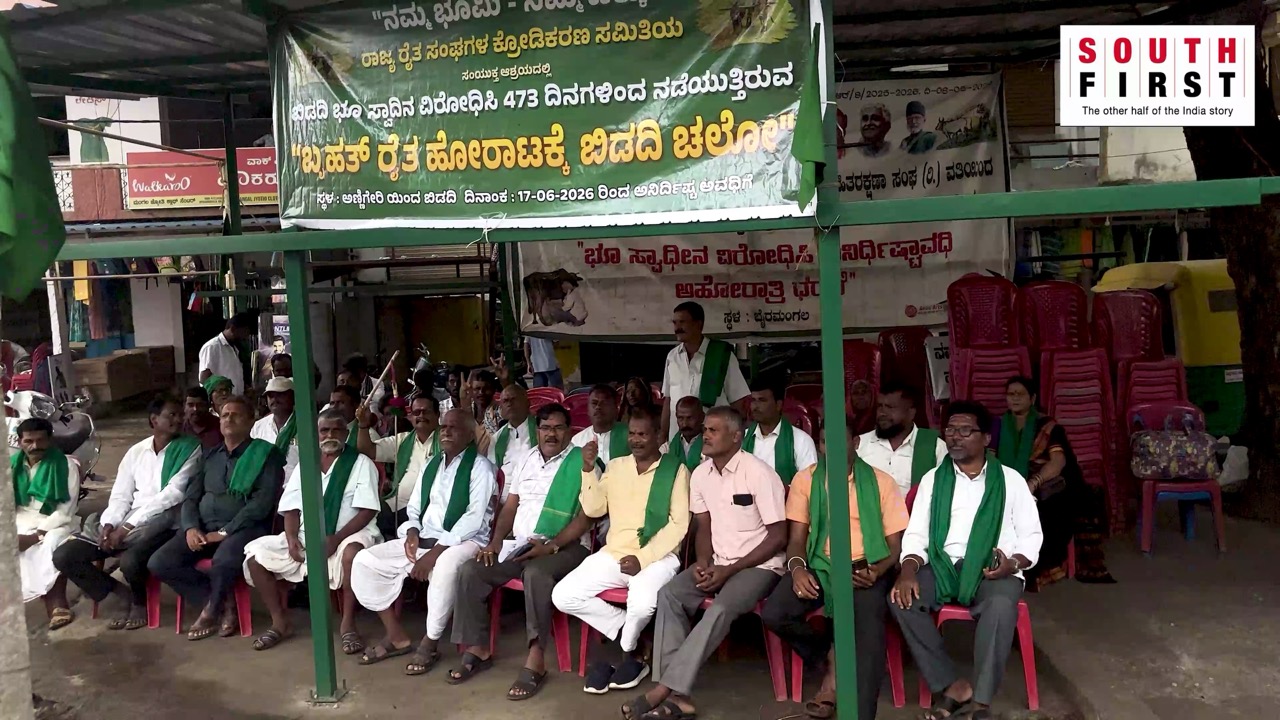
For the past 460 days hundreds have been holding a continuous protest against the Bidadi AI township project.
Synopsis: Karnataka wants to build a ₹18,000-crore “AI township” spread across nearly 9,600 acres of land in Bengaluru South district. The project promises to create jobs, decongest Bengaluru and build a futuristic “work-live-play” city. But for thousands of farmers, this is fertile agricultural land that has sustained generations through farming, dairy production and sericulture. For more than 460 days, they have been holding a continuous protest against the project.
Some 40 kilometres from Karnataka’s capital, Bengaluru, lies the village of Allalasandra. Forty-two-year-old Sujatha moved to the village after her marriage more than two decades ago. Over the past 10 years, she and her husband have built a comfortable livelihood on their modest four-acre holding, rearing an ever-growing herd that now includes 10 cows, two goats and dozens of chickens.
In 2025, the couple earned more than ₹13 lakh from dairy farming.
“We supplied a little over 28,700 litres of milk. We received ₹10.23 lakh in dairy payments, an additional ₹2.4 lakh through the ₹5-per-litre incentive, and a ₹1-per-litre bonus when excess profits were disbursed,” she told South First.
The couple supplement this income by selling surplus manure and baby corn fodder to Bannerghatta National Park. Altogether, they say, their earnings have enabled them to live comfortably, educate their children and live without financial worry.
That livelihood, however, is now under threat. For the past 460 days, hundreds of farmers like Sujatha, from dozens of surrounding villages, have been camped at Byramangala, near Bidadi in Ramanagara taluk, maintaining a round-the-clock vigil against what they say is an existential threat: the Karnataka government’s proposed Greater Bengaluru Integrated Township (GBIT) project.
Byramangala lies roughly at the centre of a 20-kilometre stretch of greenery sandwiched between the industrial hubs of Bidadi and Harohalli.
Locals say the region rivals Malenadu itself in its lush green cover. It is home to lakhs of trees, including coconut, areca nut, mango, chikoo and custard apple, alongside vast banana plantations, mulberry fields used for sericulture, and crops such as ragi, paddy and red gram, as well as dozens of varieties of vegetables and flowers.
The region is also a major source of milk for Bengaluru. Estimates put the cattle population at around 50,000, collectively producing close to six lakh litres of milk every month.
Farmers say this land has sustained their families for generations and that they want it to do the same for their children and grandchildren.
But the GBIT project, championed by Chief Minister DK Shivakumar since the Congress party returned to power in 2023, threatens to take away their sole source of livelihood.
Also Read: ‘Why should a Dalit person be concerned with RSS?’: Karnataka BJP MP on Priyank Kharge
The origins of the project date back to 2006, when the JD(S)-BJP coalition government led by HD Kumaraswamy announced plans to develop five integrated townships on Bengaluru’s periphery.
In September that year, the government identified Nandagudi hobli in Hosakote taluk; Kasaba hobli and Bidadi hobli in Ramanagara taluk; Soluru hobli in Magadi taluk; and Sathnur hobli in Kanakapura taluk as sites for the proposed townships.
The objective was to create satellite towns that could absorb some of Bengaluru’s rapid expansion and spur the growth of new urban centres outside the city.
For the proposed Bidadi satellite town alone, 9,684 acres of agricultural land were earmarked. However, none of the projects materialised.
Over the next two decades, successive governments across party lines revived and modified the proposal in different forms, but it never disappeared entirely. The land originally notified for acquisition remained in limbo and continued to be subject to restrictions on land-use conversion.
After the Congress returned to power in 2023, DK Shivakumar, then Deputy Chief Minister and Minister for Bengaluru City Development, revived the project under a new avatar.
Now being executed by the Greater Bengaluru Development Authority, GBIT has been pitched as India’s first AI-powered ‘work-live-play’ township.
The project envisages a new central business district; residential neighbourhoods with schools, hospitals and government service centres; industrial and commercial hubs; roads, parks and civic amenities; an international cricket stadium; Olympic-standard sports infrastructure; and a network of cultural and entertainment spaces.
According to the government, GBIT will create one lakh jobs, decongest Bengaluru and serve as a model for future urban development.
The township will be built on nearly 9,600 acres of fertile farmland spread across nine revenue villages and more than a dozen non-revenue villages under the Byramangala and Kanchugaranahalli gram panchayats.
The project is expected to cost more than ₹18,000 crore and will be financed through a combination of loans, internal resources and land monetisation.
Earlier this month, the government issued the final notification to acquire 518.45 acres across three villages in the first phase: 384.22 acres in Kempayyanapalya, 71.13 acres in Mandalahalli and 63.10 acres in Vaderahalli.
Farmers have been offered compensation of a little over ₹2 crore per acre, along with the option of receiving developed plots within the proposed township. They have also been offered compensation for trees lost on the acquired land.
Farmers, however, say no amount of money can replace their land and insist they will not part with it under any circumstances.
Also Read: People first: Karnataka to set up Praja Seva department to redress grievances
In May, Chief Minister DK Shivakumar, while defending the project amidst increasing opposition, asserted that the region had no farmers.
“Nobody is doing agriculture. There are no farmers there. Maybe there might be one or two or perhaps 10 or 20,” he said.
Farmers say the statement is a barefaced lie.
“DK Shivakumar, despite being in such a high position, says this is barren land and that no farmers cultivate here. I wonder how people in such positions can tell such lies,” said K Ramaiah, president of the Kanchugaranahalli-Byramangala Bhoo Hitarakshana Sangha.
“There are six to seven lakh coconut trees here. It is fertile land. It is like a forest deity itself. There are areca nut trees, mangoes, sapota, bananas and sericulture. Our farmers have cultivated all of this and built prosperous lives.”
Others point out that the current landscape has been the result of deliberate efforts by local farmers.
“There was a time when people could grow only ragi and paddy, relying entirely on rainfall,” said Anand, one of the directors of the Sangha.
“Today, wherever you look, you see greenery – coconut trees, areca nut plantations, banana plants, sericulture, fodder grass and cattle. Think about the effort it has taken to bring this region to this level. If we plant a coconut tree today, it takes at least eight to 10 years before we see meaningful returns.”
Radhakrishna, another director of the Sangha, said the region’s natural geography also favours agriculture.
“This is fertile land. On one side is the Vrishabhavati River and on the other is the Suvarnamukhi River,” he said. “Because two rivers flow through this region, groundwater availability is good. This land is naturally suited for agriculture.”
A former Ramanagara zilla panchayat member said the region supplies around 6.5 lakh litres of milk every month to the Karnataka Cooperative Milk Producers’ Federation in Bengaluru, while farmers also collectively earn ₹35–40 crore annually from sericulture.
He added that there are around eight lakh trees in the region, including coconut, mango, chikoo, areca nut and banana trees. Over the past decade, the Social Forestry Department has planted another 30,000 to 35,000 saplings in government cremation grounds, grazing land and along roadsides.
“This is a prosperous region, and people have built peaceful lives here,” he said. “The women here live independent lives. The men may bring four or five bales of hay in the morning and then go on to other work. The women do the rest and are paid once every fifteen days. Even after expenses, many women earn around ₹20,000 to ₹25,000 a month.”
Also Read: Two investigations in US and India raise fresh Gautam Adani questions; Karnataka deal highlighted
Farmers have criticised the state’s rationale for the project. If the objective is to decongest Bengaluru, they say, the government should focus on developing other districts instead of further expanding the city’s footprint at the expense of fertile agricultural land.
They contend that the concentration of jobs, industries and public investment in Bengaluru has itself contributed to the city’s woes, and that a more balanced model of development should be the priority.
“They say Bengaluru has become overcrowded. But why?” asked K Ramaiah.
“There are 28 districts. Set up industries in those districts, create jobs for people there and let them stay there. Why should they have to come to Bengaluru? And why should we, who have built our lives here, be uprooted?”
Anand pointed to the influx of migrants into Bengaluru.
“Why are people coming here from other districts? Because they don’t have industries there, they don’t have jobs there, and farming itself is difficult in many places,” he said.
“Those districts have ministers and MLAs. Why not work with them and create opportunities there itself? Why does everything have to be done in Bengaluru?”
At the same time, residents say they are not opposed to development, but it has to be beneficial.
“We are not against development. In Bidadi, for example, we have already given enough land for industries whenever it was needed,” said the former Ramanagara zilla panchayat member.
“If the government wants land for development, it should identify rain-fed or barren land elsewhere in the taluk rather than acquire fertile agricultural land. This area has such rich water resources that anyone who comes here calls it the ‘Malnad of Bengaluru’. Yet you want to acquire this natural wealth, this landscape full of trees, for this project. How can that be right?”
Also Read: Kharge recalls how almost entire family was burnt to death a year after independence
Opposition to the project is not universal. A section of farmers want the project to move ahead. One farmer from Hosuru said farming was becoming increasingly unsustainable.
“Farming is no longer possible. We can’t find labour. We simply can’t manage anymore. Even getting a borewell dug and installing a motor costs ₹20,000–30,000. How are we supposed to do that? For us, it would be better if this happened,” he said.
A farmer from KG Gollarapalya concurred.
“If the crop comes on time, there’s no price; when there’s a good price, there’s no crop. We’re struggling. It’s gotten to the point where we feel like giving up farming,” he added.
He, however, added that prolonged uncertainty around the project had become a burden in itself.
“Either go ahead with the project or remove the red-zone restrictions. Kumaraswamy did this earlier and left it hanging, calling it his brainchild. Every new government simply carries it forward,” he said.
The Hosuru farmer said that if the project is delayed any longer, it could push some farmers towards taking extreme steps.
“If this drags on for another four months, who knows how many people will be driven to consume poison? Children have to be married off, school fees have to be paid – where will people get the money from?” he added.
At the same time, farmer leaders strongly dispute Chief Minister DK Shivakumar’s assertion that more than 80 per cent of the roughly 10,500 farmers expected to be affected by the project have agreed to part with their land.
“They keep saying that 80 per cent have agreed. I challenge them,” said K Ramaiah.
“Let the farmers on your side come with their papers and Aadhaar cards, and we’ll bring farmers from our side with theirs. You sit on one side and we’ll sit on the other. You don’t even have to prove 80 per cent – if you can prove that even 40 per cent have agreed, we’ll call off this protest that very day.”
Others said the government had not adequately verified landowners’ views before issuing notices.
“Everyone is saying they won’t give up their land,” said a farmer from Mandalahalli.
“Maybe a few people have quietly accepted the notice hoping to collect the compensation – that’s all. No one came here to verify anything or conduct a survey. They only issued notices. We didn’t want to accept them at first, but eventually took the second notice just to see what it was about.”
The former Ramanagara zilla panchayat member said that of the roughly 8,500 acres under consideration, only about 2,000 acres belonged to people who supported acquisition.
“Of that, around 1,000 acres belong to local farmers who want development. Another 500 to 800 acres have been purchased by real-estate investors from Bengaluru,” he said.
“Since the township proposal emerged in 2006, some people have seen this as an opportunity to convert their black money into white,” he added.
Also Read: No plans to stop guarantees, but beneficiaries will need ID: Karnataka CM DK Shivakumar
Farmers also alleged that the project is being pushed through without meaningful consultation. They allege that no effort was made to understand their concerns, seek their consent or involve them in the decision-making process.
Many are particularly critical of Magadi MLA HC Balakrishna, who they say has repeatedly refused to visit the protest site despite repeated appeals.
“They should have visited every village,” said the farmer from Mandalahalli.
“Whichever party they belong to, they should have fixed a day, called all the local leaders and said, ‘This is the proposal. Should we go ahead with it or not?’ They should have asked the farmers for their opinion.”
He said the exercise could have been undertaken at the outset, even with police protection if necessary.
“They could have come village by village and said, ‘Kumaranna started this and then stopped it. Now we have decided to take it up again. Do you want this or not?'”
Sujatha said protesters had repeatedly invited Balakrishna to visit the area and see the situation for himself.
“We kept calling Balanna and asking him to come. I’m not saying this simply because he belongs to the ruling party that’s carrying out the land acquisition,” she said.
“We asked him many times to come and see the actual situation here – to see whether farming is happening here or not. But he never came.”
She also alleged that those opposed to the project were sidelined during an interaction at the Deputy Commissioner’s office.
“They invited people who supported the project, and they invited us too. But we weren’t given a chance to speak. We were taken outside while the people they wanted were allowed to remain inside. Even then, we politely raised our concerns.”
She rejected suggestions that elected representatives had stayed away because of safety concerns.
“They later put out statements saying that if they came here, we’d beat them up. If an MLA comes to listen to our grievances, are we the kind of people who would assault him?”
Also Read: BY Vijayendra seeks Rahul Gandhi’s intervention as opposition to Bidadi township project grows
Many farmers and farmer leaders also allege that the project will ultimately benefit real-estate interests rather than local communities.
“They have only one objective,” said K Ramaiah.
“There are 3,000 acres of grazing land here, and they want to seize it. This township isn’t for the government – it’s for real-estate interests. They’re offering ₹2 crore now, but later those real-estate players will sell it for ₹10 crore or ₹20 crore. All they want is to drive out the farmers and make money.”
Ramaiah also demanded that Chief Minister Shivakumar take the project to his own constituency and perhaps to his own land.
“DK Shivakumar himself is said to own thousands of acres of land. Let him develop that first. Let him give up all of his own land before asking us to give up ours,” he added.
He was particularly scathing about Balakrishna.
“Is he even an MLA? It’s our misfortune that we voted for him and sent him there. We’ve been sitting here for 460 days, and he hasn’t even looked in our direction. When we call him and ask him to come, he says, ‘You’ll attack me if I come’,” he added.
Some farmer leaders also alleged that the administration has favoured those supporting acquisition while marginalising those opposing it.
“When we went to meet the District Collector, he invited the 20 per cent who support the acquisition, welcomed them and seated them in an air-conditioned room,” said Ramachandra K, one of the directors of the Sangha.
“Meanwhile, when 3,500 to 4,000 of us gathered there, Section 144 was imposed.”
Ramachandra said farmer representatives had approached the District Collector multiple times and had even sought the intervention of the Adichunchanagiri Mutt.
“The moment the swamiji called him, the Deputy Commissioner came running and bowed at his feet. When he asked, ‘How can you treat farmers like this?’, the Deputy Commissioner replied, ‘Sir, I have to do as I’m told. Otherwise, I’ll be transferred. I have to do what the Deputy Chief Minister says.'”
Also Read: 10 days on, Krishna Byre Gowda still awaits clarity on Bengaluru Development portfolio
Farmers also argue that the compensation being offered by the state is inadequate and cannot replace a livelihood built over generations. Many say a one-time payment will eventually be exhausted, while the land would continue to sustain families indefinitely.
“We are three brothers, and we have 10 acres of land. We’ve built our lives around it,” said a farmer from Hosuru.
“Right now, we’re able to feed ourselves from this land, and with a little income from milk, we’re educating our children. If the land goes, everything goes with it.”
He said the family depends on a mix of crops and dairy farming.
“We have coconut trees, mango trees and borewells. We grow paddy, ragi, maize and fodder. This is what sustains our lives. Our children are able to go to school because of it,” he added.
“If this land is acquired, we’ll have nothing. Money will eventually run out. But if you have land, it will always provide for you. Even now, I’m earning around ₹45,000 a month because I have this land. What more do we need? We don’t want this acquisition.”
A farmer in his 20s in Allalasandra said the land has afforded him a prosperous livelihood that any form of employment never can.
“We make our living by rearing cattle. We supply at least 150 litres of milk each time and earn around ₹1.5 lakh a month,” he said.
“Even after expenses, we save around ₹1 lakh. If we go and work in a factory, how long will that last? You might get work for six months in a year, but for the other six months there may be no work at all. If we lose our land, we’ll have nothing left.”
Others argue that the compensation being offered does not reflect the true value of the land.
“We have only one and a half acres and three daughters, and we’ve managed our lives with it,” said a farmer from Mandalahalli.
“They’re saying they’ll give us ₹2 crore per acre, but what is that worth? There is Bidadi Industrial Area and Harohalli Industrial Area nearby. In those places, a single gunta is valued at ₹30–40 lakh.”
He continued:
“We’re right in the middle of all this. Shouldn’t our land be worth even more? If they really want to satisfy farmers, they should properly assess its value and offer a fair price. You can’t give us a pittance and then make crores from it yourself. If we give up our land, where are we supposed to go?”
A young farmer from KG Gollarapalya added that his family’s land is already in a prime location on the boundaries of Bengaluru and would fetch three times the price being offered if the restrictions on land use are removed.
“They say they’ll give us ₹2 crore, but that’s nothing to us. If the red-zone restrictions are removed, our land is already worth ₹6–7 crore because we’re right along Bengaluru’s borders. This area is already developed,” he said.
“We don’t need any more development. Leave us as we are and let us live our lives. That’s all we’re asking. We fold our hands and plead with Shivakumar sir – just leave us and our land alone.”
An elderly woman who works as a farmhand said her family had lived in the area for more than four decades.
“We don’t own farmland. We’ve only built our houses here. Our children were born and raised here, and this is where we’ve built our lives,” she said.
“They’re saying they’ll give one site only to those who own land. Then what about people like us? What is our situation supposed to be?”
Farmer leaders say this vulnerability is particularly acute because most affected households are small and marginal farmers.
“Eighty per cent of them survive on one acre, two acres, half an acre, 10 guntas, or even two guntas of land,” said K Ramaiah.
“People with very little have somehow built lives for themselves, reared cattle and raised their children. In many cases, three or four members of the same family depend on one or two acres.”
He argued that a one-time payout would offer little long-term security.
“What will ₹2 crore amount to in the end? After that money is spent, what will their children do? There won’t be any work left.”
Some also questioned the government’s promises of future employment.
“What jobs will they give?” asked the former Ramanagara zilla panchayat member, adding, “Let the government issue a white paper stating exactly how many jobs will be given to those who lose their land.”
He said employment guarantees should be tied to educational qualifications and prioritised for residents.
“Any government, semi-government or contract jobs created here should be reserved for people from these two gram panchayats. Then we’ll see whether those jobs are actually created.”
Much of the anger in these villages is directed personally at Chief Minister DK Shivakumar. Several farmers were particularly incensed after hearing him urge residents of his own constituency, the neighbouring Kanakapura taluk, not to part with their land.
“What did the Chief Minister say when he went to Kanakapura? He said, ‘Don’t sell even a handful of land. I’ll improve your lives. Don’t go to Bengaluru to work as construction labourers or daily-wage workers’,” a farmer from KG Gollarapalya said.
“So what have the people of Byramangala and Kanchugaranahalli done to deserve this? People here have built their lives on half an acre, one acre, even 10 guntas of land, and now you’re making them suffer.”
Another farmer from Allalasandra accused Shivakumar of hypocrisy, pointing to his wealth and questioning why farmers couldn’t even have 10 guntas of land.
“DK sir says, ‘I’m in power. I can do whatever I want.’ If that’s the case, then as the Deputy Chief Minister, and as someone from our own district, just give us poison instead,” he said.
“Hold a function, hand out the poison, and all of us—our children and grandchildren—can die at once. Then you can do whatever you want. They alone can own land worth thousands of crores, but shouldn’t farmers be allowed to have even 10 guntas of land?”
Some appealed to Shivakumar to abandon the project.
“DK Shivakumar sir, we’re folding our hands and pleading with you – leave us alone. Stop this,” said the farmer from Gollarapalya.
“If you want people to welcome you again in 2028, it would be better if you dropped this project.”
Others issued warnings.
“Do whatever you want – you have two years left,” said another farmer from Hosuru.
“Kumaraswamy had to step down as Chief Minister, Yediyurappa did too, and Siddaramaiah also touched this issue and had to resign. If you don’t back off now, you’ll also have to go home.”
Another from Allalasandra said: “If he drops this, he’ll earn respect here. We will carry him on our shoulders. But if this continues, we’ll stamp him into the abyss.”
(Edited by R Rajesh Kumar.)



