

Published Aug 12, 2026 | 5:22 PM ⚊ Updated Aug 12, 2026 | 5:22 PM

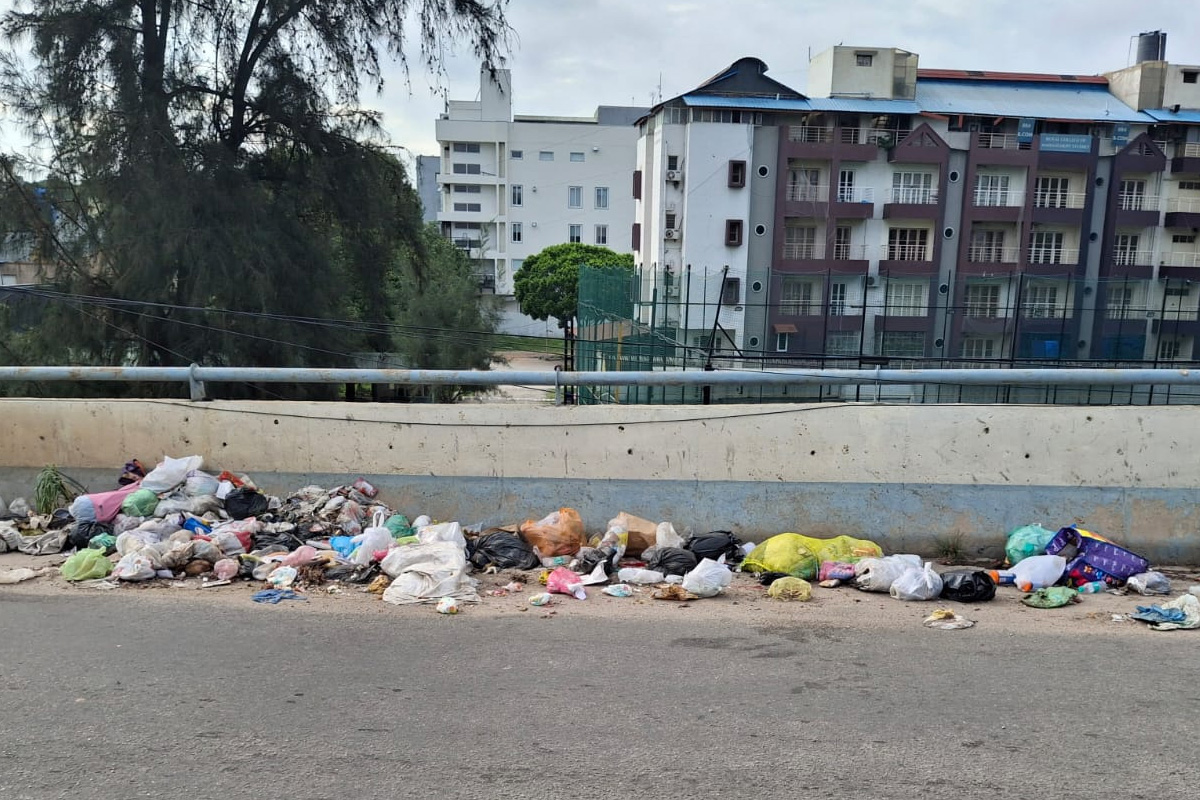
Residents of Hennur flagged the recurring dumping near the flyover and pointed out the limitations of periodic cleanup drives.

Synopsis: Bengaluru’s “Freedom from Waste” drive has cleared several long-standing garbage hotspots, bringing visible relief in areas such as JP Nagar and Ranka Colony. However, ground checks in Hennur and Varthur show that inadequate door-to-door collection, shortages of tippers and staff, and recurring illegal dumping continue to undermine the city’s waste-management efforts.
The “Freedom from Waste” campaign, launched by the Greater Bengaluru Authority (GBA) to clear more than 22,000 tonnes of legacy waste accumulated across the city’s 1,600 garbage hotspots, has brought visible relief to the residents even as shortcomings emerged, including a lack of adequate resources.
The campaign was launched on August 1 and will continue till August 15. The drive focuses on clearing long-standing garbage blackspots and construction and demolition (C&D) waste across Bengaluru’s five corporations.
Even as the campaign came as a sigh of relief to residents of the city, some have expressed dissatisfaction with the methods used. Several residents pointed out issues, including inadequate door-to-door collection, shortages of vehicles and staff, and recurring illegal dumping, which they said undermined the efforts of the campaign.
When the South First team visited JP Nagar 4th Phase Dollars Colony, a few days after the cleanup, we found remarkable improvement. Garbage that had accumulated at dead ends had been removed and the road was considerably cleaner.
“There used to be lots of garbage littered around the dead ends and it never used to be collected. They cleared it in the last two days and the area has become better,” said Chetan Kumar, a resident of JP Nagar.
A similar check in Chamarjpet found that garbage that had accumulated around footpaths had been cleared on Aug 8, providing much-needed relief to residents.
But residents worry that the relief is temporary until the authorities address the larger problem of regular door-to-door collection, a lack of which eventaully leads to the accumulation of garbage in public places.
Also Read: Bengaluru hotel horror: Man kills minor daughters over ‘marital dispute’, attempts suicide
Aleem Mohammed, a resident of Chamrajpet said “The problem is the lack of auto-tippers and staff. Oftentimes, there is only the driver and no cleaner. Otherwise, these tippers collect garbage from commercial establishments and ignore us.”
According to Aleem, only about 60–65% of household waste is collected regularly, while the remaining is left behind and then dumped on roads.
The concern regarding lack of sustainable mechanism to adress the issue, was echoed by residents of Hennur, north-eastern Bengaluru. They flagged the recurring dumping near the Hennur flyover to point out the limitations of periodic cleanup drives.
Muniraju, general secretary of the Hennur Residents Association, said garbage continued to return despite repeated complaints and cleanup drives which took place on August 5.
“Garbage is dumped here repeatedly. We have complained and there have been cleanup drives, but the garbage comes back again. Sometimes it remains here for weeks,” he said.
Muniraju said door-to-door collection was also inconsistent, leading to waste accumulating on internal roads and at dead ends.
“The main roads are cleaned, but the arterial roads and dead ends are left unclean. Only around 75% of the waste is collected,” he said.
He also pointed to illegal dumping and a lack of awareness among residents as contributing factors.
The Hennur flyover lies around the boundary of HBR Ward 24 and Kacharakanahalli Ward. Muniraju said the lack of CCTV cameras made it difficult to identify those dumping garbage at the spot. Garbage is also dumped and burnt near a stormwater drain around Kempegowda Road, Arkavathi Layout and Hennur Bande, Muniraju said, raising concerns about pollution.
“We will take the issue into notice and action will be taken against those responsible. There will also be an increase in staff,” he said.
In Ward 149 in Varthur, east Bengaluru, residents pointed to shortages of tippers and questioned the structure and accountability of the sanitation system. They also raised concerns about whether Public Health Inspectors (PHIs) and Junior Health Inspectors (JHIs), who oversee sanitation, have specialised solid-waste management expertise.
Meanwhile, residents in Varthur said they are yet to see the impact of the drive.
Jagadish Reddy, a resident of Varthur in east Bengaluru, said the cleanliness drive had not reached the area and that garbage continued to pile up at existing hotspots.
“No cleanliness drive has reached our area. The garbage hotspots are still the same and waste keeps piling up every day,” he said.
Reddy attributed the problem partly to a shortage of JCBs and auto-tippers compared with the population they are expected to serve.
“We do not have enough JCBs and tippers for the population here. The equipment is simply not sufficient,” he said.
He also questioned the accountability within the sanitation system and said the absence of elected ward councillors had made it difficult for residents to push for solutions to civic issues.
Data reviewed by South First on the campaign’s construction and demolition (C&D) waste disposal shows a similar pattern to what residents described on the ground. According to GBA figures for Bengaluru North, 319 requests for C&D waste pickup were already pending before the campaign began on August 1.
In the 11 days since, another 504 new requests have been raised — 330 by Assistant Engineers and 174 by enforcement Marshals patrolling for illegal dumping — but only 317 trip permits have been issued in that window.
The gap suggests new requests are arriving faster than they can be cleared, even as the campaign publicly reports large volumes of waste disposed — 7,694 tonnes of C&D and inert waste in North Bengaluru alone between August 1 and 11, most of it dumped at a single site, Marenahalli, which accounted for 6,551 tonnes, or roughly 85 percent of the total.
Bengaluru North City Corporation Commissioner Pommala Sunil Kumar said the complaints would be taken up and action would be initiated against those responsible for illegal dumping.
Dakshayini J, Joint Commissioner, Bengaluru East, said waste management had been handed over from the Bengaluru Solid Waste Management Limited (BSWML) to the respective zones two days earlier.
“Waste management has been handed over to the zones from BSWML. 15 legacy garbage hotspots have been identified across Bellandur, Varthur and Mahadevapura, and the work will start soon,” she said.
The experiences of JP Nagar, Chamrajpet, Hennur and Varthur present a mixed picture of the GBA’s campaign. For Bengaluru, the bigger test may therefore not be how many blackspots are cleared by August 15, but whether the city can strengthen its everyday collection system – with adequate staff, vehicles and accountability – to ensure that the garbage does not return.
(Edited by Fayisa CA)



