

Published Nov 18, 2026 | 9:18 PM ⚊ Updated Nov 18, 2026 | 9:18 PM

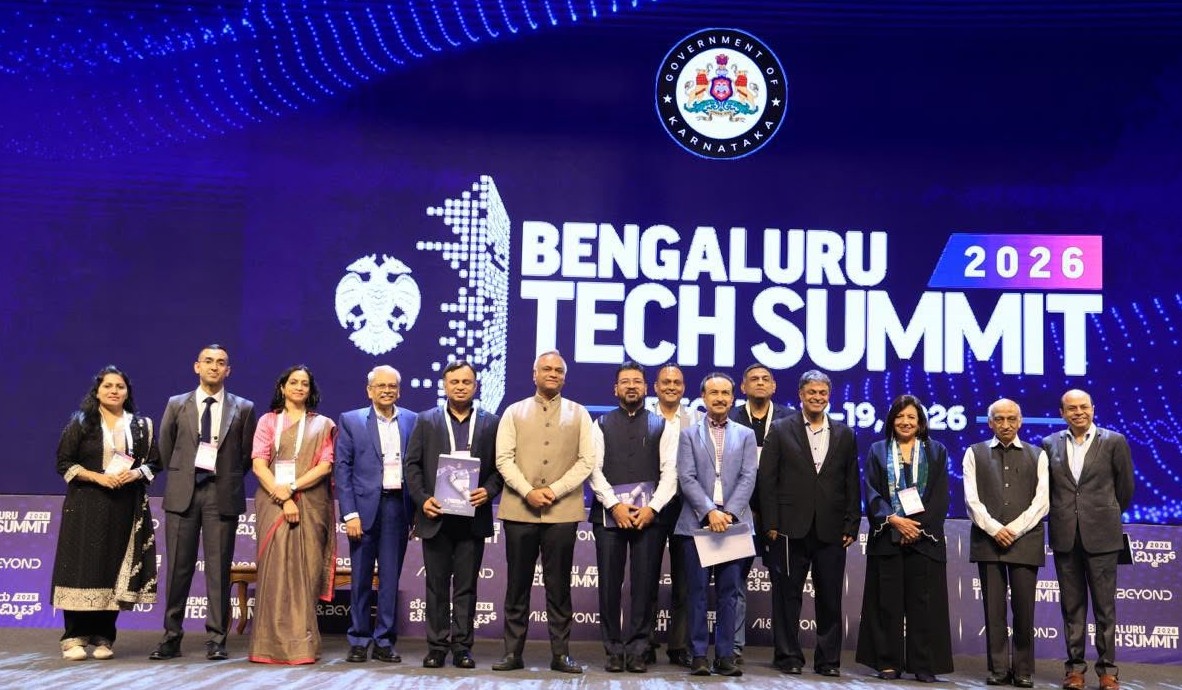
Karnataka's IT and BT Minister Priyank Kharge released the Bengaluru Innovation Report 2026 at the 29th edition of the Bengaluru Tech Summit.

Synopsis: Bengaluru-based startups have raised about US$85 billion since 2010, accounting for 47% of all venture funding raised by Indian startups. Of that, startups raised US$76.5 billion in the past 10 years. The number of the city’s active, funded startups since 2010 numbered 3,810, nearly twice Mumbai’s 1,982.
Bengaluru is consolidating its position as India’s AI capital, with the city commanding 36.3% of the country’s native AI startup funding and hosting 71% of India’s AI and deep-tech unicorns created since 2023.
The figures were part of the Bengaluru Innovation Report 2026, Karnataka’s IT and BT Minister Priyank Kharge released at the 29th edition of the Bengaluru Tech Summit on Wednesday, 18 November.
Terming the city a deep tech powerhouse, the report said that of the 1,556 deep tech startups founded in Bengaluru since 2010, 1,319 were active and funded, together raising US$3.77 billion; and 764 of the city’s 799 native AI startups were active and funded.
Bengaluru accounted for 3% of India’s native AI startup funding, which the report said was more than any other city.
Also Read: Are IT firms sidelining Kannadigas in Karnataka?
On the capital front, Bengaluru-based startups have raised about US$85 billion since 2010, accounting for 47% of all venture funding raised by Indian startups. Of that, startups raised US$76.5 billion in the past 10 years. The number of the city’s active, funded startups since 2010 numbered 3,810, nearly twice Mumbai’s 1,982.
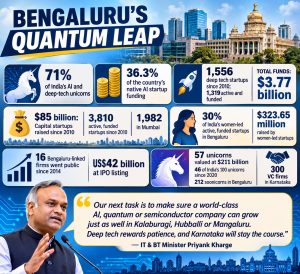
Close to 30% of India’s women-led active, funded startups in deep tech and native AI were founded in Bengaluru, the report said, adding they raised US$323.65 million in total.
Sixteen Bengaluru-linked companies have listed since November 2024, together worth about US$42 billion at listing. Bengaluru accounted for 33 of the 226 IPOs by funded companies in India during this period, and Karnataka-headquartered companies for 37, about 16% of the total. Startups in the ecosystem took about 8.2 years from founding to exit, against a global average of 11.1 years.
The report valued Bengaluru’s 57 unicorns at US$211 billion, which accounted for 44% of India’s 131 unicorns and 55.3% of their combined value, making the city the world’s fifth-largest unicorn hub and the largest outside the USA, Europe and China. Bengaluru produced 46 of India’s 100 unicorns since 2020, and its startups take about six years to reach unicorn status, against seven to eleven years in other Indian hubs.
Also Read: Kharge urges tech industry to invest beyond Bengaluru
Bengaluru has hosted 212 soonicorns (soon-to-be-unicorns), 36% of India’s 589, more than Delhi NCR (134) or Mumbai (121). Its startups reached soonicorn status in about five years, faster than in any other Indian city, and about 38% of all funds raised by India’s soonicorns have gone to Bengaluru companies.
The report said about 300 venture capital firms were operating in Karnataka, and “Bengaluru holds 75 Category I AIFs, 21% of India’s, second only to Mumbai. Typical early rounds are a median seed round of US$810,000 and a median Series A of US$5.9 million. Domestic capital is rising: 52% of capital raised by Category I and II AIFs now comes from domestic investors, and 10 Bengaluru family offices are active in deep tech, with 57 deep tech and 45 native AI equity-round participations.”
The state’s ELEVATE grant-in-aid programme has backed 1,479 startups with ₹393.58 crore since 2017, with 38.6% beyond Bengaluru. The ₹75 crore Beyond Bengaluru Cluster Seed Fund has been set up as a SEBI-registered Category I AIF; Global Technology Centres are coming up in Mysuru, Hubballi and Belagavi; and the ₹1,000 crore Local Economy Accelerator Programme (LEAP) targets 5 lakh jobs over five years.
“The Bengaluru Innovation Report 2026 shows how far Karnataka’s founders have come and how much more they can build from here. Our next task is to make sure a world-class AI, quantum or semiconductor company can grow just as well in Kalaburagi, Hubballi or Mangaluru. Deep tech rewards patience, and Karnataka will stay the course,” Minister Kharge said.
Dr Manjula N, Secretary, Department of Electronics, IT, BT and S&T, said the figures in the report reflected years of steady implementation, from ELEVATE grants and Centres of Excellence to the new Global Technology Centres.
“With 1,479 startups backed through ELEVATE and winners in 30 of our 31 districts, the Department’s focus now is on converting early support into scale: government as a first customer, patient capital for deep tech, and research that moves from our laboratories into the market,” she added.
Prepared by the Karnataka Digital Economy Mission (KDEM) with 3one4 Capital, and using data from Tracxn, the report drew on India’s startup and market data to track Bengaluru’s talent, capital, unicorns, policy, the Beyond Bengaluru clusters, and six frontier sectors.
(Edited by Majnu Babu).



