

Published Nov 03, 2026 | 4:00 PM ⚊ Updated Nov 03, 2026 | 4:00 PM

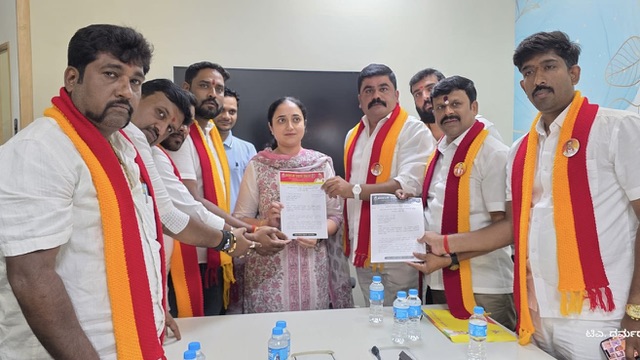
On Monday, 2 November, several KaRaVe delegations approached heads of human resources at companies across Karnataka.

Synopsis: Pro-Kannada outfit Karnataka Rakshana Vedike has begun a month-long campaign across the State to establish how many Kannadigas are employed at private companies and examine their recruitment practices. The campaign comes amid growing demands for local representation in private industries in the State and allegations of discrimination against Kannada-speaking jobseekers. KaRaVe says the intention of the exercise is to ascertain these details so long-term policy could be structured around the findings.
The Karnataka Rakshana Vedike (KaRaVe) has begun a month-long campaign across Karnataka to collect data on the number of Kannadigas employed in private companies and press for greater access to jobs for locals.
The campaign comes amid growing demands for jobs for locals as Karnataka sees a rapid expansion of lucrative employment opportunities in IT, finance and other frontier industries, alongside rapid urbanisation.
Led by its State president TA Narayana Gowda, the pro-Kannada organisation is visiting IT parks and other industrial establishments in different parts of the State to seek information on their workforce and recruitment processes.
On Monday, 2 November, several KaRaVe delegations approached heads of human resources at companies across Karnataka, including some in Bidar, seeking details of their employees. The organisation wants to establish how many Kannadigas work in private industries and examine whether recruitment processes are fair and accessible to local candidates.
“[KaRaVe] has fought for better job opportunities for people from Karnataka ever since it was founded 25 years ago,” says Arun Javgal, KaRaVe’s State organisation secretary, who worked in the IT industry for more than two decades.
“The truth, today, is that most of these jobs are in the private sector. While there might not be prejudice on the part of companies in terms of policy, this is not true on an interpersonal basis,” he adds.
“The problem, today, is there is no data to understand how many Kannadigas are part of the workforce in this industry,” says Javgal. The survey is intended to generate information that can help frame long-term policies. If the findings point to a skill gap among local candidates, for instance, the government could intervene through targeted measures to address it.”
Chief Minister DK Shivakumar has urged activists against approaching IT and biotechnology companies directly to conduct such campaigns.
“I appeal to all organisations not to visit IT-BT companies directly or take matters into their own hands. Such issues must be resolved through dialogue and within the framework of the law. Our government remains firmly committed to protecting the rights and interests of Kannadigas,” Shivakumar stated.
KaRaVe says the intention of the exercise is to ascertain these details so long-term policy could be structured around the findings. If there was a skill gap, for instance, the records could help remedy this through specific government intervention.
“There is no intention to compel companies to share information,” Javgal adds.
Several States, including Maharashtra, Tamil Nadu, Andhra Pradesh, Haryana and Rajasthan, have considered provisions to increase employment for local residents.
Most of these efforts have focused on factories and manufacturing units. However, enforcing local hiring requirements has proved difficult in States that have introduced such provisions.
There are also concerns that restrictions on recruitment could narrow the available talent pool and discourage companies from making further investments.
Also Read: Delivery executive holds woman at knifepoint on Bengaluru’s 100-ft road during chain-snatching bid
The demand for greater access to private-sector jobs for locals has gained renewed traction amid allegations of discriminatory practices in private companies operating in Karnataka.
In October, a woman’s social media post alleging discrimination against Kannada-speaking candidates in recruitment by IT companies went viral. The post prompted several people to share their own experiences and views, with some agreeing with the allegation and others disputing it.
Kiran, a senior manager at an IT company in Bengaluru, said he was surprised to find that all 10 applications forwarded by the HR department for just three vacancies in his team were from the same State. He declined to disclose which State it was, saying only that it was not Karnataka.
“I was surprised to see that all ten resumes that I received for the positions were from one state. I enquired further with the HR person who brought me these applications and learned that they were also from this state. They had received the CVs from a consultancy firm based in this state,” he says.
A Bengaluru-based software engineer, who spoke on condition of anonymity, says he has not witnessed discrimination in recruitment or at the workplace.
“I also know Hindi and was hired pretty quickly, so my friends and I, who are also from Karnataka, have not faced discrimination,” he says.
(Edited by Dese Gowda)



