

Published Sep 23, 2026 | 7:45 PM ⚊ Updated Sep 23, 2026 | 7:45 PM

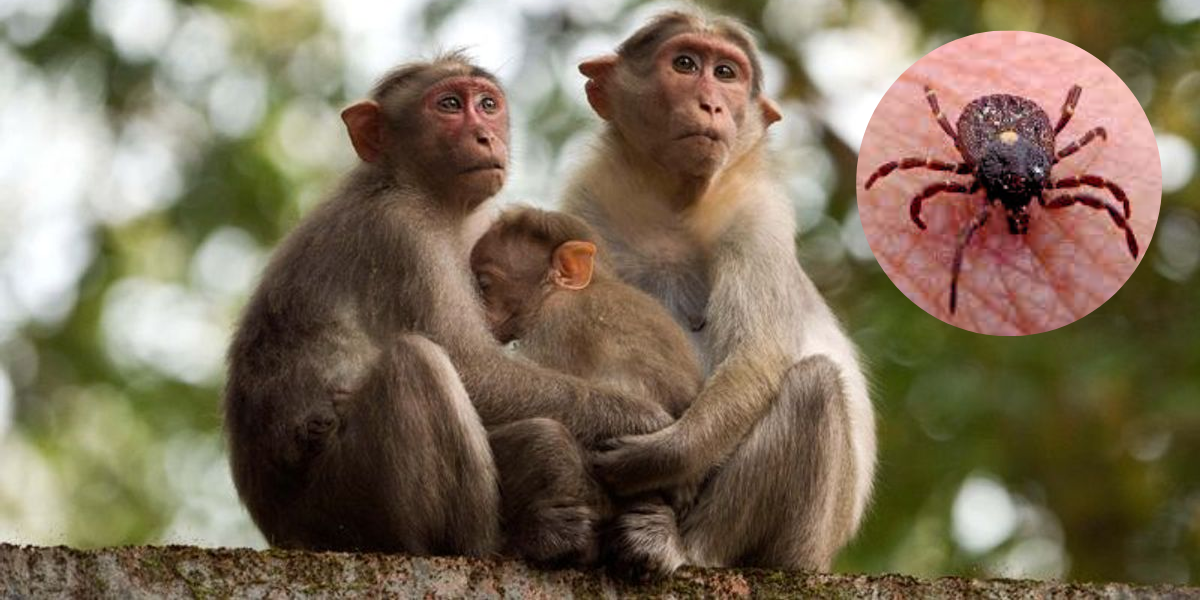
KFD, also known as monkey fever, is a tick-borne viral disease.

Synopsis: Once largely confined to Karnataka, Kyasanur Forest Disease, or monkey fever, has spread to Kerala, Goa, Maharashtra, and Tamil Nadu. A new systematic review finds 21% positivity among clinically suspected patients and a 4% pooled case-fatality ratio, while highlighting gaps in surveillance, diagnosis and monitoring of emerging transmission hotspots.
Deforestation in the Western Ghats, expanding agricultural and human activities, and changing climate may have aided the spread of the Kyasanur Forest Disease (KFD), popularly known as monkey fever, a new study suggested.
The study, published in The Lancet Regional Health – Southeast Asia, examined data from 31 studies conducted between 2000 and 2025. It measured how the disease spreads, how it kills, and India’s efficiency in tracking it.
Once confined to its traditional base in Karnataka, the tick-borne disease has now spread to Keralam, Tamil Nadu, Goa and Maharashtra.
The study linked ecological change to the disease’s geographic reach, though it stopped short of drawing a firm conclusion.
“Reduced rainfall and rising heat in southern states may have promoted tick proliferation and elevated the risk of KFDV (Kyasanur Forest Disease Virus) transmission,” the authors wrote. They added that “deforestation in the Western Ghats, driven by agricultural expansion and human activities, has disrupted ecosystems, promoting tick proliferation and expanding KFD transmission into new areas.”
The researchers described these as contributing factors rather than confirmed drivers of the spread documented across the four states.
“KFDV was first identified in 1957 from dead and sick monkeys in the Kyasanur forest of Shimoga (Shivamogga) district, Karnataka state, India, and is known to infect both primates and non-primates, including birds, rodents, and squirrels,” the study said.
For decades, the disease stayed within five districts of Karnataka.
“Historically, KFD was restricted to five districts of Karnataka, but its documented activity has spread to neighbouring regions along the Western Ghats, with outbreaks reported in the states of Tamil Nadu, Maharashtra, Goa, Kerala and Karnataka in recent years,” the study noted.
Also Read: Karnataka BJP offers support to govt to oppose Kasturirangan report
Researchers screened 7,907 patients with symptoms consistent with the disease. Among them, 1,431 tested positive, giving a pooled positivity rate of 21%.
The authors flagged a distinction that mattered for how readers interpreted the finding.
“This 21% figure represents diagnostic positivity among clinically suspected patients and should not be interpreted as the prevalence of KFD in the general population,” they said.
Positivity did not spread evenly. Wayanad in Kerala posted the highest rate, at 47%. North Goa followed at 29%, then Shivamogga in Karnataka at 27%, and Sindhudurg in Maharashtra at 21%.
Shivamogga still carries the largest case count in raw terms, with 666 cumulative cases logged across the review period.
Also Read: Vaccine for Kyasanur Forest Disease expected by 2026
Among 1,799 patients confirmed through laboratory tests, 78 died—putting the pooled case fatality ratio at 4%.
The hilly district of Wayanad, bordering Karnataka, again stood apart. Four studies covering 253 participants in the district produced a pooled fatality ratio of 10%, with individual studies ranging from 7% to 29%.
The authors urged caution before reading too much into the pooled number. “This estimate must be interpreted with considerable caution as it is influenced by multiple context-specific factors, including case ascertainment rates, healthcare access, outbreak severity, severity of reported cases, availability of supportive care, and completeness of follow-up,” they wrote.
The researchers added that “region-specific CFRs (Case Fatality Rates) are likely more meaningful for local public health planning than the pooled estimate.”
Also Read: Shivamogga to be developed as health hub for Malnad region
The disease spreads through bites from infected ticks, chiefly Haemaphysalis spinigera, though other species in the same genus also carry it.
Researchers tested 3,466 tick pools across 11 studies and found the virus in 116.
“The vast majority of ticks tested positive for KFDV belonged to species H. spinigera, while some infections were reported in H. turturis, suggesting that there are two major ticks responsible for KFDV transmission reported in India,” the study said.
Infection rates in ticks rose sharply during outbreaks. Pools collected during active outbreaks showed 7.3% positivity, compared with 2.5% in pools collected outside outbreak periods.
The team found no cases of person-to-person transmission in the literature it reviewed.
Also Read: In Karnataka, monkey bite results in death of a 66-year-old man
Monkeys die quickly once infected, and researchers treat monkey deaths as an early warning sign. The team tested 808 monkey carcasses across 10 studies and found 125 positive for the virus.
“Monkey mortality may serve as an early indicator of KFDV activity in new foci,” the authors wrote, pointing to a pattern in which carcass testing outside active outbreaks turned up 24.9% positivity, versus 6.7% during outbreaks.
They flagged a caveat too: some of that gap could stem from teams choosing to test carcasses only where they already suspected the virus circulated, rather than reflecting a true underlying pattern.
Nearly every confirmed patient developed fever, with a pooled reporting rate of 99%.
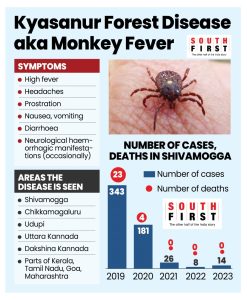
Headache and muscle pain followed close behind, each turning up in about 76% of patients across the studies that tracked them.
“Headache and myalgia were also consistently reported with concordant estimates across sensitivity analyses, indicating minimal under-reporting bias,” the study said.
Bleeding, the symptom associated with the disease’s classification as a viral haemorrhagic fever, appeared far less often, at a pooled rate of 4% across nine of 11 studies that examined it.
Neurological complications, including meningoencephalitis, appeared during what researchers call a second phase of the illness. But only three studies in the entire review documented this phase.
“Neurological symptoms, which are recognised as a distinct feature of the second phase of KFD, were reported in only three studies and need more focus in future research,” the authors said.
Among 2,082 patients whose exposure history researchers could trace, agricultural work accounted for 32.3% of reported exposures. Forest visits followed at 30.3%.
Contact with cattle, forest products, dead monkeys and tick bites also featured among the risk factors the team identified.
The findings pointed to specific interventions. “Proximity to forest areas, handling forest products like dry leaves, etc., and contact with dead monkeys and tick bites exacerbate risk of infection, highlighting the critical need for implementing targeted preventive interventions, such as the use of personal protective equipment (PPE), effective tick management strategies, and community-based awareness initiatives,” the study said.
The review found numerous blind spots in how India tracks the disease, particularly in districts bordering known transmission zones.
In Karnataka, researchers had conducted positivity studies across 11 districts. Positive cases turned up in only six.
“Over the past two decades, there were only 59 patients tested in the non-positive districts adjacent to endemic regions,” the authors wrote, calling this evidence of “a lack of robust surveillance.”
In some districts, only one study was conducted, which limited confidence in the estimates drawn from them.
“In several districts, there was only a single study conducted, due to which a random effects model could not be applied. These districts have been marked in the figures, and the diagnostic positivity estimates in these districts have low reliability,” the study noted.
The authors also pointed to a structural bias running through the underlying data. Hospital-based studies and community surveillance efforts did not measure the same population, and comparing results across the two introduces distortion that the pooled figures cannot fully correct.
The authors closed by recommending measures to stay a step ahead of a possible KFD spread.
“Surveillance needs to be strengthened using molecular diagnostics [like loop-mediated isothermal amplification (LAMP) and other sensitive diagnostic techniques], and priority must be placed on non-endemic regions, particularly districts bordering endemic areas,” they wrote.
They also called for deaths of monkeys to serve as a formal warning system.
“Monkey surveillance could be explored as sentinels to detect KFD transmission to new foci,” the study said. It also called for research into antiviral treatments, tick vaccines, and the genetic diversity of virus strains circulating across regions.
(Edited by Majnu Babu).



