

Published Oct 27, 2026 | 2:38 PM ⚊ Updated Oct 27, 2026 | 2:38 PM

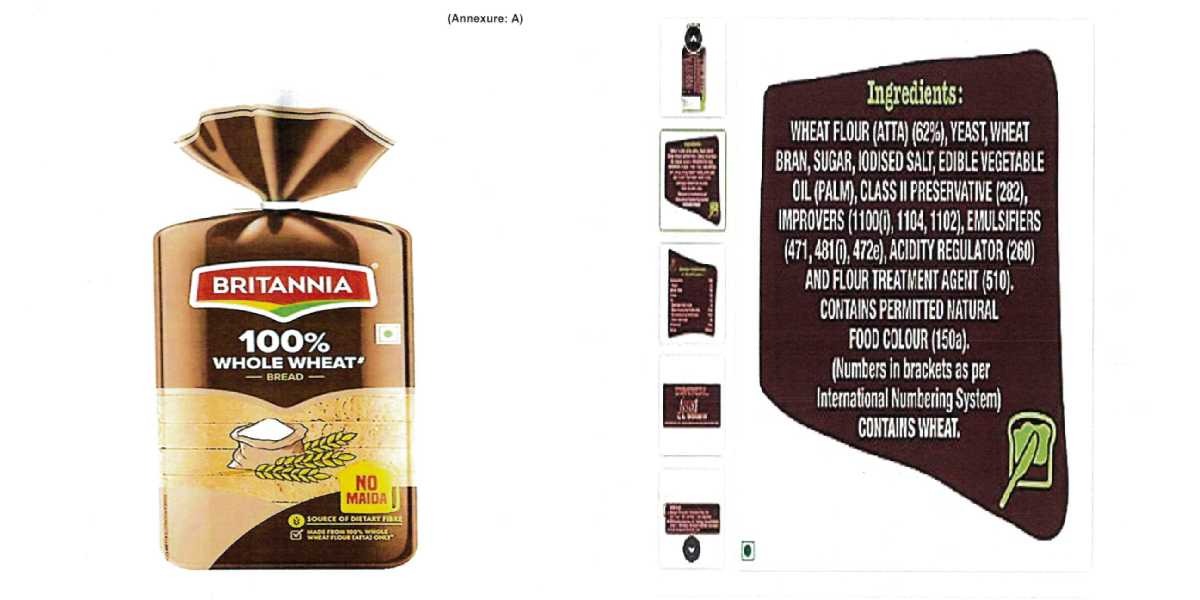
The authority also rejected the argument that the product’s “No Maida” claim justified describing it as “100% Whole Wheat Bread”.

Synopsis: The Central Consumer Protection Authority (CCPA) has imposed a ₹1 lakh penalty on Britannia Industries for misleading consumers with its “100% Whole Wheat Bread” claims, as the product contains only about 62% whole wheat flour, below the prescribed 75% threshold. Rejecting the company’s argument that the claim referred only to the flour used, the authority said the prominent label and smaller-print disclaimer could mislead consumers about the bread’s composition and nutritional value.
The Central Consumer Protection Authority (CCPA) has imposed a penalty of ₹1 lakh on Britannia Industries Ltd for misleading consumers through its “100% Whole Wheat Bread” claims, alleging that the company sought to exploit its brand reputation through representations about the product’s composition.
In an order dated 22 October, the consumer watchdog directed Britannia to immediately discontinue the misleading advertisements across print, electronic and social media platforms. The company must also submit a compliance report within 15 days.
In one of its strongest observations, the CCPA said the company’s use of the claim was “prima facie dishonest, deliberate, malafide and solely motivated to take advantage of the goodwill and reputation attached to the said product”.
The authority said consumers could reasonably rely on prominent representations on product packaging without examining the detailed ingredient declaration printed on the reverse.
The proceedings centred on Britannia’s marketing of its bread as “100% Whole Wheat Bread”, even though its declared whole wheat flour content was approximately 62% of the finished product.
“The use of the expression ‘100% Whole Wheat’ is misleading, factually incorrect, and violative of the principles governing fair advertisement,” the CCPA said.
Britannia argued that the “100%” claim referred to the source of the flour used in the bread, rather than the composition of the finished product. The company maintained that it used whole wheat flour without refined wheat flour, commonly known as maida.
It submitted that the product contained 62 percent wheat flour (atta), while the remaining ingredients included water, yeast, wheat bran and other permitted ingredients and additives. It argued that the claim should be assessed on a flour basis, with “100%” indicating that the flour used was whole wheat flour.
The CCPA rejected this interpretation, stating that the claim had to be assessed from the perspective of an ordinary consumer.
“In common parlance as well as under regulatory scrutiny, the expression ‘100%’ conveys totality of composition and not selective exclusivity of a single category of ingredient,” the order said.
The authority also rejected the argument that the product’s “No Maida” claim justified describing it as “100% Whole Wheat Bread”. It said the two claims, when read together, reinforced the impression that the bread consisted entirely of whole wheat flour.
The CCPA questioned the way Britannia presented the claim on its packaging. The company used the qualification “Made From 100% Whole Wheat Flour. On Flour Basis”, linked to the main claim through a symbol. However, the qualification appeared in substantially smaller print.
“The impugned packaging, when viewed as a whole and from the standpoint of an ordinary consumer, is calculated to create a misleading impression as to the actual composition of the product,” the order said.
The authority said consumers should not have to examine the reverse of a package or interpret a small-print qualification to understand the product’s composition. It also cited the Guidelines for Prevention of Misleading Advertisements and Endorsements for Misleading Advertisements, 2022, which require disclaimers to be clear, prominent and legible.
Also Read: Mounjaro KwikPen batches fail quality tests in CDSCO’s September drug-quality alert
The CCPA also examined the regulatory requirements for using the name “Whole Wheat Bread”.
Under Regulation 2.6 of the Food Safety and Standards (Labelling and Display) Second Amendment Regulations, 2022, whole wheat flour must meet a prescribed minimum compositional threshold of 75 percent for a product to use the nomenclature “Whole Wheat Bread”.
The authority said Britannia’s declared whole wheat flour content of approximately 62 percent fell below this threshold.
The order also referred to observations by the Food Safety and Standards Authority of India (FSSAI), which considered the “100% Whole Wheat Bread” representation misleading and ambiguous. The CCPA cited an FSSAI advisory dated 28 May 2025 advising food business operators to discontinue the use of “100%” on food-product labels, packaging and promotional materials.
The CCPA examined Britannia’s claim that its “100% Whole Wheat Bread pairs perfectly well with a healthy diet”, alongside a packaging comparison stating that the dietary fibre obtained from three slices of bread was equivalent to that obtained from one roti.
The authority said these representations could create the impression that the bread was a nutritionally appropriate substitute for a traditionally prepared wheat roti without adequately accounting for material differences in nutritional characteristics.
It also examined other descriptions, including “Rich in Proteins”, “High Fibre Bread” and “Goodness of Prebiotics”, observing that the combined claims could create an impression of superior nutritional quality.
The investigation report, dated 7 September 2026, recorded that Britannia continued displaying the “100% Whole Wheat” claim on its website and other promotional channels after the FSSAI advisory.
The CCPA acknowledged that the company had initiated changes in some places, replacing “100% Whole Wheat Bread” with “Zero Maida Whole Wheat Bread”. However, it said partial changes did not absolve the company of liability for the period during which the earlier claim remained in use.
The authority had initially examined six claims associated with the product and dropped three from further consideration. It proceeded with three claims involving the “100%” representation, including the claim that the bread was suitable for a healthy diet.
Under Section 21 of the Consumer Protection Act, 2019, the CCPA can direct advertisers to discontinue or modify misleading advertisements and impose penalties of up to ₹10 lakh for a first contravention.
The authority imposed a penalty of ₹1 lakh on Britannia and directed the company to discontinue the advertisements immediately and submit a compliance report within 15 days.
(Edited by Dese Gowda)



