

Published Dec 17, 2025 | 11:44 AM ⚊ Updated Dec 17, 2025 | 11:44 AM

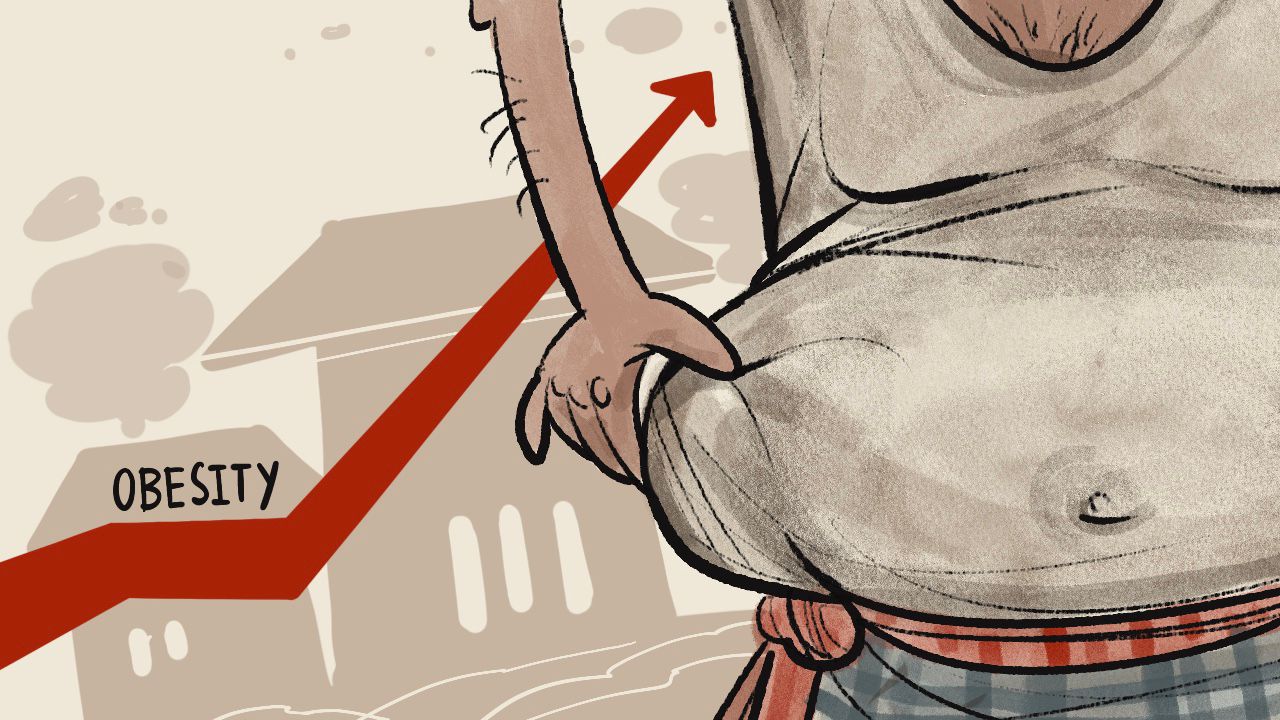
obesity is now an economic crisis masquerading as a health issue. In 2019, obesity cost India approximately $28.95 billion (₹2.4 lakh crore), representing 1.02% of the GDP. By 2030, projections forecast this burden will escalate to $81.53 billion (₹6.7 lakh crore).
Synopsis: While urban India has traditionally borne the brunt of obesity, rural areas are catching up at an alarming pace. NFHS-5 data show that overweight/obesity among rural women increased from 8.6% to 19.7%, and among rural men from 7.3% to 19.3%, reflecting how rapidly processed foods and sedentary lifestyles are penetrating even agrarian India.
The numbers are staggering. In 2025, approximately 21.8 crore men and 23.1 crore women in India are overweight or obese – a mind-boggling third of India’s entire population.
Despite this alarming prevalence, obesity remains a neglected public health crisis in India, overshadowed by infectious disease narratives, while metabolic diseases silently reshape our demographics, health infrastructure, and economic trajectory.
According to the National Family Health Survey (NFHS-5, 2019-21), overweight and obesity among Indian adults have surged alarmingly. Among women aged 15-49 years, overweight and obesity now affect 24%, with generalised obesity impacting 6.4%.
Among men, the figures are comparably grim: 23% are overweight or obese, with 4% meeting criteria for obesity.
Between the NFHS-4 (2015-16) and NFHS-5 (2019-21) cycles, the prevalence among men increased to 22.9% from 18.6%, while in the case of women, it rose to 24% from 20.7%, a concerning acceleration within just five years.
More insidious is the problem of metabolic obesity without generalised obesity — a uniquely Indian phenomenon.
The ICMR-INDIAB 2025 analysis reveals that only 26.6% of Indian adults are truly metabolically healthy, meaning that more than seven in 10 Indians already harbour at least one metabolic abnormality (elevated fasting glucose, hypertension, or dyslipidemia, or high levels of cholesterol/ triglycerides), regardless of body mass index.
This “skinny-fat” phenotype, where individuals appear lean yet carry excess visceral fat, places them at extraordinarily high metabolic risk, which is something our current classification systems often miss.
While urban India has traditionally borne the brunt of obesity, rural areas are catching up at an alarming pace. NFHS-5 data show that overweight/obesity among rural women increased from 8.6% to 19.7%, and among rural men from 7.3% to 19.3%, reflecting how rapidly processed foods and sedentary lifestyles are penetrating even agrarian India.
Conversely, the urban prevalence exceeds rural by nearly two-fold, with states like Tamil Nadu and Maharashtra showing particularly elevated rates.
Let us face it: obesity is now an economic crisis masquerading as a health issue. In 2019, obesity cost India approximately $28.95 billion (₹2.4 lakh crore), representing 1.02% of the GDP.
By 2030, projections forecast this burden will escalate to $81.53 billion (₹6.7 lakh crore), which is a staggering 1.57% of GDP. If unchecked, by 2060, obesity-related costs are projected to reach $838.6 billion (₹69.6 lakh crore), consuming 2.5% of GDP.
These figures, however, underestimate the true burden. They capture direct medical costs and some indirect costs, but miss the insidious drain of lost livelihood, opportunity costs, and the profound emotional toll of societal stigma that particularly ravages women.
Retired scientist Avula Lakshmaiah from the National Institute of Nutrition has cogently argued that the hidden economic costs — loss of productive workdays, reduced earning capacity, premature mortality, and family dynamics – amplify the measurable burden multifold.
Perhaps most concerning is the trajectory in children. Overweight prevalence among children under five has risen from 2.1% to 3.4% in recent years.
Among adolescents, studies report overweight prevalence ranging from 6% to 35%, with obesity between 0.3% and 18% —, with strikingly higher rates in urban and private-school populations.
Current trajectories suggest that 27 million Indian children will be obese by 2030, creating a generation burdened with metabolic disease before their productive years begin.
India faces a choice: recognise obesity as the systemic threat it has become and invest in multidisciplinary solutions — from school nutrition reform and ASHAs’ training to creating affordable pharmacotherapy access and bariatric surgery capacity — or absorb an unsustainable fiscal and human cost in subsequent decades.
The data are unambiguous. The time for incremental policy is past. India needs a comprehensive national obesity strategy now — one that spans prevention, early detection of metabolic abnormalities, lifestyle intervention, pharmacotherapy, and surgical care. The question is not whether India can afford such action. The question is whether India can afford inaction.
(Edited by Majnu Babu).


