

Published Nov 06, 2026 | 1:03 PM ⚊ Updated Nov 06, 2026 | 1:03 PM

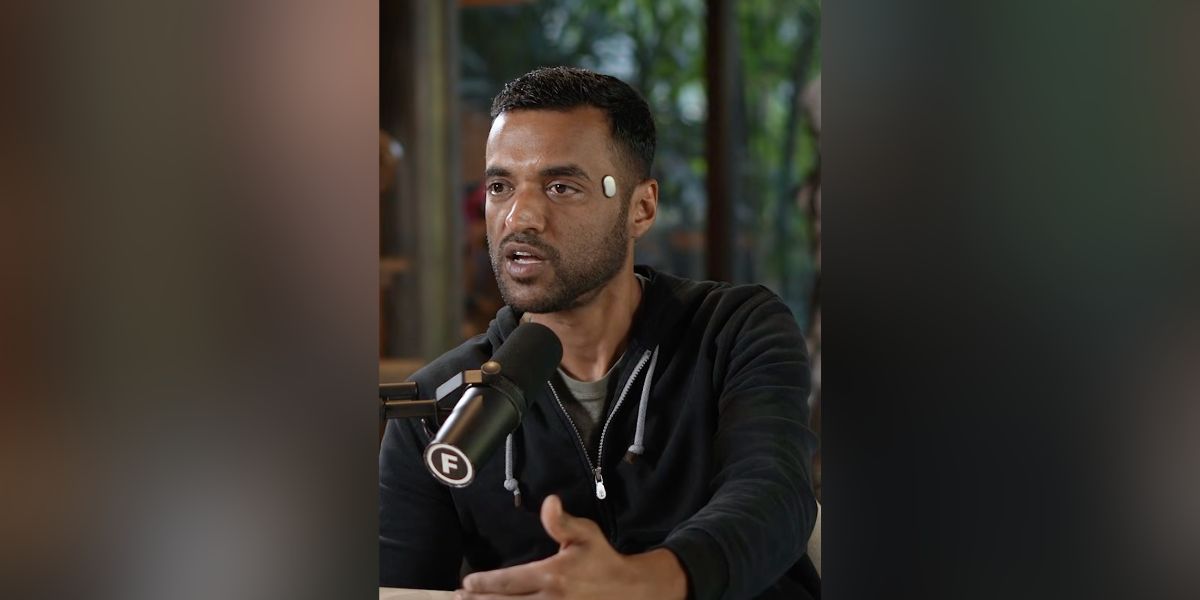
Deepinder Goyal wearing 'Temple'. (Screengrab)

Synopsis: Deepinder Goyal has defended his Temple wearable amid doctors’ concerns over its brain blood flow claims, citing investments, return policies and forthcoming studies. While research found the device tracked changes measured by Doppler in healthy adults, neurologists warn that its readings cannot establish overall brain circulation or diagnose vascular disease.
Deepinder Goyal, founder of Temple and former CEO of Eternal, has defended his brain-monitoring wearable against criticism from doctors, citing the money invested in its development, its return policy and plans for independent scientific validation.
However, his defence has also sharpened questions about what the device can establish and whether consumers could mistake its readings for a reliable assessment of brain circulation.
The controversy centres on Temple, a wearable device placed over the temple that generates a proprietary metric called Brain Flow. The company describes it as an indicator of changes in cerebral blood flow. Doctors, however, have questioned whether signals collected from the surface of the head can reliably represent blood circulation across the brain, particularly in people with vascular disease.
Also Read: Zomato CEO’s gravity aging theory sparks scientific debate
Responding to criticism on X, Goyal addressed doctors directly in a post titled “Dear Concerned Indian Doctors”. He argued that the product’s 14-day return policy would expose any failure quickly.
“First and foremost, a business lesson: if Temple were a scam, and any of what we said weren’t true, people would know it in just a few days of using Temple. We have 14-day, no-questions-asked returns (which even Apple doesn’t offer in India),” he wrote.
“If the product doesn’t work, it fails out of the gate and the company dies before recovering a tenth of its R&D.”
Goyal also cited the investment behind the device, saying the company had spent $30 million developing Temple, of which $20 million came from his own money. He argued that selling a few thousand devices would recover only a small fraction of that investment.
“A scam that pays nothing is not a scam anyone would run,” he said.
He further linked his personal commitment to the project with the credibility of its claims, saying he had left his role as Eternal CEO to pursue Temple.
“I left the Eternal CEO role to chase purpose with Temple. This is not about money. I have enough of it to last for generations. My incentives are fully aligned with getting the science right. I am not staking a reputation earned over 20 years on making a quick buck,” Goyal wrote.
He also pointed to the financial participation of employees and customers. According to Goyal, employees had invested in a funding round a few months earlier, while the current round was being raised mostly from customers.
“Scams don’t build that cap table,” he said.
Dear Concerned Indian Doctors,
I see your rage against Temple on X. I have a few points
to make:1. First and foremost, a business lesson: if Temple were a scam, and any of what we said weren’t true, people would know it in just a few days of using Temple. We have 14-day, no-questions-asked returns (which even Apple doesn’t offer in India). If the product doesn’t work, it fails out of the gate and the company dies before recovering a tenth of its R&D.
2. We have already spent $30m building Temple, $20m out of which is my own money. Selling a few thousand devices recovers a small fraction of this investment. A scam that pays nothing is not a scam anyone would run.
3. I left the Eternal CEO role to chase purpose with Temple. This is not about money. I have enough of it to last for generations. My incentives are fully aligned with getting the science right. I am not staking a reputation earned over 20 years on making a quick buck.
4. Our employees bought into our round a few months ago. The round we’re raising now is mostly our customers. Scams don’t build that cap table.
5. Most wearable companies start with internal studies. Whoop shipped its band in 2015, and the first published validation followed a few years later. We hold ourselves to a higher standard; pre-prints are a step prior to peer reviewed publications, and they are coming up.
6. At some point you have to stick your neck out and say: we believe in our science, and the product is now valuable enough for people to pay for and use. We believe we are there. More validation continues in public.
7. We are confident that we are building something that the world is going to be positively astonished with. We stand by our science and our methods. Each of our claims is easily verifiable by individuals and institutions alike, and you will see a lot of independent studies come up on their own when the device becomes available to use.
Last but not the least, the most ground breaking features in Temple are not even public yet. And some of them, thankfully, have nothing to do with doctors 🤭
Hope this addresses some or all of your concerns. If not, keep raging 😘🤗
— Deepinder Goyal (@deepigoyal) November 5, 2026
Goyal acknowledged that the product’s scientific validation is still developing, but argued that this is not unusual for wearable technology. He cited Whoop, saying the company launched its band in 2015 and published its first validation study only a few years later.
“Most wearable companies start with internal studies. Whoop shipped its band in 2015, and the first published validation followed a few years later. We hold ourselves to a higher standard; pre-prints are a step prior to peer reviewed publications, and they are coming up,” he said.
He maintained that the company believes its science is ready for consumers, while promising further scrutiny.
“At some point you have to stick your neck out and say: we believe in our science, and the product is now valuable enough for people to pay for and use. We believe we are there. More validation continues in public,” Goyal wrote.
He also said the company expected independent studies to emerge once the device became available to users.
“We stand by our science and our methods. Each of our claims is easily verifiable by individuals and institutions alike, and you will see a lot of independent studies come up on their own when the device becomes available to use,” he said.
Goyal added that some of Temple’s features had not yet been made public, saying, “The most ground breaking features in Temple are not even public yet. And some of them, thankfully, have nothing to do with doctors.”
In another post, however, he made a distinction between the device’s current positioning and medical applications. “Temple is a fitness tracker, and wellness device. We are not a medical device. If at some point, we clinically validate any of our metrics, we will let you know,” he said.
The scientific discussion has centred on a study that compared Temple’s Brain Flow index with transcranial Doppler (TCD) ultrasound, a method used to measure blood-flow velocity in the middle cerebral artery, a major artery supplying the brain.
The study involved 23 healthy adults who underwent two protocols: cycling exercise and a transition from standing to lying down. Twenty participants were analysed in each protocol.
The researchers reported significant within-person correlations between Temple’s Brain Flow index and TCD measurements. The median Pearson correlation, which measures the strength and direction of a linear relationship between two continuous variables, was 0.795 during exercise and 0.799 during the postural transition.
The researchers also observed that when participants moved from standing to lying down, both middle cerebral artery blood-flow velocity and Temple’s Brain Flow index increased, while heart rate decreased. They said this provided evidence against the possibility that the wearable was simply tracking changes in heart rate.
However, the study describes Brain Flow as a proprietary, dimensionless index intended to track relative changes in cerebral haemodynamics. It does not measure absolute cerebral blood flow or provide values in the same physical units as TCD.
The researchers also acknowledged that further studies involving broader populations, complementary measurement methods and additional physiological challenges are needed to establish the cerebral specificity of the signal and determine its potential uses.
The study involved healthy young adults under controlled conditions. It did not establish whether the device can identify impaired blood supply, detect arterial blockages or assess people with cerebrovascular disease.
Also Read: Ask an AI chatbot for a medicine, and you may get the same brand again and again, study finds
Dr Sudhir Kumar, Senior Consultant Neurologist at Apollo Hospitals, Hyderabad, said the study’s findings in healthy participants cannot be extended to people with neurological or vascular conditions.
He pointed out that the brain receives blood through multiple arteries and that disease can affect one artery, one side of the brain or even a limited segment of a vessel.
“It may correlate in somebody who is completely healthy. But we know very well that the disease does not affect all the arteries,” he told South First.
He questioned whether a reading obtained from a sensor placed over the temple could be extrapolated to represent circulation across the entire brain.
“It’s not that easy to just focus in one small area of the scalp and then extrapolate, saying that the entire brain blood flow is the same as what we are seeing there,” he said.
Dr Kumar also warned that a normal reading could create a false sense of reassurance among people experiencing symptoms.
“If somebody has symptoms, and the Temple device says that your blood flow is good, he may not come to the hospital and meet a doctor. That is the problem with making health claims which are not reliable,” he said.
He added that the brain’s blood supply involves arteries on both sides and vessels supplying the back of the brain. A measurement from one temple, he argued, cannot establish that circulation is normal throughout these regions.
Dr Kumar said he was not opposed to new technology or innovation, but argued that companies developing health and wellness devices must communicate their limitations as clearly as their advertised capabilities.
“Innovation is always good. We all want innovation, and we are all for it. India is moving ahead, and we are definitely seeing a lot of Make in India initiatives. Only thing is, we should not claim something which the device is not yet capable of doing,” he said.
He said consumers should be told what a device can measure, what it cannot establish and when they should seek medical attention.
“Especially when we are dealing with people’s health, we should always give a disclaimer saying what all it cannot do. He is only highlighting what all it can do,” Dr Kumar said.
He added that people experiencing unusual symptoms should not rely on a wearable reading instead of seeking medical care.
Dr Kumar also questioned the need for consumers to spend around ₹85,000 on a device if they were primarily interested in tracking heart rate, which can be measured using simpler and cheaper methods.
The debate has also drawn criticism from doctors on social media, who say Goyal’s financial investment and personal commitment do not answer questions about the device’s scientific accuracy.
Dr Rishabh Jain, responding to Goyal on X, said doctors were asking for scientific evidence rather than details of the company’s investment or the entrepreneur’s reputation.
“Doctors are asking for scientific evidence, not your financial history, personal sacrifices, or business credentials. Stop calling legitimate scientific scrutiny ‘rage’,” Jain wrote.
He argued that a return policy, investment figures and customer participation cannot establish whether a device measures what it claims to measure.
“Spending $30 million doesn’t prove efficacy. Medical history is full of expensive technologies that failed rigorous testing,” he said.
Jain added that doctors were not opposed to innovation but wanted evidence before health-related claims were accepted by the public.
“Doctors are not against innovation. We are against asking the public to trust medical claims before the evidence is available. If Temple delivers what it promises, doctors will be among its biggest supporters,” he wrote.
Dear Temple Team,
Doctors are asking for scientific evidence, not your financial history, personal sacrifices, or business credentials. Stop calling legitimate scientific scrutiny “rage.”
You have responded to questions about medical accuracy with investment figures, return policies, personal reputation, and promises of future studies. None of these constitutes scientific validation.
A few simple points:
1.A 14-day return policy is not scientific validation. Patients can feel better on placebo treatments too. Subjective satisfaction cannot establish medical accuracy.
2.Spending $30 million doesn’t prove efficacy. Medical history is full of expensive technologies that failed rigorous testing.
3.Personal reputation is not evidence. Science doesn’t become more credible because a successful entrepreneur believes in it.
4.Customer investment is not independent validation. Financial confidence and scientific credibility are two different things.
5.Promising future publications doesn’t validate present claims. If you make health-related claims today, doctors are justified in asking for evidence today.
6.Individual experiences cannot replace properly designed validation studies. We need accuracy, reproducibility, clinically meaningful outcomes, and independent testing.
And one final point:
Doctors are not against innovation. We are against asking the public to trust medical claims before the evidence is available.
If Temple delivers what it promises, doctors will be among its biggest supporters.
But science is not a popularity contest, and criticism is not “rage.”
You cannot answer questions about scientific evidence with a balance sheet, a biography, and emojis.
Publish the data. Let independent researchers examine it. Let the evidence speak.
That’s all we’re asking.
@theliverdoc
— Dr Rishabh Jain (@DrRishabhOnco) November 5, 2026
Dr Shaaz A Khan, writing about the difficulty of assessing cerebral blood flow, also cautioned consumers against assuming that a wearable’s appearance or technology automatically makes its readings accurate. He noted that methods such as transcranial Doppler and near-infrared spectroscopy are used to assess aspects of brain circulation, but accurate non-invasive assessment remains an active area of research.
The disagreement, therefore, is not simply about whether Temple’s Brain Flow index tracks changes observed in a controlled study. The study reports that it does. The unresolved question is how specifically the signal represents cerebral circulation, how it performs in people with disease and what consumers should infer from its readings.
Goyal has maintained that Temple is a wellness product and not a medical device. The researchers, meanwhile, have called for further validation before its Brain Flow metric can be assigned broader clinical significance.
(Edited by Sumavarsha)



