

Published Sep 22, 2026 | 5:50 PM ⚊ Updated Sep 22, 2026 | 5:50 PM


Image used for representational purposes only. (AI generated image)

Synopsis: Telangana government procurement data and a Hyderabad hospital bill reveal stark gaps in prices of medical consumables such as IV cannulas, IV sets and syringes. The comparison comes amid renewed scrutiny of hospital consumable pricing, years after NPPA documented high trade margins on syringes and Parliament flagged similar concerns in medicines.
A few days back, Maharashtra Food and Drug Administration Commissioner Tukaram Mundhe put out a statement that has since travelled far beyond his state.
“The most expensive part of a hospital bill may never touch the hospital at all,” he said.
“A patient admitted for care has no way of knowing whether the price on a medical consumable reflects its actual cost or a markup fixed long before it ever reached the ward. That gap in information is, at its core, a public health issue.”
His survey of Maharashtra’s hospital consumables found an IV infusion set procured at ₹11.05 carrying a printed MRP of ₹325, a markup of 2,841 percent. A syringe procured at ₹6.75 carried an MRP of ₹57.20. A catheter procured at ₹29.41 carried an MRP of ₹310.
“These are not elective purchases,” he said. “Patients cannot compare prices, seek alternatives, or question a number printed on a box while receiving care, and the MRP itself is often fixed upstream by manufacturers and distributors, disconnected from the trade price by a wide, unexplained margin.”
Also Read: India and second-hand smoke: Women, children suffer as anti-smoking law drives smokers indoors
Look south, and the same mechanism sits waiting to be measured, this time against a state government document rather than a survey.
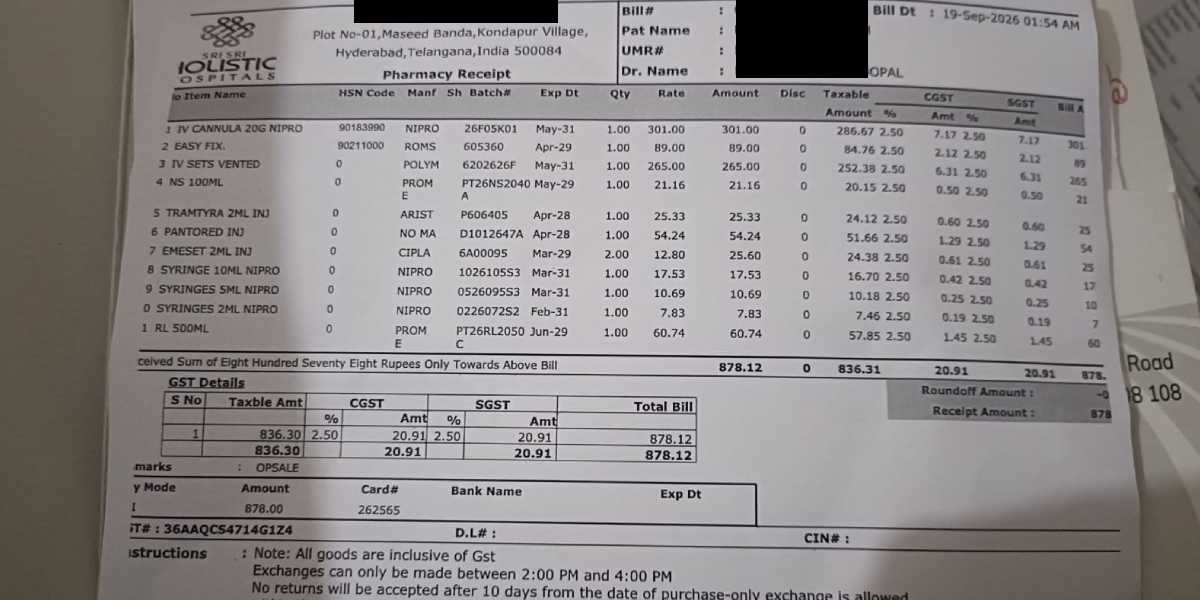
A pharmacy receipt from a private hospital of consumables.(Sumit Jha/South First)
The Telangana Government Medical Services and Infrastructure Development Corporation, TGMSIDC, runs the state’s centralised procurement for surgical items and publishes its rate contracts. These are not retail estimates. They are the rates at which the Telangana government itself buys these items for its own hospitals, negotiated at scale through a formal tender process.
A pharmacy receipt from a hospital in Hyderabad’s Kondapur area, dated this month, shows what a patient was billed for the same category of item.
Set side by side, the gap is stark. An IV cannula, size 20G, procured under TGMSIDC’s rate contract at ₹5.71, was billed to the patient at ₹301.00. An IV set, vented, procured at ₹12.43, was billed at ₹265.00. A 10ml syringe, procured at ₹5.32, was billed at ₹17.53.
The cannula shows the widest gap of the three, the difference between what the state government pays to acquire the item and what this patient was billed for it running to 5,171 percent. The IV set shows a gap of 2,032 percent over the government’s rate. The syringe, the smallest item on the bill, still shows a gap of 230 percent.
The body responsible for pricing oversight has sat on this exact problem for years.
In March 2018, the National Pharmaceutical Pricing Authority issued an internal analysis titled “Display of the Trade Margin on Syringes and Needles,” built from manufacturer and distributor data it had itself collected.
Across every syringe category NPPA measured, average trade margins ran from 214 percent to 664 percent, with an overall average of 516 percent and a recorded maximum of 1,251 percent, on both a 5ml and a 50ml hypodermic syringe without needle.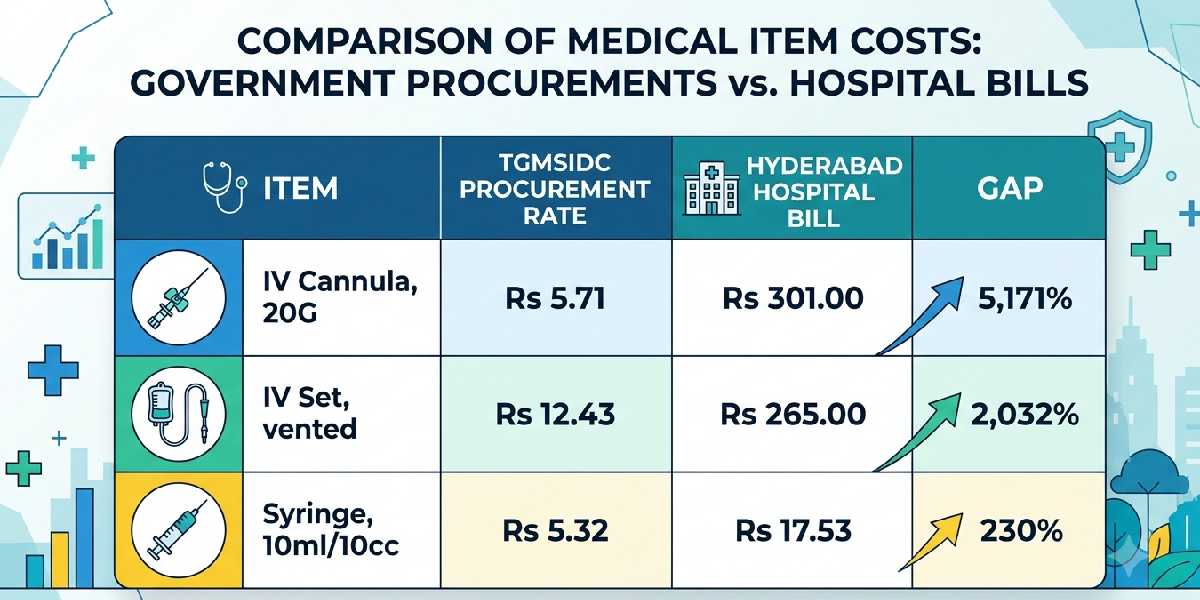
On needles, the average margin across categories was 255 percent, with a maximum of 789 percent on disposable hypodermic needles. Spinal needles averaged 246 percent. Epidural needles averaged 356 percent.
NPPA’s own 2018 average price-to-distributor for a 2ml syringe was ₹1.30, against an average MRP of ₹8.52. TGMSIDC’s current rate for a comparable item sits even lower today.
That data sat inside the regulator for years without producing a price cap on this category.
Also Read: India’s first approved dengue vaccine QDENGA likely to hit private market in 2027
Parliament has since taken up the broader question of what happens when trade margins run unchecked, though its focus fell on medicines rather than devices.
The Standing Committee on Chemicals and Fertilizers, in its Fourteenth Report on price rise in the pharmaceutical sector, found trade margins running from 600 percent to 1,100 percent on common medications and called the Department of Pharmaceuticals’ explanations for it unconvincing.
The Department’s own submitted data, drawn from the Pharmarack database covering roughly 98,000 stock-keeping units, showed that 87 percent of the non-scheduled market carries a weighted average markup of up to 45 percent. Roughly 4 percent of that same market carries markups exceeding 100 percent of the price to distributor.
The committee did not accept this as reassurance. It noted that even a small fraction of a 98,000-item market running above 100 percent margin still represents thousands of formulations reaching patients at inflated cost.
The structural reason both drugs and devices can sit unregulated for this long traces to one distinction.
Scheduled formulations, those on the National List of Essential Medicines, have their ceiling prices fixed directly by NPPA under the Drugs (Prices Control) Order, 2013. Everything else, non-scheduled drugs and the entire category of medical devices and consumables, falls outside that direct control.
NPPA can only restrict how much a non-scheduled item’s price rises annually, capped at 10 percent. It never fixes where that price starts.
Mundhe named this precisely: “scheduled medicines are capped under the Drugs (Prices Control) Order, 2013. Most medical devices and consumables are not, leaving both the pricing and the information around it almost entirely unmonitored.”
The only exception NPPA has ever carved out for devices came during the pandemic, when it used an emergency provision under paragraph 19 of the DPCO to cap trade margins on six specific items: oxygen concentrators, pulse oximeters, blood pressure monitors, nebulisers, digital thermometers and glucometers, at 70 percent.
That cap has never been extended to IV cannulas, syringes, catheters or infusion sets, the exact items sitting on the Kondapur bill and in NPPA’s own 2018 syringe analysis.
The scale of what consumables represent inside a hospital’s finances shows up clearly in numbers one listed hospital chain has itself disclosed.
Manipal Health Enterprises, in its July 2026 public listing document, reports purchase of medical consumables and pharmacy items as its largest single cost category after staff and doctors. This came to ₹21,161.55 million for fiscal 2026, equal to 20.47 percent of revenue.
The filing describes this line as covering “disposable medical supplies, as well as drugs and consumables administered to patients,” bundled together with GST, customs duty and freight. No further breakdown separates a catheter’s cost from a chemotherapy drug’s.
One in every five rupees a large hospital chain earns runs through this single, opaque category. Neither the company’s own filing nor any public dataset separates what portion of it is markup on items of the kind TGMSIDC prices at a few rupees each.
The National Sample Survey’s 80th Round offers one more piece of this picture, from the patient’s side rather than the company’s.
For hospitalisation in Telangana, the average private-hospital bill runs to ₹72,561, against ₹5,856 at a government facility.
Within that private bill, the single largest component is not medicines, not bed charges, not even the doctor’s own fee. It is a package component, ₹32,633, nearly 45 percent of the entire bill, billed as one bundled rate rather than itemised charge by charge.
Consumables of exactly the kind priced on the Kondapur receipt sit somewhere inside that package figure, folded into a number the survey cannot break apart any further, and that no regulator has yet required hospitals to itemise.
Eight years after NPPA first measured margins running past 1,200 percent on syringes, and years after Parliament’s own committee called similar margins on medicines unjustified and unexplained, the specific items behind both findings, cannulas, syringes, IV sets, remain outside any price cap.
Mundhe’s recommendation, sent to the Department of Pharmaceuticals and NPPA, asks for clear guidelines on the permissible gap between trade price and declared MRP.



