

Published May 25, 2026 | 10:35 AM ⚊ Updated May 25, 2026 | 10:35 AM

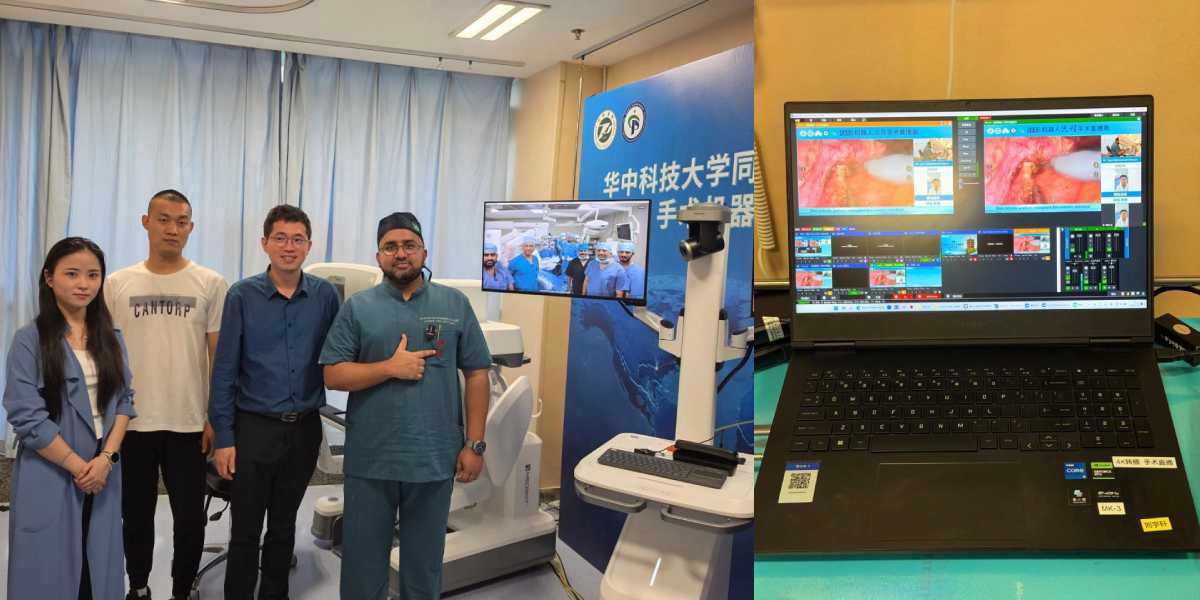

Synopsis: On 18 May, Dr Syed Mohammed Ghouse of AINU Hyderabad remotely performed the world’s first tele-robotic ureteric reimplantation from Wuhan, China. Using the Toumai robotic system and 5G connectivity, his console movements controlled surgical arms nearly 3,900 km away. The 90-minute operation showcased borderless surgery, enabling expert care across distances with minimal latency and seamless precision.
A patient walked into the Asian Institute of Nephrology and Urology (AINU) in Hyderabad for bladder surgery. The doctor who performed it was not in the hospital. In fact, he was not even in the country.
On 18 May, Dr Syed Mohammed Ghouse, director of robotic and minimal access urological surgery at AINU, sat inside a control room at Tongji Hospital in Wuhan, China, and operated on a patient nearly 3,900 km away in Hyderabad.
The 90-minute procedure has now become the first tele-robotic ureteric reimplantation of its kind in the world, performed remotely across this scale and distance.
The surgery sounds futuristic, almost impossible at first glance. But doctors say the technology behind it has quietly existed inside modern operating theatres for years.
Also Read: Falling asleep with earbuds plugged in? Here’s what doctors say
To understand what happened between Wuhan and Hyderabad, Dr Ghouse says one first has to understand how robotic surgery already works inside a single operation theatre.
“The robotic surgery per se is a telesurgery even inside the operation theatre itself,” Dr Ghouse explained to South First.
“You have a patient cart which attaches to the patient. You have an imaging cart which processes the imaging and displays it on the monitor. And you have a surgeon’s console where the surgeon can see the patient.”
In robotic surgery, the surgeon does not stand over the patient holding surgical instruments directly. Instead, the surgeon sits at a console, watches a magnified 3D image of the inside of the body, and controls robotic arms using hand movements.
“Even inside the OT, you are not directly handling or touching the patient. You are sitting on a console and moving your hands on the console, and that movement happens inside the patient’s abdomen,” he said. “Basically, even in a single OT itself, the surgery is a telesurgery only.”
What changed on 18 May was simply the distance.
“What you are doing now is taking this console hundreds and thousands of kilometres away and operating from there. That is the telesurgery,” Dr Ghouse said.
“When you break these barriers and go as far as possible with good connectivity, you can operate from anywhere in the world.”
Before the operation began, doctors in Wuhan and Hyderabad jointly reviewed the patient’s medical records and planned the robotic movements online.
Inside AINU’s Banjara Hills headquarters in Hyderabad, the patient was administered anaesthesia and connected to the Toumai robotic surgical system developed by Chinese company Medbot. The robot’s arms, carrying miniature surgical instruments and high-definition 3D cameras, were inserted through tiny incisions.
Meanwhile, in Wuhan, Dr Ghouse sat at a surgeon’s console and watched a live 3D feed from Hyderabad through a binocular-style viewer.
Every movement of his fingers in China was transmitted through a 5G network to the robotic arms in Hyderabad.
The average one-way latency during the operation was 63 milliseconds, according to the medical team. For comparison, a human blink takes roughly 150 to 400 milliseconds.
A local surgical team remained beside the patient throughout the operation, ready to intervene immediately if needed.
“It truly felt as though I was operating in my own operating room,” Dr Ghouse said. “The precision, responsiveness, and seamless integration made the entire procedure incredibly smooth.”
Also Read: 7 in 10 Kerala doctors want to leave. Who will run the hospitals?
Interestingly, doctors say the patient was not selected because of any special medical condition.
“No criteria as such,” Dr Ghouse said. “We had a conference there in China which we had to attend, and we had planned for a good surgery this year. In fact, we do one or two robotic surgeries daily. So we had this patient and the possibility of doing it from a remote place. The patient agreed, so we just went ahead and did it.”
The procedure performed was a ureteric reimplantation, a surgery that reconnects the ureter to the bladder.
AINU currently operates seven branches across India, including centres in Chennai, Vizag, Siliguri and Hyderabad. Dr Ghouse says telesurgery could eventually allow experienced surgeons to assist operations across cities and countries without physically travelling.
“Whenever we have got a robot somewhere else and that surgeon wants some help from my side, I sit in Manjeera and operate and help the surgeon at some other place anywhere in the world,” he said.
He believes the larger significance lies in access to specialised care.
“Suppose the surgeon does not want to travel to every nook and corner of the country, and you have got a robot available locally in some hospital,” he said. “The patient gets admitted there, and you have a surgical expert sitting hundreds and thousands of kilometres away. You can give that expertise to a patient in some faraway place where either the surgeon cannot travel or the patient cannot travel to the surgeon.”
Also Read: ICMR promoted a ‘Make in India’ handheld TB device; it used core parts imported from China
The surgery linked two major medical institutions: Tongji Hospital in Wuhan, one of China’s largest hospitals, and AINU, Asia’s largest single-specialty uro-nephrology centre.
“This historic collaboration connected Tongji Hospital, one of the largest hospitals in China, with AINU, Asia’s largest single-specialty uro-nephrology centre,” Dr Ghouse said.
The operation was also noticed diplomatically. Yu Jing, spokesperson for the Chinese Embassy in India, posted about it on X and described it as “life-saving care, transcending borders.”
For Dr Ghouse, the surgery felt like a glimpse into the future.
“Hard to believe that what once seemed like the wildest imagination is now a clinical reality,” he said.
“The future of surgery is not just minimally invasive, it is borderless.”



