

Published Mar 29, 2026 | 8:32 AM ⚊ Updated Mar 29, 2026 | 8:32 AM

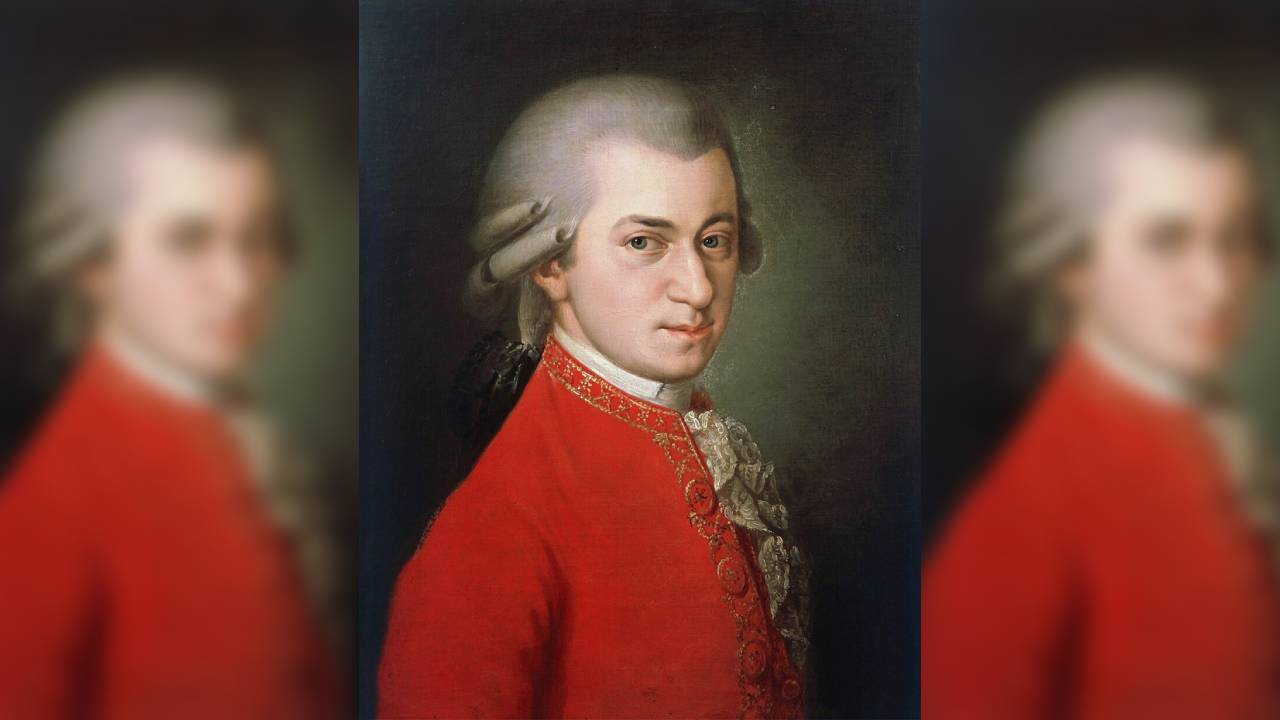
A posthumous painting of Wolfgang Amadeus Mozart (27 January 1756 - 5 December 1791) by Barbara Krafft done in 1819. (Creative Commons)
Synopsis: Mozart composed 22 operas with diverse styles and themes ranging from the sacral mythological dramas to the more ingenious humanistic ones, capturing the vignettes of ordinary lives, departing from the usual operatic focus on ‘Monarchs and Gods. Many of Mozart’s operas touch upon the hearts and minds, transcending the barriers of time, making it relevant for contemporary audiences; the universality of human existence, manifest through emotions and feelings, is how I would define the operatic impact.
“The music of Mozart is of such purity and beauty that one feels merely found it – that it has always existed as part of the inner beauty of the Universe waiting to be revealed.” – Albert Einstein.
As the world celebrates the 270th birth anniversary of Western classical composer Wolfgang
Amadeus Mozart, my mind drifted towards my excursion to Salzburg, visiting the residence of the Austrian great, and a BBC documentary, ‘The Joy of Mozart‘.
What are the most striking elements of this extraordinary life of a musician who has often
been compared to a ‘divine being’, a ‘mythical Godlike-genius of music’ and someone inspired by
inexplicable forces from Heaven above? The documentary, ‘The Joy of Mozart,’ encapsulates his
music and life fairly succinctly and is accessible online.
There are broadly four dimensions of his life which struck a deep chord in me; his prodigious childhood, emotional exuberance of his music, his brilliant and ingenious operas, and finally the composition widely known as ‘Requiem’.
Mozart was born in 1756 in the town of Salzburg in a highly musical family; his father was Leopold Mozart, the court musician to the Archbishop of Salzburg, court composer mother, Anna-Maria, could play and read music, and his sister Nannerl was a brilliant keyboard performer.
Mozart lived until the age of 36 and died in 1791, leaving behind an extraordinary, enriching musical legacy of 600 diverse range of compositions, including symphonies, sonatas, concertos and operas.
Mozart was a child prodigy par excellence who composed his first ‘Andante in C major, K. 1a’, when he was five years old, which his father Leopold had to write down.
At the age of 8, Mozart achieved the incredible feat of writing down his own composition ‘Klavierstück in C, K. 5a’ and composed 10 violin sonatas between the ages of 5 and 8. His remarkable achievement as a musical genius was the composition of his first symphony at the tender age of 8, ‘Symphony No. 1, K. 16’; a rather complex task since it involved multiple instruments of a symphony.
Legend has it that while composing, he told his sister Nannerl, ‘Remind me to give the horn something worthwhile to do!’ One can only marvel at the musical talent of Mozart in this piece since he composed this symphony entirely relying on his inner ears, since they were not allowed to make noise while Leopold was recovering from sickness during this period.
Leopold took his young son on a musical tour of Europe, covering major cities including London,
where young Mozart played for the aristocrats and nobility, leaving them totally impressed. As a matter of fact, there is an interesting British connection with his childhood prodigious compositions: aged 11, Mozart composed in 1767 the “Duty of the First Commandment”, which was acquired in the form of a manuscript by Prince Albert in 1841 and was one of his earliest dramatic works.
Queen Victoria wrote in her journal in 1844 with respect to this composition, “The music had been most beautifully selected by Albert”. During this musical tour, he struck a deep, life-long friendship with musician Johann Christian Bach, son of the famous Johann Sebastian Bach.
Mozart composed 22 operas with diverse styles and themes ranging from the sacral mythological
dramas to the more ingenious humanistic ones, capturing the vignettes of ordinary lives, departing from the usual operatic focus on ‘Monarchs and Gods. Many of Mozart’s operas touch upon the hearts and minds, transcending the barriers of time, making it relevant for contemporary audiences; the universality of human existence, manifest through emotions and feelings, is how I would define the operatic impact.
Most significant Operas were composed during his residence years in Vienna, which include works like ‘Le nozze di Figaro’, ‘Don Giovanni’, and ‘Die Zauberflöte’. In these productions, opera was transformed from an amateurish courtly entertaining experience to one of universal humanistic narratives delivered with certain emotional richness, empathy with the lives of the roles and sparkling wit.
Often, Mozart is credited with transforming opera from a high, abstract art form into one where ordinary human beings and their feelings, emotions and sentiments find artistic expression with exuberance.
The remark by Nicola Benedetti, brilliant and one of the finest contemporary violinists, that “Mozart with caution is not doing him justice”, aptly captures the visceral, emotionally exuberant, expressive nature of his music. Mozart’s music goes beyond the confines of perfection and beauty of musical composition, but unveils a whole new world of richness in humanistic characteristics.
Mozart’s musical compositions manifested the joys, pleasures, pain, trials, and tribulations of our human existence with humane touch and refinement, much more than most composers. For instance, the ‘Symphony 40’, popularly known as the ‘Great G Minor Symphony’, composed in the summer of 1788, is a dark, intense and dramatic. The sorrowful nature of the composition captures and expresses the feelings of agony and despair.
Towards the end of his life, Mozart, at the behest of a commission reportedly by Count Franz
von Walsegg, composed the ‘Requiem in D minor’, known as ‘Mozart’s Requiem’ in popular parlance.
The composition genre is that of sacral music, which remained incomplete to be finished by his student Franz Xaver Süssmayr. Apparently, the Count had intended this composition as a funeral music for his deceased wife. Mozart’s health deteriorated while working on the Requiem, and he often feared that he was writing his own requiem.
Incidentally, two movements of the Requiem were performed at Mozart’s funeral: Introitus: Requiem and the Kyrie. Requiem has romanticism in its expression and classicism in its structure, and the composition conveys pathos, faith and fear. The composition is a testament, as desired by Mozart, to our intrinsic connection with the Almighty, high above the mere mortal existence.
(Edited by Majnu Babu).


