

Published Aug 16, 2026 | 12:00 PM ⚊ Updated Aug 16, 2026 | 12:00 PM

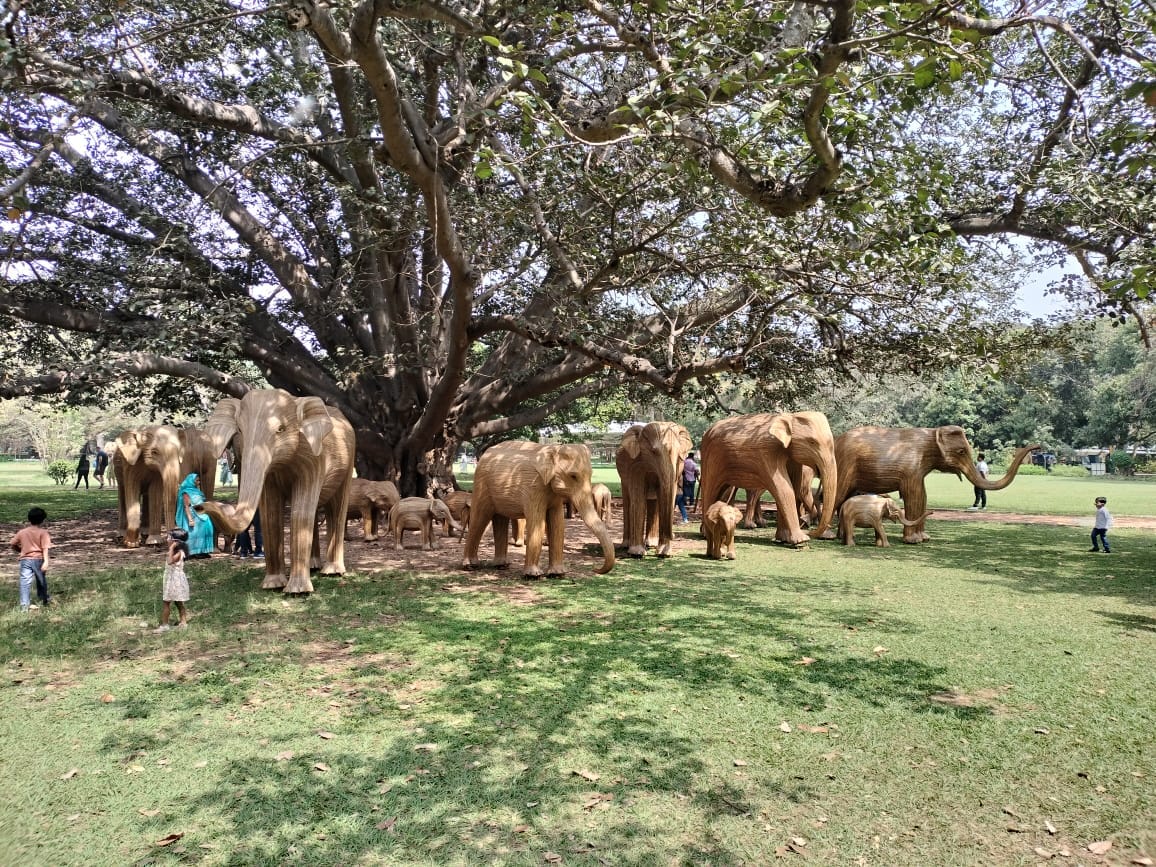
Whether lantana directly causes human-elephant conflict remains scientifically difficult to prove. (Special Arrangement)

Synopsis: Lantana camara is shrinking elephant habitats, but restoring native forests could help wildlife reclaim its lost home.
When Tamil Nadu recently cleared thousands of hectares of forests overrun by Lantana camara, something remarkable followed. Elephants, spotted deer, gaurs and other wildlife began returning to restored patches that had long been abandoned.
The viral images shared by Supriya Sahu, former additional chief secretary, environment, climate change, and forests, Tamil Nadu, highlighted a crisis unfolding across the Western Ghats. Introduced in India as an ornamental shrub nearly two centuries ago, Lantana camara has spread across vast stretches of forests in Karnataka, Kerala, and Tamil Nadu. Today, it has gone beyond invading landscapes. It is transforming and replacing the native grasses and shrubs that sustain elephants and other herbivores.
“What disappeared wasn’t the forest. It was the forest floor,” says a conservationist.
A forest invaded by lantana can look deceptively healthy. Dense green thickets cover the landscape, causing the disappearance of the plants that elephants actually eat.
“Lantana is a serious invasive plant in MM Hills (Malai Mahadeshwara Hills) and BRT Hills (Biligiri Ranganatha Temple Tiger Reserve). It reduces native grasses, herbs and browse plants that elephants depend on for food. Dense lantana also makes movement difficult and forces elephants to use open areas, valleys, corridors, and forest edges more frequently,” says Harisha RP, conservation biologist at the Ashoka Trust for Research in Ecology and the Environment (ATREE).
The plants disappearing beneath lantana include native grasses such as Themeda cymbaria, Themeda triandra, Cymbopogon flexuosus, Imperata cylindrica, Setaria intermedia, Digitaria, and Eragrostis species, besides bamboo, one of the preferred food sources of elephants. As these are replaced by lantana, forests may remain green but turn nutritionally poorer for wildlife.
Conservationist Sreekesh Pathal, an artist, perfumer, and founder of the Shambhala Foundation, explains why the shrub is so difficult to displace. His foundation is a family-owned ecological ethnobotanical conservation programme.
“Lantana is an allelopathic plant. It releases chemicals that prevent native plants from growing around it. Over time it forms dense thickets where natural regeneration simply stops,” he says.
Whether lantana directly causes human-elephant conflict remains scientifically difficult to prove, but conservationists do feel that shrinking forage inside forests cannot be ignored.
“The simpler question is whether elephants are moving out of parks more and coming into conflict with local people,” says Tarsh Thekaekara of the Shola Trust. “A logical answer is yes. If 40 to 50 per cent of major parks in South India are covered by unpalatable lantana, that’s effectively 40 to 50 per cent of the habitat lost to mammals.”
The Shola Trust works in the sphere of human-inclusive conservation, human-elephant interactions, and community-based Lantana management in the Nilgiri Biosphere Reserve.
He is quick to add a note of caution.
“It is extremely difficult to scientifically prove that lantana alone is responsible. Changing rainfall, elephant behaviour, attractant crops, and several other factors also influence human-elephant conflict.”
Former Principal Chief Conservator of Forests BK Singh agrees. Lantana, he says, is only one part of a larger ecological challenge.
“When forests degrade, lantana gradually takes over grasslands. Wild animals find it increasingly difficult to access food, water, and shelter. Eventually they move out of forests. But fragmentation of forests and the loss of traditional elephant corridors are equally important reasons behind rising conflict.”
Long before scientists began documenting the spread of lantana, the Soliga community living in the forests of BRT Tiger Reserve and MM Hills, both of which are situated in Karnataka, had already witnessed the transformation.
Interestingly, lantana does not appear in their songs, folklore, or rituals.
“They call it ‘ro.’ It is viewed as a recent invasive plant rather than a traditional forest resource,” remarks Harisha.
The Soligas remember forests with open understoreys (undergrowth), abundant grasses, and richer forest produce. Today, they report declining honey, fewer medicinal plants, and the disappearance of baṇe hullu, a Cymbopogon grass preferred by elephants. Their observations match scientific studies documenting the loss of native vegetation.
Harisha believes this traditional ecological knowledge should become an integral part of restoration planning rather than remain on the fringes of conservation.
Removing lantana, conservationists say, is only half the battle.
“Lantana has existed in India for more than a century. Controlling it requires much more than removal. It needs long-term restoration of native plants, protection of elephant corridors, fire management, and continuous monitoring,” says Harisha.
The challenge is immense because the shrub cannot simply be cut back.
“If you cut it at the stem, it comes back even thicker after the rains. The only effective way is to uproot it completely,” says Pathal.
Thekaekara shares that a park like Bandipur has about 50,000 hectares of dense lantana. “Currently, the department, CSR funds, and NGO interventions altogether remove a few hundred hectares, and even then we don’t have the knowledge on how to fully restore it,” he adds.
Pathal and Thekaekara see opportunity where others see only an ecological menace. While Pathal’s foundation is exploring ways to convert harvested lantana into furniture, sculptures, biopesticides, and other products that can create livelihoods while supporting restoration, Thekaekara has set up the Real Elephant Collective and Wild Carbon Conservation and Livelihoods Private Limited.
The collective collaborates with the Soliga, Bettakurumbas, Kattunayakan, and Paniya tribes to craft life-size elephants from the invasive weed itself. The sculptures are then taken and exhibited in green spaces across the world.
“There’s an exhibition in Boston next month, and the elephants will continue to have exhibitions around Europe for the next three to five years,” reveals Thekaekara.
Wild Carbon, on the other hand, converts lantana into biochar and leverages carbon credits to fund its removal.
Pathal reflects, “We need NGOs, businesses and local communities to work together because the scale of the invasion is simply too large.”
Lantana craft centres run by village cooperatives have already shown what such partnerships can achieve. Soliga artisans have transformed harvested lantana into furniture, baskets, lampshades, and elephant sculptures that have travelled to exhibitions around the world, generating livelihoods while helping clear invaded patches.
But both Pathal and Thekaekara agree that art and handicrafts alone cannot solve a problem spread across millions of hectares. The need of the hour is scale.
“We need a business model and ecologically appropriate machines in areas where lantana is very dense, because it costs almost one lakh rupees per hectare to remove, and it will cost many hundreds of crores to remove it at scale. But in low-density areas, where lantana is just starting to spread, a completely manual approach to keep it out should be prioritised. You have an outer ring that prevents lantana from spreading into new areas, and from the core you work outwards, clearing dense lantana using a community enterprise model,” explains Thekaekara.
Also Read:
Elephants sans passage, people without peace: Trapped in Chinnakanal’s endless conflict



