

Published Jul 18, 2026 | 6:06 PM ⚊ Updated Jul 18, 2026 | 10:16 PM

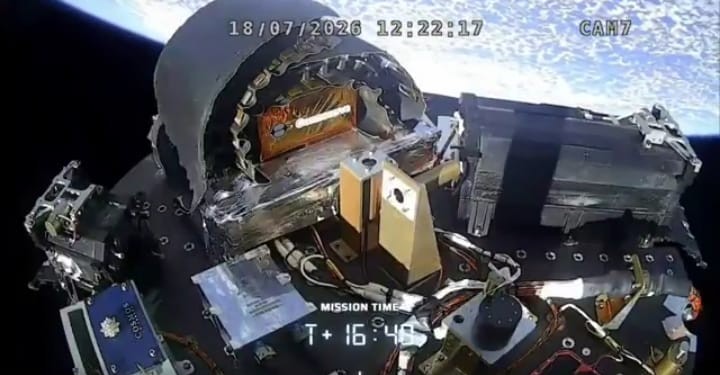
Vikram-1 flew a nominal profile to reach its target Low Earth Orbit of approximately 450 km at a 60-degree inclination.

Synopsis: With a flawless first launch, Skyroot becomes the first private company to design, build and fly an Indian rocket to orbit, deploying its own SCOPE satellite and Grahaa Space’s Solaras satellite, and other in-orbit experiments, and opening a new door of access to space for the world.
Hyderabad-based Skyroot Aerospace made history on Saturday, 18 July, becoming the first private company to fly an Indian-built rocket to orbit on its maiden attempt.
Mission Aagaman, meaning ‘arrival’, lifted off from the First Launch Pad at the Satish Dhawan Space Centre, Sriharikota, and the launch vehicle, Vikram-1, flew a nominal profile to reach its target Low Earth Orbit of approximately 450 km at a 60-degree inclination.
It successfully deployed its payloads, and Skyrooted joined the exclusive group of companies able to reach orbit.
In a moment the team called the honour of a lifetime, Prime Minister Narendra Modi called to congratulate the Skyroot team on Vikram-1’s success. He has also sent a handwritten postcard inscribed with “Vande Mataram” on the Vikram 1 to space.
“This is a defining moment in India’s space journey. The growing participation of our private sector is opening new frontiers and accelerating innovation,” Modi said on X.
“This achievement will encourage countless youngsters to dream bigger and innovate fearlessly,” he added.
Also Read: India’s first privately developed rocket lifts off
During the flight, Vikram-1 completed every principal mission milestone, validating the performance of its propulsion, avionics, and guidance, navigation and control systems under real operational conditions.
The vehicle deployed its customer payloads and generated a wealth of in-flight data that will directly inform future Vikram missions and the continued evolution of Skyroot’s launch programme.
Vikram-1 is a seven-storey-tall, multi-stage orbital launch vehicle built around an all-carbon-composite structure and powered by in-house-developed propulsion, including 3D-printed engines and high-thrust solid-fuel motors—and is designed to carry small satellites of up to 350 kg to Low Earth Orbit.
Its ultra-low-shock, ground-testable separation systems are engineered to protect the delicate satellites it carries.
On this flight, Vikram-1 carried technology-demonstration payloads from Grahaa Space, Cosmoserve and DCubed, alongside Skyroot’s own SCOPE satellite, together with Cosmos Diamonds’ artwork ‘Cosmic Bloom’ and a micro-art piece — a small, human reminder of what access to space can carry.
Also Read: Hyderabad puts India on aerospace map as Skyroot becomes sector’s first unicorn
Congratulating Team Skyroot, ISRO Chairman Dr V Narayanan said their achievement reflected the growing maturity of India’s private space sector.
“It is encouraging to see Indian industry translating technological capability into launch capability, complementing our national space programme. ISRO and IN-SPACe remain committed to working closely with industry partners to build a vibrant, globally competitive space ecosystem that advances India’s space ambitions,” he noted.
IN-SPACe Chairman Dr Pawan Goenka said only a handful of nations could reach space on their own, and today, a private Indian company joined that exclusive club.
“What lifted off today is the culmination of years of work, a team of over a thousand people, and efforts of close to four hundred suppliers with it. Congratulations to Team Skyroot. You have given us an India moment,” he added.
Skyroot’s Co-founder and CEO Pawan Kumar Chandana said the firm is the first private company to take a rocket to orbit on its very first flight.
“What the world witnessed today is the result of years of work by our team, our partners and suppliers across the country. It proves that India has the talent, the technology and the industrial strength to build launch vehicles that meet the world’s standards and to serve the world from here. Our mission has always been to open space for all. Today we opened that door a little wider. This is not the destination. It is the beginning. From here, we leap,” he added.
It may be noted that SpaceX, the global private leader in space launch technology, tasted success with its Falcon 1 rocket in 2008 only after three failed attempts.
Skyroot’s Co-founder and COO Naga Bharath Daka said the dedication of hundreds of engineers, technicians and mission specialists made Aagaman successful.
“Even as we celebrate, we are already applying today’s learnings to the next chapter of the Vikram series and to building a world-class launch capability from India, for the world,” he added.



