

Published Jul 29, 2026 | 4:29 PM ⚊ Updated Jul 29, 2026 | 4:29 PM

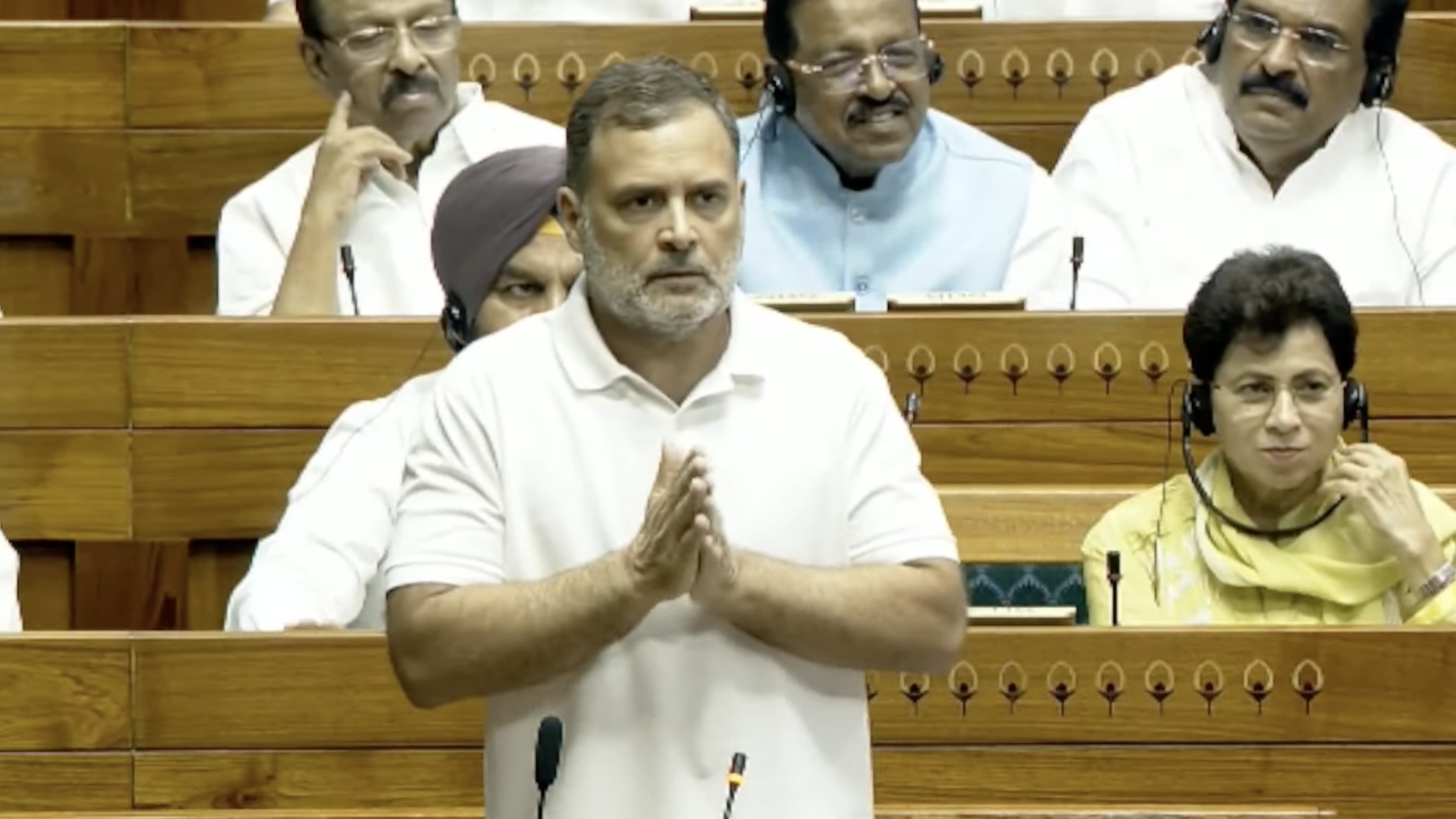
Leader of the Opposition in the Lok Sabha Rahul Gandhi.

Synopsis: Leader of the Opposition in the Lok Sabha Rahul Gandhi accused Union Home Minister Amit Shah of “authorising” the shooting of student protesters during a debate on the Public Examinations (Prevention of Unfair Means) Amendment Bill, 2026 on Wednesday, leading to uproar in the House. The remarks were expunged from the parliamentary record and led to a brief adjournment of the House. Parliamentary Affairs Minister Kiren Rijiju demanded that Gandhi withdraw or substantiate his claim, while Union Minister Jitendra Singh accused him of politicising the debate and making baseless allegations.
Chaos reigned in the Lok Sabha on Wednesday, 29 July, during the discussion on the Public Examinations (Prevention of Unfair Means) Amendment Bill, 2026, after Leader of the Opposition Rahul Gandhi accused Union Home Minister Amit Shah of having “authorised the shooting of our students” during last week’s Jantar Mantar protests.
Gandhi criticised the police action against protesting students and said, “Sir, the Home Minister authorised the shooting of our students. He put bullets into the bodies of our students. He ordered that the students of India be shot.”
The remarks immediately triggered loud protests from treasury bench members.
🔺The Home Minister ordered the shooting of our students.
🔺He put pellets into the blood of our students.
🔺He ordered the students of India to be shot.: LoP Shri @RahulGandhi in Lok Sabha pic.twitter.com/DWrjb4RnRH
— Congress (@INCIndia) July 29, 2026
Parliamentary Affairs Minister Kiren Rijiju denounced the allegation as “very irresponsible”, repeatedly asking Gandhi to explain the basis for directly naming the Home Minister. “Who ordered the firing?… On what basis have you made this allegation? Who told you this? What evidence or reasoning do you have for making such a claim?” Rijiju said, demanding that the remarks be expunged from the proceedings.
Samajwadi Party President Akhilesh Yadav intervened in Gandhi’s defence, arguing that if the Leader of the Opposition had levelled a serious allegation, it was incumbent upon the government to explain “on whose orders the police behaved in this manner towards children, students, and young people.”
Rejecting Yadav’s argument, Rijiju said the issue was not the demand for an inquiry but Gandhi’s decision to directly accuse Amit Shah of ordering the firing. “If you are asking for an inquiry, that is different… Rahul Gandhi did not ask for an inquiry. He directly alleged that the Home Minister ordered the firing,” he said, insisting that Gandhi either apologise, withdraw the statement, or substantiate it.
Intervening repeatedly, the Speaker said allegations against an individual could not form part of the parliamentary record unless backed by “firm evidence”, such as the findings of an inquiry commission or another authoritative source. He told Gandhi he was free to demand an investigation into the police action but could not attribute responsibility to a specific individual without such a basis.
Gandhi sought to continue, asserting that “the use of force can only be authorised by the Home Minister.” The Speaker ruled that Gandhi was disregarding repeated directions from the Chair, even as treasury bench members continued shouting slogans. The House was adjourned till 3 pm.
Also Read: CJP urges Centre to honour promise to withdraw FIRs against protestors, warns of fresh agitation
Gandhi began his speech on the House floor with an anecdote that immediately drew objections from treasury bench members.
“There are three categories of people: one, there is the student, then there is the idiot [referring to the BJP leaders], and the third is the andhbhakt that blindly follows the idiot,” Gandhi said.
Parliamentary Affairs Minister Kiren Rijiju forcefully interrupted Gandhi, demanding that he not use unparliamentary language. Defence Minister Rajnath Singh requested Speaker Om Birla to have the expression expunged from the proceedings before appealing to ruling party MPs to remain calm and allow the Leader of the Opposition to continue his speech.
Resuming his address, Gandhi avoided repeating the expression, saying, “I’m not using the word.” He instead contrasted students with “the two other categories” that he declined to name. A student, he said, seeks knowledge, is unafraid of the truth, respects differing viewpoints and does not resort to force, whereas the other categories “need an image”, “need force” and “need violence.”
Gandhi argued that students’ anger extended far beyond paper leaks. He described India’s education system as “terrible”, “cruel” and “an extortion system”, alleging that paper leaks, arbitrary re-examinations, rampant privatisation of examinations and the outsourcing of recruitment processes had systematically disadvantaged poor and middle-class students.
He also alleged that the education system had been “captured” by the RSS and said former Union Education Minister Dharmendra Pradhan’s resignation was irrelevant because he had never exercised real authority over the ministry.
“The organisation that actually runs the Education Ministry is the RSS. And the person who runs it is an Officer on Special Duty (OSD) sitting in the minister’s office,” he said.
He further alleged that every university in the country was headed by an RSS-affiliated Vice-Chancellor and accused the organisation of preventing students from pursuing their passions, questioning authority and studying history free from ideological influence. Addressing students directly, Gandhi said their “real enemy” was the RSS, not the Education Minister, accusing the organisation of seeking to turn students into “andhbhakts” instead of independent thinkers.
Gandhi described the Jantar Mantar protests as an assertion by young people that they would not allow others to dictate their future. He praised the students for confronting fear despite pressure from the government and the RSS, saying they had publicly questioned unemployment, restrictions on personal freedom and attacks on religious communities.
Gandhi then turned his attention to Union Home Minister Amit Shah’s absence from the House. Saying he had seen the Home Minister’s convoy earlier in the day, Gandhi claimed Shah “does not have the courage to come and sit here” and asked why he was absent during the debate.
Repeated sloganeering and interruptions followed. Speaker Om Birla intervened, urging Gandhi to confine his remarks to the Bill. He said the minister responsible for the legislation was present, in keeping with established parliamentary procedure.
Also Read: Supreme Court accepts CBI reports, closes coal allocation case against Dr Manmohan Singh
When the House resumed, Union Minister of State in the Prime Minister’s Office Jitendra Singh accused the Opposition of choosing political confrontation over constructive engagement. “When such an important Bill is under discussion… instead of participating constructively, offering suggestions, and engaging in a meaningful debate, the Opposition is trying to politicise the issue,” he said.
Opposition members, meanwhile, repeatedly shouted slogans of “We want justice”.
Singh nevertheless continued his speech, attacking Rahul Gandhi over his use of the word “idiot” during the debate. He said the language was so grossly unparliamentary that he would not utter it himself.
“If a person—or even an honourable Member—considers himself an idiot, he may say so outside the House, but such language cannot be used inside this House,” Singh said, adding that Gandhi’s subsequent claim that he had not used the word to refer to any particular individual only raised the question of whether he was referring to students instead.
“If those children—who are our future, the future of India, and the citizens of a developed India—are being called idiots, then nothing could be more unfortunate than that,” he said.
The Minister then turned to Gandhi’s allegation that Union Home Minister Amit Shah had ordered the firing on protesting students, accusing the Congress leader of making claims without understanding how the government functions.
Singh said the authority to order firing, wherever legally required, rested with an Executive Magistrate, a Sub-Divisional Magistrate or a District Magistrate, not with any minister.
“First, when he says that the Home Minister ordered the firing, and then fails to substantiate that claim, the most fundamental fact is this: nowhere is an order to open fire given by a minister,” Singh said. He added that no firing had taken place during the protests in any case, maintaining that security personnel had only used tear gas. “If no shots were fired, the question of anyone ordering firing simply does not arise.”
Singh also disputed Gandhi’s claim that Amit Shah had travelled with a convoy of 30 vehicles, saying the Home Minister was never accompanied by such a convoy.
He further rejected Gandhi’s assertion that Shah had gone abroad, saying there was “no such information and no evidence whatsoever because the Home Minister never went abroad.”
“So, to make statements in this House without facts, without truth, and without responsibility—and then simply leave after making them—is not conduct befitting a responsible leader, especially not the Leader of the Opposition,” Singh said.
He then shifted to a personal attack on Gandhi, referring to the Congress leader’s 21 July protest outside the gates of 7, Lok Kalyan Marg, the Prime Minister’s official residence. Singh suggested Gandhi’s action reflected an unfulfilled ambition to occupy the residence as Prime Minister, saying that after “that wish was never fulfilled”, he had gone and sat outside its gates.
Singh further claimed that Gandhi initially distanced himself from the student agitation because he believed it was being led by the Aam Aadmi Party, but later joined it after realising it had gathered momentum. Borrowing internet slang, Singh said Gandhi had first been “MIA”—”Missing in Action”—before experiencing “FOMO”, or “Fear of Missing Out.”
Singh denied allegations of police excesses and claimed that authorities had exercised “utmost restraint” to ensure there were no casualties.
(Edited by Dese Gowda)



