

Published Jul 28, 2026 | 7:00 AM ⚊ Updated Jul 28, 2026 | 7:00 AM

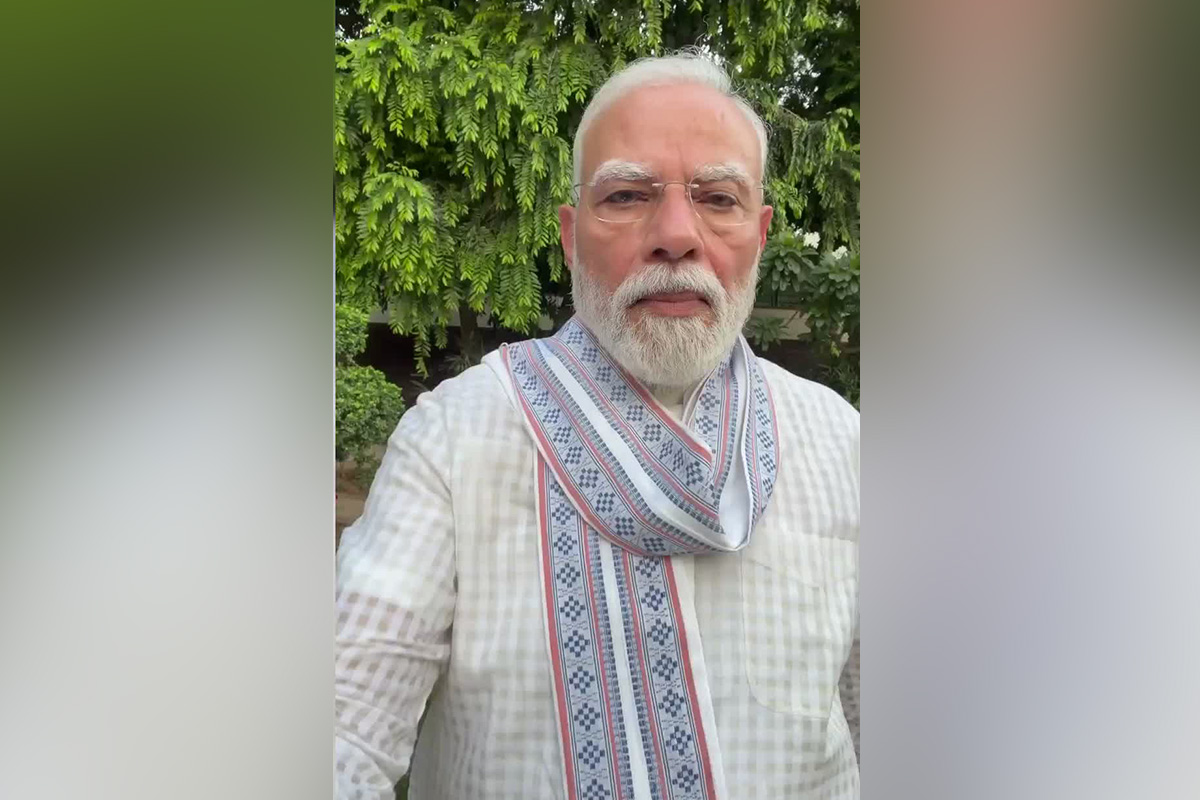
Prime Minister Narendra Modi seen announcing the setting up of the task force.

Synopsis: On a day when fresh apprehensions about the government backtracking on their promises to the protests began to bubble over, the playbook Nandan Nilekani’s high-power taskforce could follow and the fate of the Radhakrishnan Committee report also became topics of discussion.
Prime Minister Narendra Modi’s announcement of a new high-powered task force on exam reforms under the leadership of Nandan Nilekani has got many talking.
“Our examination system should be trustworthy, should be transparent and the system should make maximum use of technology to make exams clean and transparent,” the Prime Minister said.
Among the earliest to respond to the PM was Trinamool Congress MP Sagarika Ghose, who lashed out at what she called the Prime Minister’s endless gimmickry, which she said has led to committee after committee being constituted to little effect.
“Perhaps you have forgotten there is already a committee headed by K Radhakrishnan former ISRO chairman to look into examination reforms. It submitted its report in 2024. Then another committee, also headed by Dr Radhakrishnan, was set up to monitor implementation of its recommendations,” she reminded the Prime Minister in a post.
“In June 2026, the Parliament’s Education Standing Committee noted that exam irregularities were still continuing and called for a time-bound roadmap to implement the Radhakrishnan recommendations,” she added, before demanding that the Prime Minister tell students of the fate of the Radhakrishnan Committee recommendations and why they haven’t been implemented.
“Big-ticket names and multiple committees are no substitutes for accountability,” she told the Prime Minister.
Siddharth Varadarajan, the editor of The Wire, highlighted how Anita Karwal, who was named in the six-member task force, had been the CBSE chairperson (2017-2020) when the Class 10 Maths paper and Class 12 Economics paper were leaked in 2018. Karwal was promoted as the Education Secretary in April 2020.
Others in the committee include former ISRO chairman S Somnath, former Intelligence Bureau Director Tapan Deka, IIT Madras Director V Kamakoti and logistics expert Amrit Lal Meena.
Senior journalist Tavleen Singh expressed the hope that Nilekani will “suggest that we learn from the American model in which academics play a bigger role than officials”.
Also Read | Beyond Pradhan’s resignation: CJP and the unfinished struggle for educational justice in India
Nikhil Pahwa, a noted voice on tech on social media, was unimpressed. He called the plan that could be rolled out one that the bureaucracy has wanted for decades and in which the “politicians have been coopted”.
“Nandan Nilekani has a standard playbook: create ‘Digital Public Infrastructure’, create a digital identity and try and build 100% national coverage for this. He has a single playbook for government that he and ISPIRt have used in the past, and you can expect the same,” he posted.
Pahwa, a critic of Nilekani, went on to outline how he believed the playbook would unfold.
“The identity: One part of this Playbook already exists… the ID, specifically the Apaar ID. They’ve done: Aadhaar (ID), UHID(Health), Apaar ID(Education), FasTag(Transportation). Every crisis is an opportunity for our Tech godman. COVID was used to create UHID without consent during vaccination. The Apaar ID, which schools have forced students to get and link to Aadhaar, will be used here. The idea was always that these would be used for examinations.
“The infrastructure is the second part: IT services companies benefit from the deployment of this infrastructure. Look at banking, GSTN and govt services, and you can see who benefits and how. There’s sometimes a conflict of interest for some people but who cares.
“The people: You need to look at the people in this committee and ecosystem that will be built around it. Some of them will be old affiliates… You’ll see the former Aadhaar “volunteers” in different parts of it, and in the business that gets built around it. Guess who backs EkStep and who is there. If you start a people map, you’ll see a pattern. Earlier, Omidyar Network was involved, and now I’m sure the Bill and Melinda Gates Foundation (some affiliates there) might be interested. There’s a pattern, but of course, even lots of correlation may not be causation.
“The committee will recommend the usage of Apaar ID and exam systems that use them. They might recommend an authority to manage them similar to UIDAI, or just coopt or infiltrate NTA. There are areas where Nilekani influence remains: NPCI, various RBI committees mapping its future. During COVID, in CoWin and the National Health Authority, affiliates were involved, though that didn’t end well,” he shared.
Pahwa then went on to flag the risks of what he termed this citizen mapping plan “which maps and tracks us from, in their words, ‘cradle to grave’. Multiple IDs linked to Aadhaar give it a sense of permanence and help with dedupe across databases. All this eventually is used to build, as the Aadhaar-related state resident data hubs said, ‘a 360-degree citizen profile’, and that’s the surveillance infrastructure. All touchpoints of your file, mapped for surveillance. Fed into NATGRID.”
Also Read | ‘Foul on democracy, red card for brutality’: How students beat the BJP at their own game
Congress General Secretary Jairam Ramesh was pithy in his response to the announcement. He termed it a “form-a-committee, distract-attention” approach.
कमिटी बनाओ, ध्यान भटकाओ pic.twitter.com/n7dXvQWi7J
— Jairam Ramesh (@Jairam_Ramesh) July 27, 2026
The seven-member K Radhakrishnan Committee, headed by the former ISRO chairman, had been tasked with ensuring a zero-error exam.
The other members in the committee were Dr Randeep Guleria, former director, AIIMS Delhi; Professor BJ Rao, Vice Chancellor, Central University of Hyderabad; Professor K Ramamurthy, Professor Emeritus, Department of Civil Engineering, IIT Madras; Pankaj Bansal, Co-Founder, People Strong and Board Member, Karmayogi Bharat; Professor Aditya Mittal, Dean, Student Affairs, IIT Delhi and Govind Jaiswal, Joint Secretary, Ministry of Education.
The Reformation of National Common Entrance Testing in India report that they released on October 21, 2024, made 101 recommendations, which were grouped under 46 major action points.
The report batted for secure Computer-Based Tests in place of pen-and-paper-based Tests—a total use of technology to make the exam system clean and transparent, if you were to echo the Prime Minister. This was because paper leaks take place during transport in the interval between printing and delivery. But while pilot runs of digital delivery of question papers have been conducted, it has not been implemented for exams like NEET where 22 lakh students appear at over 4000 centres.
Also recommended were examinations being held in multiple shifts.
Another big step the committee members outlined was making the National Testing Agency (NTA) an autonomous body with dedicated verticals for operations, technology, security, R&D, psychometrics, and governance.
The Committee suggested hiring domain experts in cybersecurity, data analytics, AI, psychometrics and assessment. It recommended end-to-end encryption of examination material too. While advanced encryption for question paper storage and delivery has been implemented, the NTA’s DIGI-Exam (along the lines of DIGI-YATRA) platform hasn’t been rolled out yet.
Hybrid models for large-scale tests, AI-assisted monitoring and anomaly detection were other suggestions when it came to going digital.
Setting up secured test centres in each district, mobile testing centres in rural and remote areas, government departments requesting examinations working as knowledge and examination partners with NTA on syllabus and grievance portals that provide quick resolution of complaints were the other significant ideas to have made it to the list.
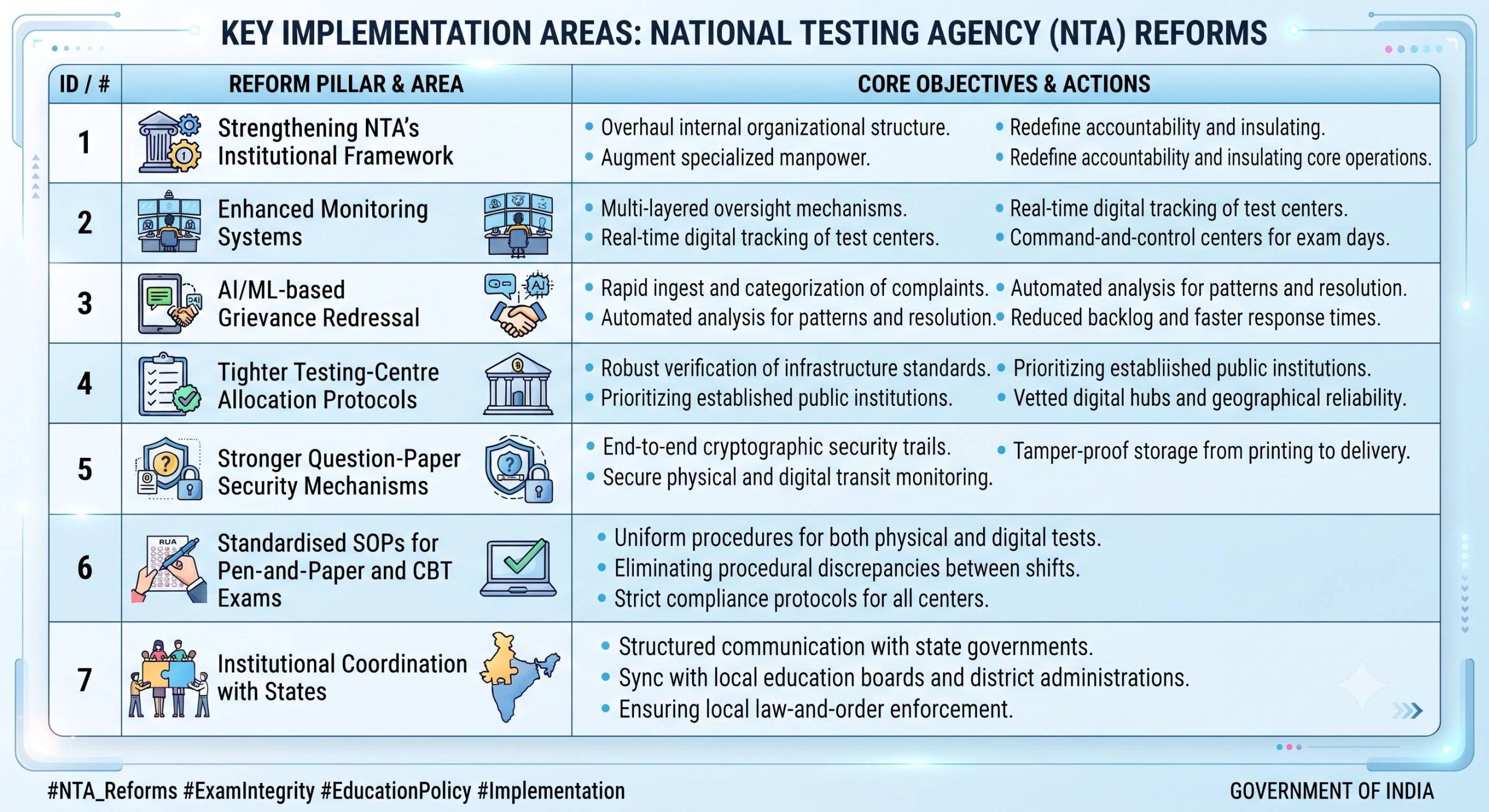
When asked by the Supreme Court in May 2026, Radhakrishnan submitted that a “majority” of the recommendations have been implemented.
But several education experts insist that the truly important recommendations are still hanging fire, while some of the easier-to-implement ones have been actioned.
In fact, an advertisement for Chief Technology Officer (CTO) for the NTA was only put out on May 16, 2026 and still remains unfilled.
The current chairperson of the NTA governing body is Pradeep Kumar Joshi, whom Congress General Secretary Jairam Ramesh had in 2024 claimed has “a very dubious record as Chairman of the Madhya Pradesh Public Service Commission”. In all, the governing body has 10 members.
Also Read: Jantar Mantar protests mark the birth of fear among Modi and his men
(Edited by R Rajesh Kumar.)



