

Published Oct 08, 2026 | 10:22 PM ⚊ Updated Oct 08, 2026 | 10:43 PM

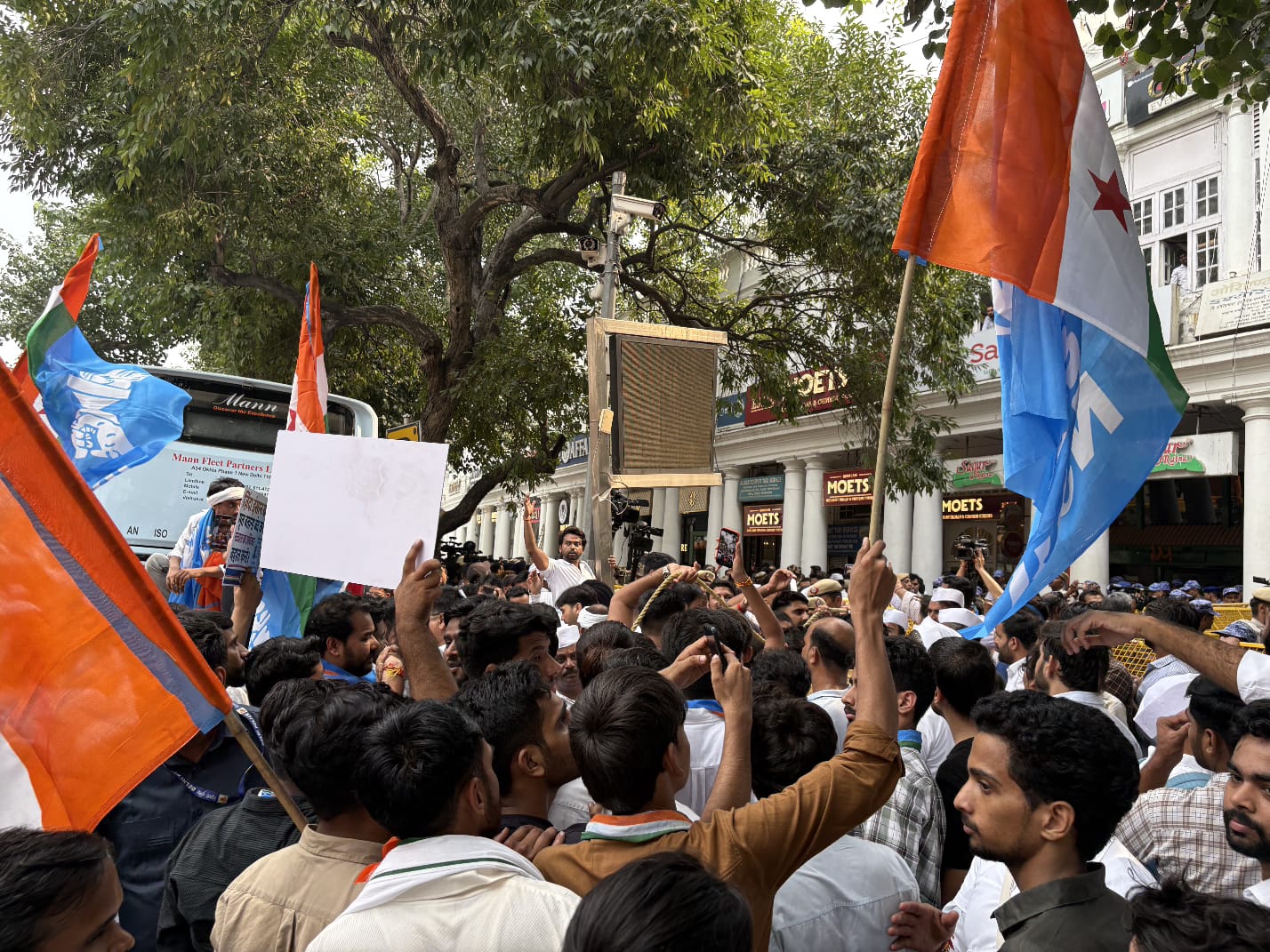
Workers of the NSUI, Youth Congress and Congress women’s wing had come from several states. Photo| Special Arrangement

Synopsis: Jantar Mantar stays sealed, and more than 20,000 personnel guard the capital. Left student groups say their members are being picked up from homes and trains ahead of the CJP’s October 10 protest.
The INDIA bloc reached Rajghat on Thursday, October 8, without being stopped by the Delhi Police, on the third consecutive day of its protest against Chief Election Commissioner (CEC) Gyanesh Kumar.
Meanwhile, Delhi is filling up with security forces ahead of the Cockroach Janta Party (CJP)’s protest on October 10, with student groups saying their members are being detained across states in an attempt to prevent the agitation.
For once, the protest ended where its leaders wanted it to.
Leader of Opposition in Lok Sabha Rahul Gandhi, Congress president Mallikarjun Kharge and other Opposition MPs met for lunch at Moets, a restaurant in the Outer Circle of Connaught Place on Thursday. It was the second lunch Kharge has hosted in two days. Priyanka Gandhi Vadra, KC Venugopal and Jairam Ramesh were present. So were Abhishek Banerjee of the TMC, John Brittas of the CPI(M), P Sandosh of the CPI and Manoj Jha of the RJD.
Telangana Chief Minister A Revanth Reddy and Himachal Pradesh Chief Minister Sukhvinder Singh Sukhu joined the meeting. The Samajwadi Party, the Shiv Sena (UBT) and the NCP (SP), who were missing for Wednesday’s lunch and protest, also came.
Before boarding the bus to Rajghat for a sit-in protest against the Election Commission, Rahul Gandhi told reporters that the around 300 MPs had been trying to protest peacefully for the past two days but were assaulted by the police.
He reiterated that Prime Minister Narendra Modi, Union Home Minister Amit Shah, CEC Gyanesh Kumar and RSS chief Mohan Bhagwat will be brought to justice for hijacking the country through a “criminal conspiracy.”
At 3.34 pm, the MPs left Connaught Place for Rajghat in three buses. Though there was heavy police deployment at both Connaught Place and around Rajghat, unlike the previous days, the police personnel did not stop the protest and even made way for the MPs to reach Rajghat.
At 3.34 pm, the MPs left Connaught Place for Rajghat in three buses. Although there was heavy police deployment at both Connaught Place and around Rajghat, police personnel, unlike on the previous two days, did not stop the protest and instead made way for the MPs to reach Rajghat.
The previous two days had unfolded differently. On Tuesday, police stopped the MPs near Akashvani Bhawan as they were heading to the Election Commission. Rahul Gandhi sat there for about eight hours before he was detained. On Wednesday, their buses were stopped on Ashoka Road, near the Shangri-La hotel, while they were heading to Jantar Mantar. Police said 91 people were detained that day. Delhi Police have since filed at least two FIRs naming Rahul Gandhi and Priyanka Gandhi.
The Opposition had to take the protest to Rajghat, as the Jantar Mantar remained sealed by the police.
Also Read: Protest as prayer: Thousands gather at Rajghat on Day 3 of INDIA bloc’s anti-CEC campaign
Workers of the NSUI, Youth Congress and Congress women’s wing had come from several states. They walked from Connaught Place to Rajghat. This reporter walked with them.
The mood was cheerful, but the numbers were thin. Marchers themselves put the crowd at 500 to 700, and several said they had expected more.
The energy dropped at Rajghat. Rahul Gandhi and the MPs remained in their buses and went straight inside. None of them met the workers who had walked behind them.
Kharge spoke to the press later. “We came here and offered prayers to grant good sense to the government. The vote theft should stop, those who made mistakes should resign, and people’s right to vote should stay intact.”
Venugopal said the Opposition wrote to President Droupadi Murmu on October 2 and again on October 5, seeking a meeting. They are yet to receive a response.
Meanwhile, not everyone in the alliance is happy with the pace of the Opposition protests. A Left MP from Kerala told South First, “We have been pushing the Congress to join hands with the CJP and build a vibrant agitation. But they are not open to that idea as such.”
The protests began on October 2, demanding the resignation of CEC Gynaaesh Kumar over alleged irregularities in the Election Commission of India’s (ECI) Special Intensive Revision (SIR) exercise, which reportedly resulted in the deletion of 13 crore names from the electoral rolls.
On October 5, the Supreme Court declined to pass an interim order restraining Kumar from taking decisions. Kumar has not publicly responded to the demands for his resignation.
Also Read: Special Intensive Removal: The Telangana model!
The people who walked to the Rajghat to join the Opposition MPs were mostly young, and many had travelled long distances.
Avantika Tiwari, national secretary of the Youth Congress, from Chhattisgarh, was one among them.
“I have always believed that we, the people of India, live by the Constitution framed by Ambedkarji. What we now hear about the CEC goes against everything we believed. Crores of voters have been removed in the SIR process. Gyanesh Kumar has to resign. He has to go,” she told South First.
Abilasha Kotwal, a national core committee member of the Congress’s Shakti Abhiyan said the protest is a struggle for basic dignity.
“We have been on the streets for a long time. What we are demanding is to safeguard our Constitution and our basic rights. We have seen a lot of corruption and a lot of violence from this government. We saw the farmers’ protests. Now women and girls are being assaulted on the streets of Delhi. But the reason we are all here is the right to vote. The government is even denying dissent. What you see here is not a fight. It is a struggle for basic dignity,” she said.
Athira C, who had travelled from Kerala to attend the protest, told South First, “We are here to support Rahul Gandhi and protect democracy. We will be here until Gyanesh Kumar resigns.”
Royce R, Youth Congress general secretary for Vasai-Virar district, from Mumbai, claimed that Rahul Gandhi has been raising issues with the ECI for the past three years.
“Now the media has exposed what exactly is happening. Why is Gyanesh Kumar not coming out? Why is he not explaining to the media what happened? We are the youth, the next generation. No one can hold back our right to vote. There are many issues in this country, jobs and other things. Now even the basic right to vote is under threat. There is a mood for change. You cannot fool us on the basis of religion. We are educated,” he said.
Anish Kansal, vice-president of the Punjab NSUI, said, “We are here for our right to vote and our right to democracy, which Gyanesh Kumar and Modi are planning to take away from us. We will not let them do that. We are here for Rahul Gandhi. We are here for the nation.”
The Cockroach Janta Party (CJP) has announced a protest at Jantar Mantar on October 10. Left student groups, including the SFI, AISF, AISA, PSU, AIDSO and AISB, declared on October 7 that they would join in large numbers for the agitation.
These groups are trying to bring students to Delhi from Madhya Pradesh, Jharkhand, Chhattisgarh, Punjab, Uttarakhand, Haryana, Uttar Pradesh, Rajasthan and Himachal Pradesh.
Several of them told South First that their members were facing police scrutiny and detention while travelling to Delhi.
The SFI’s central executive committee said in a press statement that Uttar Pradesh Police had been threatening its activists over the phone. It alleged that police were illegally entering the homes of SFI members and other activists to detain them ahead of the protest.
Dinesh Seerangaraj, national general secretary of the AISF, told South First that AISF members had been detained in different states. “We have been detained. Women students were manhandled,” he said.
He alleged that intelligence officials in Pune tracked AISF members travelling to Delhi on the Goa Express. Some students were forced to get off the train at Itarsi in Madhya Pradesh and detained, he said. He added that police in Delhi had been asking for details of student leaders in the city.
Similar allegations have been raised by the CJP. CJP spokesperson Ashutosh Ranka on Thursday said that thousands of volunteers had been detained in Maharashtra, Uttar Pradesh and West Bengal. Days earlier, CJP founder Abhijeet Dipke said police in Chandrapur had served notices on activists, asking them not to travel to Delhi and questioning who was paying for their tickets.
Meanwhile, Dinesh said the AISF, the CJP, civil society groups, farmers’ organisations and trade unions were coming together for a major protest.
“These students have turned protests into celebrations,” he said.
More than 20,000 police and paramilitary personnel have been deployed across Delhi ahead of the October 10 protest, a senior police officer said on Thursday. The officer said no permission had been granted for any protest at Jantar Mantar and that prohibitory orders were in force.
The Centre has provided the Delhi Police with 110 additional companies of central forces, including 85 from the CRPF, 10 from the SSB, seven each from the ITBP and RAF, and one from the CISF. At least five of these companies comprise only women personnel.
Hindustan Times reported that around 11,000 additional central personnel were being deployed in Delhi, taking the strength of central forces in the city to around 26,000. The additional deployment has been cleared for October 8 to 12.
Police are monitoring roads leading into Delhi from Uttar Pradesh and Rajasthan, with barricades planned at entry points. Buses heading towards the New Delhi district are also being tracked, while railway stations and bus terminals are under watch. Uttar Pradesh and Haryana have been asked to remain alert.
Police have also approached colleges and paying guest (PG) accommodation owners, asking them to prevent students from attending the protest. Officers have discussed the possibility of using stadiums as temporary detention centres if large crowds refuse to disperse.
Jantar Mantar has remained closed to protesters since October 2, when around 1,000 people were detained across the city.
Security for Chief Election Commissioner Gyanesh Kumar has also been stepped up. Kumar already has Z+ security cover, and additional police personnel have been deployed outside his residence.
(Edited by Fayisa CA)



