

Published Aug 06, 2026 | 9:00 AM ⚊ Updated Aug 06, 2026 | 9:00 AM


Lakshadweep Administrator Praful Khoda Patel with Prime Minister Narendra Modi.

Synopsis: At first glance, the Lakshadweep Town and Country Planning and Development Regulation, 2026 appears to promote planned development. However, a closer reading raises serious constitutional concerns, including questions surrounding the “heart and soul” of the Constitution—the Right to Constitutional Remedies. Legal experts say the Regulation’s complex language and sweeping executive powers make its real impact uncertain, with its true constitutional test depending on how these provisions are implemented and interpreted by the courts.
The Lakshadweep Town and Country Planning and Development Regulation, 2026 is being projected as a landmark law for sustainable development, tourism and environmental protection. But for many islanders, it is something else entirely—a law that could legitimise “legal land grabbing.”
Behind promises of planned development lie provisions that legal experts say concentrate sweeping powers in the executive, weaken local self-governance, restrict judicial remedies, and raise serious constitutional concerns about property rights and the future of indigenous communities.
These provisions have sparked fears that the Regulation is less about planning than about control.
Also Read: Heritage slayers? Many moves to strip Lakshadweep of its identity, land, language and culture
One of the most significant aspects of the Regulation is the extensive powers vested in the Government and the Lakshadweep Administrator. The Government can declare planning areas, merge or divide them, constitute Planning and Development Authorities, approve or modify Regional and Master Plans, direct the preparation of fresh plans, suspend Master Plans during emergencies, and even withdraw a revised Regional Plan after it has come into force.
Although the Planning and Development Authorities are responsible for preparing these plans, they do not become operational without Government approval. If the Government is dissatisfied with a plan, it may require modifications or direct the preparation of an entirely new one. Similarly, if the authorities fail to prepare plans within the prescribed timelines, the Government may authorise the Chief Town Planner to prepare them instead.
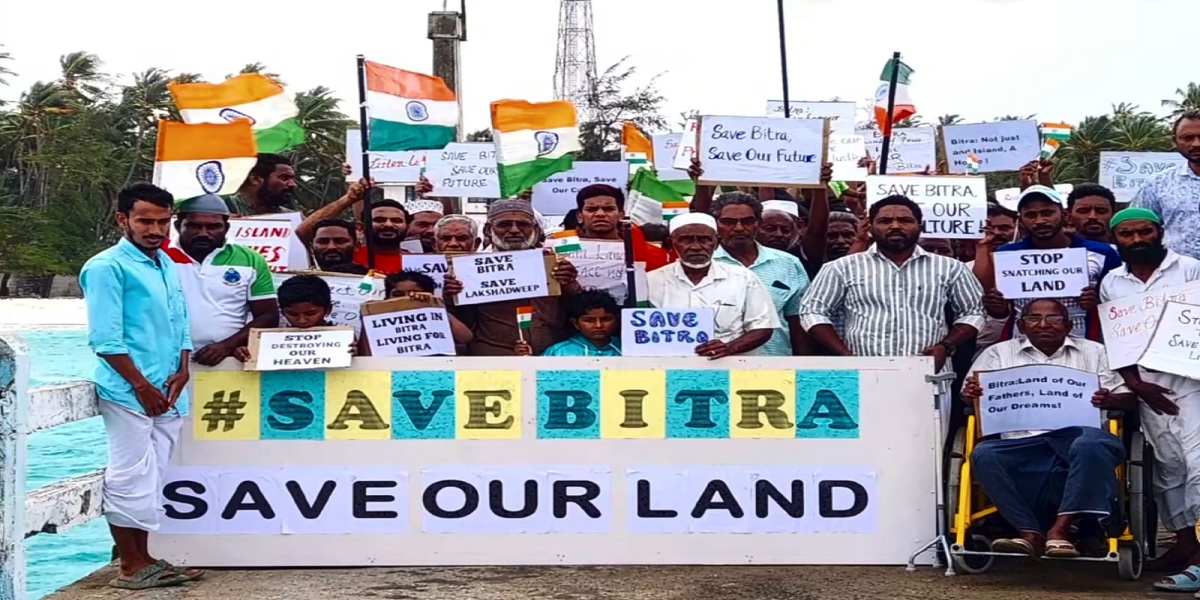
For the people of Bitra, this is not just about land, it is about legacy, identity, and survival.
When South First contacted Yaseen, a resident of Bitra Island, he said, “This is our ancestral land, and our livelihood is deeply woven into it. It was only after the administration issued a notification last year that we learned the entire landmass of Bitra Island was proposed to be acquired and transferred to central defence and strategic agencies. We are not against national security, but making such decisions without prior information or consultation puts people in deep distress.”
Like Yaseen, many residents fear they are being left out of decisions that could fundamentally reshape their lives.
This concentration of executive discretion raises important constitutional questions. Although Lakshadweep is a Union Territory administered directly by the Centre, that does not, by itself, justify highly centralised decision-making with little room for independent planning institutions or meaningful public deliberation on land laws and acquisition.
Residents argue that the right to know is a constitutional entitlement. Before decisions affecting their homes and livelihoods are made, they believe they deserve clear information, consultation, and an opportunity to participate in the process.
For many in Lakshadweep, the question is simple: they want to know what is happening to their land and their future.
The Regulation provides for the inclusion of representatives from the District Panchayat and local authorities in the Planning and Development Authorities. However, the overall planning framework remains largely executive-driven.
The Chairperson of the Planning and Development Authority (PDA) is appointed by the Administrator, while the Town Planning Officer is appointed in consultation with the Chief Town Planner. More importantly, the Government retains overriding powers over key planning decisions.
Although the Regulation lists community participation as one of the functions of the Planning and Development Authority, public involvement is largely limited to consultations and inviting objections during the preparation of Regional and Master Plans.
Speaking to South First, Advocate Ajmal R Ahmed, a lawyer based in Lakshadweep, said the Regulation weakens the constitutional mandate of local self-governance.
“By centralising planning, zoning and development decisions within nominated Planning and Development Authorities, the Regulation undermines the constitutionally mandated powers of local Panchayats to plan for economic development and social justice,” he said.
He also questioned provisions relating to land rights, arguing that they could infringe the constitutional right to property under Article 300A.
“The provisions authorising forced land pooling, summary evictions and reconstitution of land boundaries raise substantial legal concerns regarding procedural fairness, fair compensation and protection against arbitrary State action,” Ahmed added.
Also Read: Lakshadweep admin axes key degree programmes on eve of admissions, leaves students in limbo
Often described as the “heart and soul” of the Indian Constitution, the Right to Constitutional Remedies ensures that every citizen can approach the courts if their fundamental rights are violated.
Enshrined in Article 32, which empowers the Supreme Court, and Article 226, which confers similar powers on the High Courts, this constitutional guarantee enables the courts to issue writs such as Habeas Corpus, Mandamus, Certiorari, Prohibition and Quo Warranto to protect individual rights and uphold the rule of law.
One of the most debated provisions of the Regulation relates to the limited scope for challenging approved Master Plans. It allows an aggrieved person to approach the District Court within one month of a Master Plan coming into force.
However, such a challenge is restricted to only two grounds: that the Master Plan exceeds the powers granted under the Regulation, or that the mandatory procedures prescribed by the Regulation or the Rules were not followed.
The controversy deepens with Section 39(3), which states that, except on these limited grounds, a Master Plan “shall not be questioned in any legal proceedings whatsoever.”
While Parliament or a legislature cannot curtail the constitutional powers of the High Courts under Article 226 or the Supreme Court under Article 32, the language of this provision appears to discourage or significantly narrow legal challenges to approved Master Plans.
Advocate Ajmal said that, if legal disputes arise, this provision is likely to face the strongest challenge in court. The central question would be whether it limits the constitutional right of citizens to seek judicial review.
Also Read: Lakshadweep repeals 47-year-old liquor prohibition; introduces regulated excise policy
Advocate Ajmal Ahmed told South First that while the Regulation is presented as a framework for planned development, it raises several constitutional concerns.
On Scheduled Tribe protections (Article 19(5)), he warned: “Given that the indigenous population of Lakshadweep holds Scheduled Tribe status, sweeping development controls and commercial land acquisitions threaten to alter the demography and disrupt indigenous land ownership patterns.”
On ecological strain and carrying capacity (Article 21), Ajmal argued that although the Regulation refers to carrying capacity, “high-density development models pose severe risks to the extremely fragile atoll ecosystem, freshwater lenses and coral reefs, endangering the right to a clean and sustainable environment.”
He also cautioned against arbitrary discretion (Article 14), saying that “concentrating extensive regulatory and enforcement powers within executive-led bodies creates a potential risk of manifest arbitrariness in land declaration and development sanctions.”
According to Ajmal, any regulatory framework for Lakshadweep “must strictly align with constitutional principles, honour local democratic institutions and prioritise the protection of the islanders’ lands and livelihoods.”
“The true constitutional test of the Regulation will depend not only on its wording, but on how these wide-ranging powers are exercised in practice and, ultimately, how the courts interpret these provisions if they are challenged,” he said.



