

Published Jul 14, 2026 | 10:00 AM ⚊ Updated Aug 10, 2026 | 11:19 AM

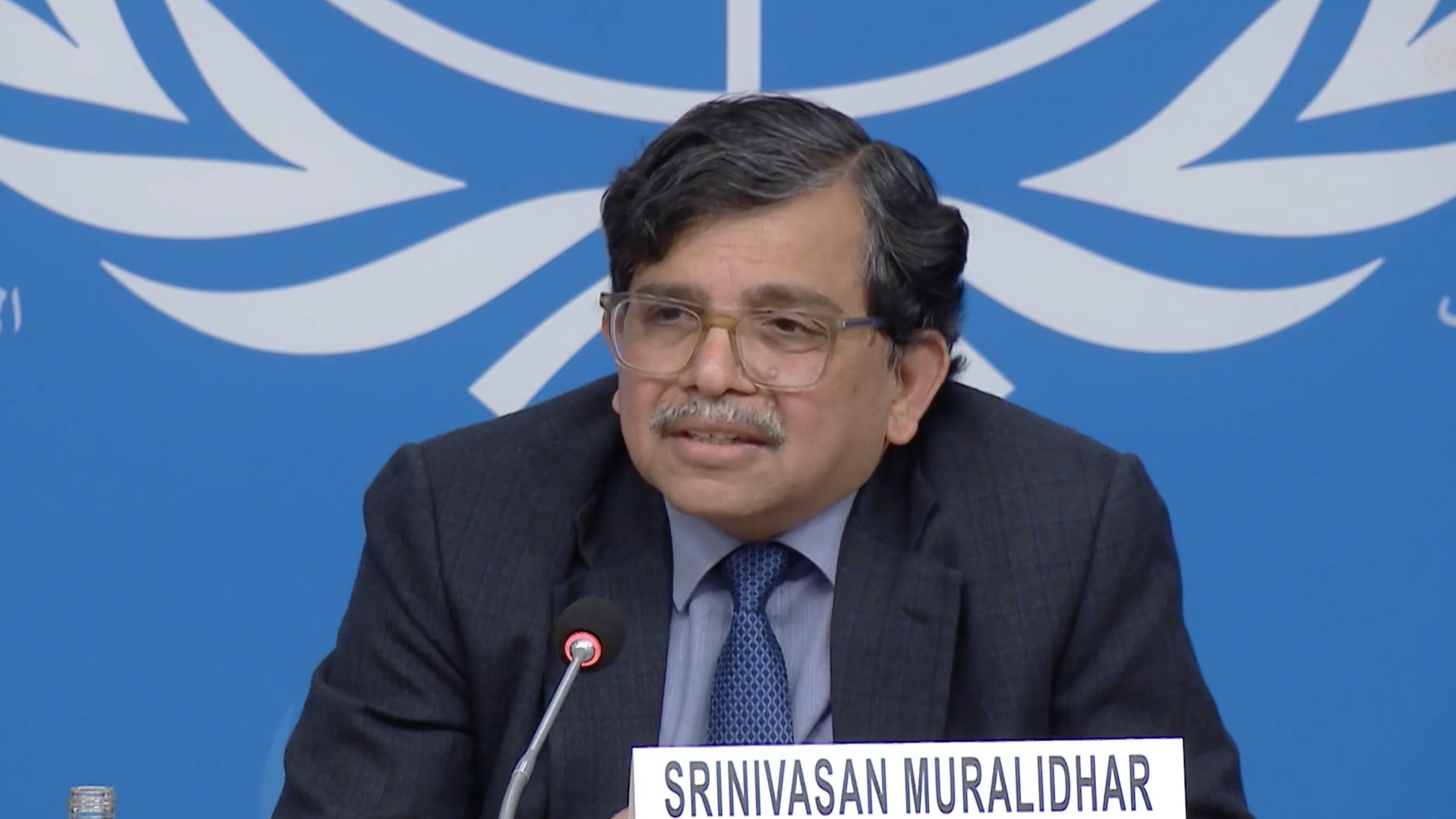
Justice S Muralidhar (United Nations)

Synopsis: In an exclusive interview with South First, Justice S Muralidhar, Chair of the UN Independent International Commission of Inquiry on the Occupied Palestinian Territory, including East Jerusalem, and Israel, explains why the Commission concluded that Palestinian children were deliberately targeted during Israel’s ongoing war on Gaza, how investigators verified evidence amid accusations of bias, and why accountability under international law cannot be postponed.
The United Nations Independent International Commission of Inquiry’s latest report, The Essence of Childhood Has Been Destroyed, has brought renewed attention to the profound human cost of Israel’s ongoing war on Gaza, particularly on children.
The report concludes that there are reasonable grounds to believe Palestinian children were deliberately targeted, documenting killings, injuries, displacement, psychological trauma and the destruction of the conditions necessary for childhood itself.
In this interview with South First, Justice S Muralidhar, who has previously served as Chief Justice of the Orissa High Court, discusses the evidence behind the Commission’s conclusions, responds to allegations of partiality, explains the legal standards applied by the inquiry, and reflects on the testimonies that left a lasting impact on him.
Edited excerpts follow.
Q: After months of investigation involving thousands of documents, witness testimonies and forensic analysis, what do you think is the single most important message the world has failed to understand from this report?
Justice Muralidhar: The most important finding that has not received adequate attention is that children were made deliberate targets.
Children are often reported as casualties in every armed conflict. News reports typically state that among those killed were a certain number of women and children. We tend to accept this as an unfortunate but inevitable consequence of war.
Our report departs from that understanding.
We conclude that this was not merely incidental to hostilities. There are reasonable grounds to believe that there was a deliberate, planned policy of targeting children. In other words, children were not simply caught in the crossfire; they themselves became the object of attack.
That is the crucial distinction our report makes.
Also Read: India urged to arrest touring Israeli soldier over Gaza war crimes by pro-Palestine NGO
Q: Israel has rejected the Commission’s findings as biased. How did the Commission ensure that its investigation remained independent and evidence-based despite these allegations?
Justice Muralidhar: We have explained our methodology in detail, particularly in paragraphs 8 and 10 of the report.
We were fully conscious of the limitations under which we operated, especially the fact that we were not permitted to visit the occupied Palestinian territories ourselves.
This was not because we chose not to. We repeatedly wrote to the Israeli government seeking permission to visit the affected areas, but those requests were not accepted.
Similarly, the Israeli government did not permit its own citizens to respond to our public calls for submissions and discouraged engagement with the Commission.
Despite this, several Israeli civil society organisations voluntarily engaged with us and provided valuable information.
As Chair of the Commission, I also sent formal diplomatic communications, notes verbales, to Israel’s Permanent Mission in Geneva, inviting the authorities to engage with us, provide relevant material and meet with the Commission.
Before finalising the report, we shared an advance copy with both the Israeli government and the Palestinian Authority, inviting comments or corrections so that we could consider any evidence that might contradict our findings. We received no response.
Israel has consistently taken the position that it will not engage with United Nations mechanisms. Since our Commission functions under the UN Human Rights Council, we were especially conscious that our work would be closely scrutinised. That is precisely why we were extremely careful about the conclusions we reached.
The Commission is supported by a professional team in Geneva comprising military analysts, cyber experts, child rights specialists, gender experts, legal analysts and investigators. Every piece of evidence undergoes rigorous scrutiny before it is relied upon.
We relied on multiple independent sources, including survivors who managed to leave Gaza, children receiving treatment abroad, eyewitnesses, humanitarian workers and doctors who treated injured children.
Also Read: Global Sumud Flotilla defies Israel’s Gaza blockade as tensions soar in Middle East
In fact, the Commission has publicly released recordings of hearings held in Geneva on 17 June, during which doctors testified about what they witnessed while treating children affected by the conflict.
No finding in our report rests on a single source. Every allegation is corroborated through multiple forms of evidence. Videos are authenticated through geolocation, chronolocation and metadata analysis, while forensic material is examined according to established investigative protocols. Media reports may alert investigators to an incident, but they are never treated as sufficient evidence on their own. Every claim must be independently verified before it forms part of the Commission’s conclusions.
Nor did we simply rely on material submitted by any party to the conflict. If Hamas were to provide information, that alone would never be treated as reliable evidence. Independent corroboration was always required.
One significant aspect of this investigation is that some of the incriminating material came from Israeli soldiers themselves. Videos and photographs they posted publicly on social media, as well as statements made in television interviews, formed part of the evidentiary record after independent verification.
Israel’s 18-page rebuttal alleges that our evidence came from Hamas. That is categorically incorrect. It also claims that the Commission ignored atrocities committed by Hamas. That is equally incorrect.
This Commission has previously produced detailed reports examining the events of 7 October 2023, including hostage-taking and other serious crimes committed by Hamas.
More recently, our June 2026 report on non-state actors documented abuses committed not only by Israeli settlers in the West Bank but also by Hamas against Palestinians in Gaza, including public executions and abuses against Palestinian children. All these reports must be read together to understand the full scope of the Commission’s work.
Israel also argues that we lacked the capacity to verify evidence. Our report explains in detail the investigative methods we employed. What is particularly striking is that, although Israel criticises the Commission, its rebuttal does not deny many of the incriminating videos and photographs posted publicly by Israeli soldiers themselves.
It does not claim they were fabricated, taken out of context or manipulated. Instead, it largely repeats the allegation that the Commission is biased and acting on behalf of Hamas. Those allegations are entirely unfounded.
The Commission comprises experienced professionals. Justice Florence Mumba, formerly of Zambia, has served on international tribunals, including the International Criminal Tribunal for the former Yugoslavia and the Extraordinary Chambers in the Courts of Cambodia.
Commissioner Chris Sidoti has decades of experience working with international human rights mechanisms. I have spent more than four decades in the legal profession in India. None of us has any reason to falsely accuse anyone, least of all a particular state. Our responsibility is simply to establish the truth.
We examine human rights violations committed by every party to the conflict with the same seriousness. Israeli civilians who have suffered violence are victims entitled to justice, just as Palestinian civilians are.
Our mandate extends to both the occupied Palestinian territory and Israel, and we remain open to receiving any evidence Israel wishes to provide. Such material would be subjected to the same rigorous scrutiny as every other source.
Finally, it is important to remember that the Commission is an investigative body, not a judicial one. We do not pronounce verdicts. Our role is to gather and preserve evidence that may assist judicial bodies such as the International Court of Justice, the International Criminal Court or domestic courts exercising universal jurisdiction.
Accordingly, we apply the standard appropriate to an investigative body, whether there are reasonable grounds supported by credible evidence, rather than the criminal trial standard of proof beyond reasonable doubt.
Based on the extensive evidence we examined, we stand firmly by the conclusions reached in this report.
Q: Your report identifies specific Israeli military brigades and operational units which allegedly carried out the attacks on children. How significant is that from an accountability perspective?
Justice Muralidhar: It is extremely significant.
In paragraph 356 of our report, we have listed 11 Israeli military brigades and operational units. Many readers may not realise that these units comprise not only Israeli nationals but also citizens of several other countries serving in the Israeli Defense Forces.
There are over 12,000 United States citizens, more than 6,000 French nationals, over 2,000 British nationals, more than 700 Australians, and citizens from several other countries serving in the IDF. Some of them may have served in the brigades and units identified in our report.
Accountability, therefore, is not confined to proceedings before the International Criminal Court or the International Court of Justice.
Countries that are party to international human rights treaties, including the International Covenant on Civil and Political Rights, the Convention on the Rights of the Child, and the Geneva Conventions, have obligations under international law to investigate whether their own citizens were involved in violations of those treaties.
If domestic investigations establish sufficient evidence, national courts can prosecute such individuals. Many domestic legal systems recognise the principle of universal jurisdiction, enabling them to try serious international crimes irrespective of where they were committed.
Our report, and the evidence gathered by the Commission, can assist not only international courts but also domestic judicial authorities that choose to pursue accountability.
Also Read: BBC staff accuse the UK broadcaster of ‘performing PR for Israel’ and ‘anti-Palestinian racism’
Q: One of the report’s striking concepts is the idea of an “occupied psyche”, suggesting that beyond physical destruction, an entire generation’s memory, identity and hope are being reshaped. Does international law adequately recognise psychological destruction on this scale?
Justice Muralidhar: I believe international law needs to pay much greater attention to the mental harm inflicted upon populations, particularly children.
The report documents several forms of psychological harm.
One example is the public humiliation of children. We encountered disturbing material, much of it posted online by Israeli soldiers themselves, showing children being forced to strip, with images of their naked bodies later circulated publicly.
We also saw videos of children’s toys being deliberately desecrated. Toys were hung from the barrel of tanks or from ceiling fans inside destroyed homes. Soldiers were seen pointing weapons at them.
In other instances, soldiers entered bombed homes, found young girls’ clothing scattered among the debris and wore those clothes while filming themselves.
We would probably never have known about many of these incidents had the soldiers themselves not posted the material online.
These acts go beyond physical destruction. They are intended to leave permanent psychological scars.
Children also live under constant fear. Drones remain overhead for long periods, producing continuous noise.
That alone creates enormous stress and anxiety. Many children are now afraid to even play outside because so many have been killed while playing, walking with their parents, or trying to collect food aid.
Ordinary childhood activities have become life-threatening.
The report also documents children suddenly becoming heads of households because their parents and relatives have been killed. Imagine a 10-year-old caring for younger siblings aged four or two.
The psychological burden placed on these children is unimaginable.
That is why we speak of an “occupied psyche.” It is one of several elements that together destroy the essence of childhood.
To expect these children to experience a healthy childhood under such circumstances is unrealistic. We should be deeply concerned about what this means for their future as adults.
Q: During the inquiry, you heard thousands of testimonies and examined countless pieces of evidence. Is there any particular testimony that has stayed with you?
Justice Muralidhar: Yes. There are several.
One that remains with me is the testimony of a 13-and-a-half-year-old boy, which we have quoted in our report.
He witnessed his mother and two sisters being killed during an airstrike.
What struck me most was what he chose to remember.
He told us that shortly before she died, his mother had urged him to grow up to become either a doctor or an engineer so that he could serve society.
Despite everything he had suffered, he said he still wanted to do something meaningful for other people.
He had not lost hope.
To me, he represented the resilience of the human spirit. Even after enduring unimaginable tragedy, he reminded us that it is still possible to preserve one’s humanity and refuse to surrender to hatred or despair.
Another experience that deeply affected me was listening to the testimony of doctors who had treated injured children in Gaza.
One doctor described having to amputate the limb of a child without anaesthesia because there was none available.
She said that the screams of the child would haunt her forever.
While recounting that experience before the Commission, she broke down emotionally.
She also described babies arriving at hospitals with catastrophic head injuries. In some cases, medical teams had to decide not to treat children whose injuries were unsurvivable so that they could focus on saving others who still had a chance of living.
As a doctor, she said, making such decisions was one of the hardest experiences imaginable.
Those testimonies remain with me because they reflect an overwhelming humanitarian catastrophe in which medical professionals were forced to make impossible choices while watching children die before their eyes.
Also Read: Bengaluru police accused of manhandling people at pro-Palestine awareness event
Q: Many governments continue to avoid using the word “genocide” even after the Commission’s findings. In your view, is that hesitation more due to legal caution or by geopolitical considerations? More broadly, how should the international community assess Israel’s actions under international humanitarian law?
Justice Muralidhar: I think it is a combination of both.
The Commission is an investigative body, not a court. Some governments may feel they should wait until a judicial body reaches its own conclusions after a full legal process before characterising events as genocide. That is understandable because genocide is one of the gravest crimes recognised under international law.
Our responsibility, however, is different. Having examined a vast body of evidence, including this report together with our September 2025 report, we concluded that there are reasonable grounds to believe there was deliberate intent directed against Palestinians as a group. That conclusion reflects the evidentiary standard applicable to an investigative body. A court applying the criminal standard of proof beyond reasonable doubt may ultimately reach its own determination.
At the same time, geopolitical considerations undoubtedly influence how governments respond.
It is also important to recognise that, under international law, war crimes and crimes against humanity are themselves among the gravest crimes. We should not think of genocide as the only crime that matters. At the end of the day, people are being deliberately killed. Whether those acts are ultimately characterised as genocide, crimes against humanity or war crimes, they remain extraordinarily serious violations requiring accountability.
No government should remain silent because of geopolitical considerations.
What the Commission asks is actually quite simple. We should all be able to agree that children must never become victims of armed conflict.
Israel has argued that Hamas uses children as human shields. Our report acknowledges that allegations concerning the use of children in hostilities require careful examination. But that cannot justify treating every child in Gaza as though they were a combatant.
We describe, for example, the case of a 10-day-old infant who was shot in the head while breastfeeding. No one can plausibly argue that such a child was participating in hostilities. Nor can one argue that children playing outside tents, walking beside their parents, or searching for food are legitimate military targets. That distinction is essential. It is precisely those innocent children whose experiences this report documents.
If the international community cannot agree that children must not be starved, denied medical care or killed during hostilities, then the credibility of the United Nations system and the humanitarian principles embodied in the Geneva Conventions is seriously called into question. We documented cases of children holding white flags being killed. Such incidents cannot simply be excused or ignored.
The principle of proportionality lies at the heart of international humanitarian law. Israel argues that Hamas operates from hospitals and other civilian infrastructure. If that is the allegation, it still does not automatically justify destroying an entire hospital.
Our report records that five of Gaza’s six major paediatric hospitals were destroyed. In some instances, patients were still inside because there had not been enough time to evacuate them. The question we ask is whether such destruction is proportionate.
Similarly, nearly 97 percent of schools in Gaza have been damaged or destroyed. Are we to believe that every one of those schools was being used by Hamas for military operations? If such evidence exists, we are willing to examine it. But the scale of destruction appears wholly disproportionate.
To us, it raises a serious concern that children are being deprived of any possibility of normal education. Many people may not realise that before this conflict, Gaza had one of the highest literacy rates in the region.
Today, instead of attending school, children spend their days searching for food, standing in long queues for drinking water, waiting to charge batteries because there is no electricity, or simply trying to survive. One child, for instance, lost a leg while waiting for batteries to be charged because an explosion occurred nearby. Other children are forced to play in sewage water.
One must ask: what kind of childhood is this?
If the international community cannot unite around the principle that children should not be subjected to such conditions, then we have failed in our collective humanitarian obligations.
Q: You chaired this Commission as an Indian jurist at a time when India maintains close strategic ties with both Israel and the United States. Did you ever feel your nationality could invite political scrutiny of India?
Justice Muralidhar: I do not see any conflict at all. India’s official position has consistently supported a two-state solution.
If you look at recent statements made by the Prime Minister, India continues to support both the State of Israel and the State of Palestine.
That has long been India’s official policy. Therefore, I do not see why India cannot simultaneously support the rights of Palestinians and also acknowledge that Israeli citizens have suffered and deserve justice.
Our Commission certainly acknowledges that Israeli civilians have been victims of violence. Justice should be available to every victim.
Recognising the suffering of Palestinians does not require ignoring the suffering of Israelis.
Likewise, acknowledging Israeli victims should not prevent anyone from recognising Palestinian victims.
There should be no controversy in accepting that both deserve justice.
Q: Several weeks have passed since the report was released. Has anything actually changed for Palestinian children?
Justice Muralidhar: Our report examined the period between 7 October 2023 and 7 October 2025.
Although a ceasefire was announced after that period, we documented that airstrikes continued well into March 2026.
Even today, airstrikes continue. Only recently, another strike reportedly killed eight people, including two children.
The intensity of the bombing has reduced compared with the earlier stages of the conflict, but the attacks themselves have not stopped.
Many strikes now occur on displacement camps because so much of Gaza’s urban infrastructure has already been destroyed.
As for whether the report itself has changed anything, I think it is still too early to make a definitive assessment.
However, I can say that when we presented the report before representatives of European Union member states, the Organisation of Islamic Cooperation and members of the Security Council, many diplomats told us they were deeply disturbed by its findings.
Several privately acknowledged that geopolitical realities limited how much their governments were willing or able to do.
At the same time, they recognised that something needed to change.
Since the report was released on 23 June 2026, we have seen significant international coverage and public discussion. My sense is that public opinion is gradually shifting.
A growing number of people are demanding that humanitarian assistance reach Gaza and that Palestinian civilians, particularly children, should not continue to suffer in this manner.
That change in public opinion is important. Another encouraging development has been the humanitarian flotillas attempting to deliver aid to Gaza by sea.
Three such flotillas have attempted the journey despite enormous risks. Each was intercepted before reaching Gaza.
Members of the third flotilla, in particular, were reportedly mistreated after being stopped.
Yet these volunteers continue to come from different countries, determined to carry humanitarian aid because they believe they cannot remain silent while governments hesitate.
That level of personal commitment deserves recognition. It suggests that a broader humanitarian movement is emerging. My hope is that reports like ours contribute to strengthening that resolve.
If citizens continue demanding action, governments may eventually begin responding to that public sentiment.
Also Read: Congress calls Modi’s pre-2014 poll promise of ‘Na Khaunga Na Khane Dunga’ a hoax
Q: Your report concludes that what is being destroyed is not merely lives, but childhood itself. In your assessment, what will it take for Palestinian children to reclaim the future they have lost?
Justice Muralidhar: One thing that gives me hope is the resilience of the human spirit.
Only recently, I watched footage of people in Gaza following an international football match between Argentina and Egypt.
Amid the rubble and destruction, there were people cheering passionately, enjoying the game, discussing football. Many of them were supporters of Lionel Messi.
Watching that reminded me that hope survives even under the most difficult circumstances. These are people who have not given up on life.
They are still waiting for the world to reach out to them. If the international community offers even a glimmer of hope, I believe they will seize it.
History gives us many examples. Look at Japan after the Second World War. Despite unimaginable destruction, people rebuilt their country because of the resilience of the human spirit.
Rather than asking whether recovery will take five years, 10 years or 20 years, we should ask ourselves a different question.
Why should we delay responding?
If the international community acts now, without delay, and extends meaningful humanitarian assistance, I believe the people of Gaza will begin rebuilding their lives far sooner than many imagine.
The human spirit is remarkably resilient. That is what gives me hope.
(Edited by Dese Gowda)



