

Published Aug 11, 2026 | 2:14 PM ⚊ Updated Aug 11, 2026 | 2:14 PM

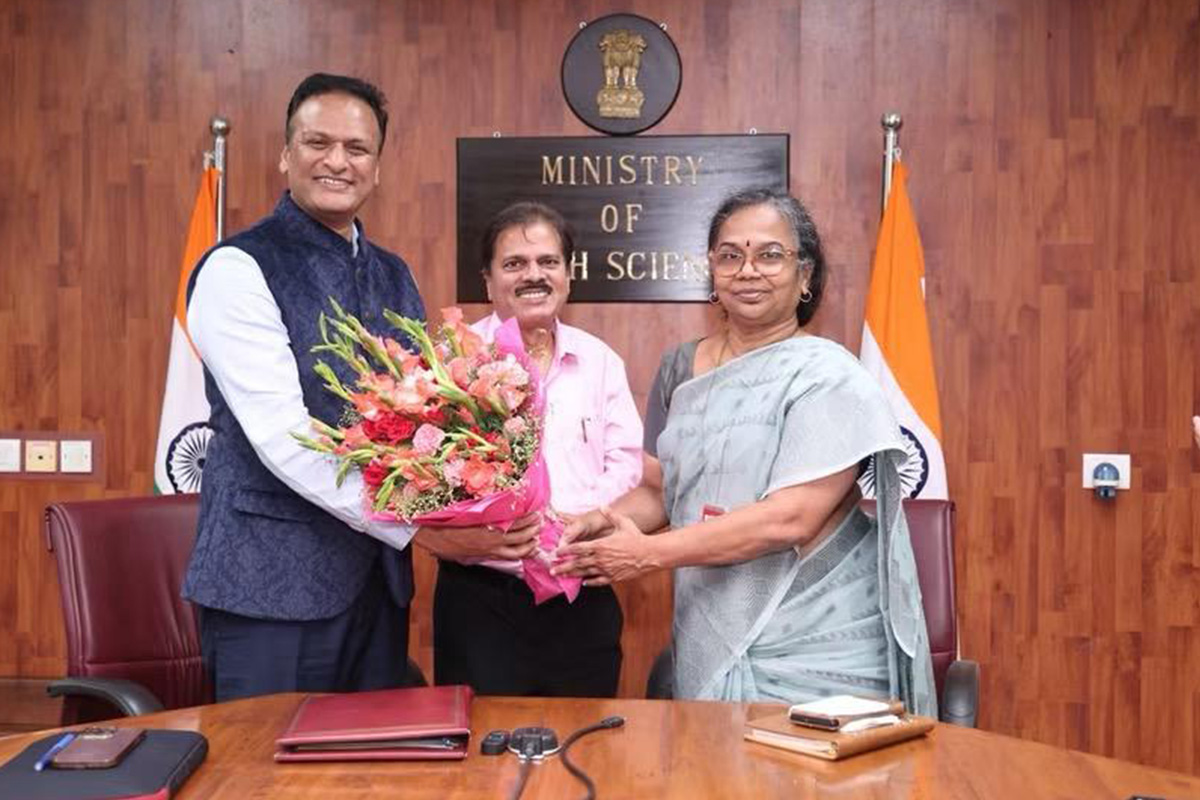
Dr T Srinivasa Kumar seen taking over charge from Dr N Kalaiselvi, (who held additional charge), DG, CSIR. (Photo | Special Arrangement)

Synopsis: The man who helped build India’s first Tsunami Warning Centre after the 2004 disaster is the new Secretary of the Ministry of Earth Sciences. He takes charge at a crucial time for India’s ocean and climate ambitions.
Think tsunami, and the first thing that comes to mind is the devastating ‘Boxing Day’ earthquake of December 26, 2004, which measured 9.1 in magnitude off the coast of Sumatra in Indonesia.
The massive quake unleashed a tsunami that wreaked havoc from the Andaman and Nicobar Islands to the Tamil Nadu coast and Visakhapatnam.
That unprecedented natural disaster led to the establishment of India’s first Tsunami Warning Centre in Hyderabad as part of ESSO-INCOIS.
The Project Director and scientist who helped set up this unique facility, which grew into a globally designated Tsunami Service Provider (TSP), was Dr Tummala Srinivasa Kumar.
On August 10, Dr Srinivasa Kumar, an eminent oceanographer and distinguished scientist, officially assumed charge as Secretary of the Ministry of Earth Sciences (MoES).
Coincidentally, it was in August 2020 that Dr Srinivasa Kumar took over as Director of ESSO-INCOIS (Earth Systems Science Organisation-Indian National Centre for Ocean Information Sciences). Under his stewardship, INCOIS significantly advanced its Potential Fishing Zone (PFZ) advisories, Coral Reef Bleaching Alert systems and multi-hazard vulnerability mapping.
Before taking over his present role as Secretary, Dr Kumar was Head of the UNESCO-IOC Secretariat for IOTWMS (Perth, Australia) from November 2024.
In that role, he oversaw the regional tsunami warning networks across 28 Indian Ocean Member States. He also led efforts to standardise ocean-watch operations globally and championed the implementation of the Tsunami Ready Community Recognition Programme.
Dr Kumar’s appointment comes at a time when India is aggressively scaling up its flagship Deep Ocean Mission, enhancing climate-modelling capabilities and fortifying its multi-hazard early-warning infrastructure, the Ministry of Earth Sciences noted in its press release.
He takes over from Dr N Kalaiselvi, who had been handling the responsibilities of MoES under an additional charge. The position was previously held on a full-time basis by Dr M Ravichandran.
Dr Kumar has over 25 years of experience across remote sensing, satellite oceanography, coastal hazard mitigation and disaster management. He brings a wealth of techno-managerial leadership at a vital juncture as India expands its scientific footprint across oceanography, polar research, meteorological disaster prevention and sustainable marine resource exploitation.
Dr Srinivasa Kumar, an alumnus of Andhra Loyola College, Vijayawada, and a PhD holder from Berhampur University, Odisha, began his career with ISRO in 1998, specialising in remote sensing and GIS (Geographical Information Systems) applications for oceans and coasts.
In March 2001, he joined INCOIS in Hyderabad. It was a fledgling institution, established under the Ministry of Earth Sciences in 1999 and led by K Radhakrishnan, who went on to become Chairman of ISRO. Dr Kumar was among the handful of scientists who joined. Several other scientists from the National Remote Sensing Agency (NRSA), Hyderabad, joined too.
From a small facility in the Nandagiri layout in Jubilee Hills, INCOIS moved to its own sprawling campus around 2005-06 in Nizampet, Hyderabad.
INCOIS made an impact with its advisories on Potential Fishing Zones (PFZ), which helped fishermen maximise their catch and minimise time and risks at sea. The advisories identified potential locations where ‘schools of fish’ gathered, based on remote-sensing imagery and interpretation by the scientists.
Sometime in mid-2001, I had a chance to cover an event at INCOIS at which the then Secretary of Earth Sciences, Dr Harsh K Gupta, was the chief guest. I first met Radhakrishnan, Srinivasa Kumar and the team, who were giving shape to the research activities of the Centre. I continued to report on its developments over time.
After a fruitful tenure of 15 years as Scientist and Head, Advisory Services, Satellite and Oceanography Group, Dr Kumar, as mentioned earlier, moved to Perth, Western Australia, to become Head of the UNESCO-IOC Secretariat for the Intergovernmental Coordination Group for the Indian Ocean Tsunami Warning and Mitigation System (ICG/IOTWMS).
An internationally recognised scientist, Dr Kumar won the National Geoscience Award in 2010 and the Indian National Geospatial Award in 2008. He has also authored over 100 peer-reviewed scientific publications in reputed international journals.
During his term, Dr Srinivasa Kumar will work to strengthen India’s observational networks, atmospheric modelling, deep-ocean exploration technologies and societal services to bolster climate resilience and ocean health across the region.
Also Read:
World Environment Day: Rising seas and sinking cities — a crisis looms over Tamil Nadu
(Edited by R Rajesh Kumar.)



