

Published Jun 24, 2026 | 7:15 AM ⚊ Updated Jul 03, 2026 | 10:57 AM

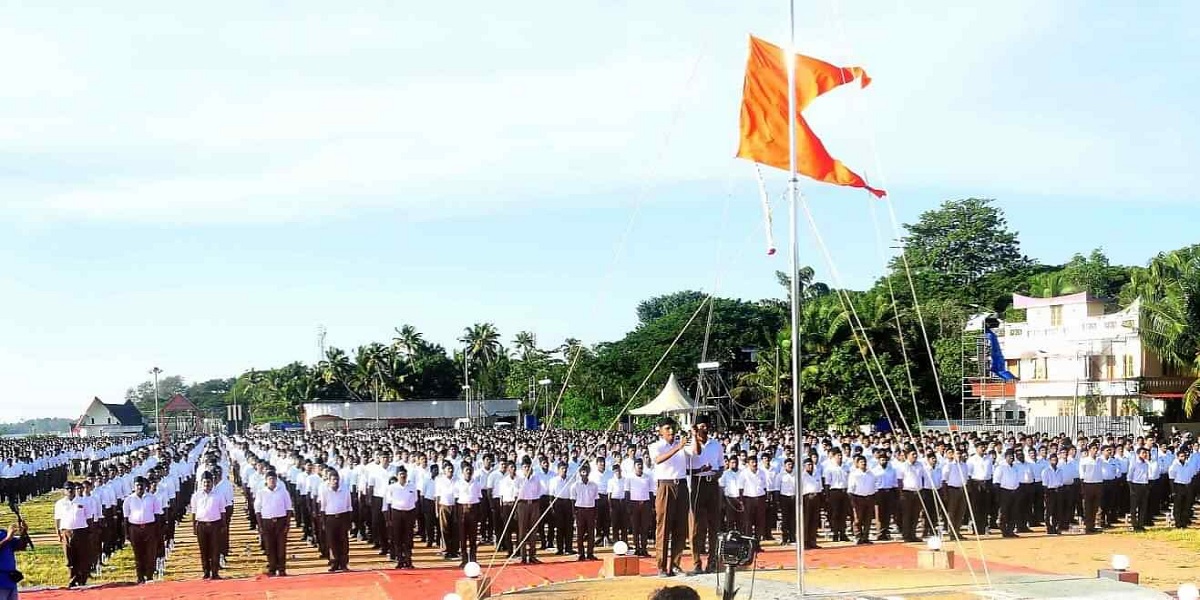
The disciplinary action comes nearly nine months after the event was held in November 2025. (File Photo)

Synopsis: The RSS’s influence on today’s politics may be all-encompassing, but it does not formally exist on paper. The Sangh is neither registered as a society nor as a trust or non-governmental organisation. With the controversial guru dakshina financial engine driving it, RSS calls itself a “movement totally nurtured by the people, one that has no parallel elsewhere”.
The Rashtriya Swayamsevak Sangh (RSS), the BJP’s ideological parent, is facing perhaps its greatest public scrutiny in decades following Karnataka Home Minister Priyank Kharge’s year-long efforts to force the more-than-100-year-old far-right Hindutva organisation to be more transparent about its operations, structure and funding.
Kharge’s repeated questioning of why the Sangh continues to operate without registration, despite its own admission that it runs an extensive network of shakhas across the country, has forced the Sangh and its affiliates to respond.
Recently, he escalated his campaign with a formal letter to RSS Chief Mohan Bhagwat seeking that the Sangh declare its legal status and organisational structure, sources of contributions and income, and the legal basis on which its activities are conducted without formal registration, among other details.
Bhagwat has maintained that he does not need to respond, claiming that “there are so many unregistered things going on, and we are not secretive. We are working in the open. We are calling people and telling them about the Sangh. This is politics, and all these gimmicks are being tried. We are used to it.”
Bizarrely, he also claimed that the Union government’s two past bans on the organisation, once after the assassination of MK Gandhi in 1948 and once during the Emergency in the 1970s, were themselves evidence of recognition by the state.
“We are used to it… Hindu Dharma is not registered. Many things are not registered… The government banned us twice, and those bans were lifted once by court order and again through Satyagraha. So the government knows the RSS exists. If they banned the RSS, it means they recognised its existence… All this is politics, nothing serious,” he said.
This line of reasoning was repeated by RSS ideologue S Gurumurthy, who claimed that when the first ban on the RSS was lifted, it was asked to submit a written constitution, but no government since then has required it to register.
“Even dissenters of RSS praise the RSS for its honesty and integrity. Only petty haters of RSS like Kharge question RSS on finance,” he wrote in a series of posts on X.
“Priyank Kharge seems illiterate in law. What is registration after all? Registration is evidence. RSS constitution, on the basis of which its ban was lifted, is a public document under Section 74 of the Evidence Act, of the existence of RSS and its purpose. Where is the need for registering RSS?”
Also Read: In Kerala’s Puthussery, an RSS worker’s attack on carolling children revives 25-year political feud
Under Indian law, organisations are typically constituted under recognised legal categories.
Broadly, these include non-profit entities such as trusts, societies and Section 8 companies; for-profit entities such as companies, limited liability partnerships and partnerships; political organisations such as registered political parties; cooperative societies; and special-purpose statutory bodies such as trade unions.
The RSS is neither incorporated as a society nor registered as a trust or non-governmental organisation. Instead, it describes itself as a “movement totally nurtured by the people, one that has no parallel elsewhere”.
In practice, the RSS functions through a decentralised network of thousands of affiliated or associated organisations operating across the country.
These include the BJP, its political arm; the ABVP, its student wing; the Bajrang Dal, its militant wing; the Vishwa Hindu Parishad, as well as organisations such as the Bharatiya Mazdoor Sangh and Seva Bharati, among others, collectively known as the “Sangh Parivar”.
An investigation led by Australian academic Felix Pal over six years through Sciences Po’s Centre de recherches internationales, and published by The Caravan, identified roughly 2,500 organisations with traceable ties to the Sangh.
They are often variously described as “affiliates”, “RSS-inspired” groups, “projects”, “sister organisations”, “allied organisations”, “RSS-related organisations”, “associate organisations” and “run” by the RSS.
Pal, writing for The Caravan, argues that this strategic distance from thousands of organisations affords the RSS “all sorts of benefits”:
“It can avoid legal or financial scrutiny. It can outsource its work and claim plausible deniability. It can manage internal tensions by accommodating contesting leadership claims. It can produce a type of segmented messaging, saying all things to all people at all times. Its organisations can be managed like a switchboard, their ties to the larger network activated and hidden as required.
“These elaborate but covert divisions of labour are critical parts of how the RSS expands into society. They ensure far-right presence in many sectors simultaneously, reaching diverse audiences, opening opportunities for constituency expansion and carving out new terrain for the Sangh.”
Legal scholar, lawyer and political commentator AG Noorani has similarly described these organisations as “fronts” in The RSS and the BJP: A Division of Labour:
“The RSS was established in Nagpur in September 1925, on Dussehra day. On October 21, 1951, it floated a political party, the Bharatiya Jan Sangh (BJS), with an eye on the first general election in 1952. The BJS dissolved itself on May 1, 1977 in order to merge with the Janata Party. On April 5, 1980 it was revived as the Bharatiya Janata Party.
“Meanwhile, Golwalkar had set up the Vishwa Hindu Parishad (VHP) in Mumbai on August 29, 1964. The VHP set up the Bajrang Dal in May-June 1984. The timing was significant – the VHP had passed a resolution in April 1984 for the ‘liberation’ of the site on which stood the Babri Masjid at Ayodhya. RSS men have been put in charge of all three organisations, the BJP, the VHP and the Bajrang Dal – Advani, Vajpayee, Murli Manohar Joshi of the BJP, Ashok Singhal of the VHP, and Vinay Katiyar, erstwhile organisation secretary of the ABVP, the parivar’s student front, of the Bajrang Dal. This trident of front organisations has led the RSS assault on Indian polity and society,” Noorani wrote in the book originally published in 2000, and reissued in 2020.
The RSS, for its part, has maintained that these organisations are independent and merely “inspired” by it.
Questions over the ambiguity surrounding the Sangh’s legal status date back to at least the 1970s.
During a set of legal proceedings initiated in that decade, the Sangh adopted various, and at times contradictory, positions about its own nature.
In his 2019 book The RSS: A Menace to India, Noorani writes that, around 1978-79, the RSS deceived courts and authorities in an effort to evade accountability:
“What emerged in the long-drawn litigation was the RSS’s proneness to lie and to deceive. It claimed before the Bombay High Court that it was ‘a charitable institution under Section 10(22) of the Income-Tax Act, 1961’ and before the Charity Commissioner that the ‘RSS is not a charitable trust but a political institution under Section 12(13) of the Bombay Public Trusts Act, 1950′. To the public at large it pretended to be a ‘cultural’ body. While the tax proceedings were on, it amended its constitution in order to avoid tax liability,” he wrote.
At the same time, RSS ideologue and future Prime Minister Atal Bihari Vajpayee was publicly insisting that the Sangh had “no political ambitions” and was “a cultural organisation”.
Also Read: How land reforms, Emergency saffronised Coastal Karnataka — and Congress’s failure
Like its unconventional organisational structure, the RSS has also managed to keep much of its funding apparatus out of public view. Central to this is guru dakshina, an annual contribution made by swayamsevaks.
S Gurumurthy, in response to Priyank Kharge’s letter to Bhagwat, claimed that he was part of the Sangh’s dealings with the income tax proceedings in the 1970s and asserted that the RSS “was regarded as Body of Individuals under the IT law”.
In a series of posts on X, he wrote: “As per the RSS constitution, individual shakhas are assessable as they are financially independent under RSS constitution. The guru dakshina of RSS is upheld as not taxable as RSS receives guru dakshina only from Swayamsevaks. Therefore, it is exempt on principles of mutuality which any first-year CA student knows. Priyank Kharge is illiterate in law, from evidence law to IT law.”
The principle of mutuality that Gurumurthy was referring to holds that money contributed and used by members for their common benefit is not taxable because an entity cannot generate income from itself.
The specific case Gurumurthy tweeted about was the Commissioner of Income-tax v. Rashtriya Swayamsevak Sangh (1994). In that case, the Patna High Court held that guru dakshina received by the RSS from its own members was exempt from income tax under the principle of mutuality because the contributors and beneficiaries were the same group.
Crucially, however, the High Court limited its decision to contributions received from members and expressly removed references to “devotees”, meaning the exemption did not extend to money received from non-members.
The judgment was the culmination of a two-decade-long legal wrangle.
In The RSS: A Menace to India, AG Noorani details a separate case brought in 1978 by MG Kambdar, an RSS member who sought to compel the organisation to register as a public trust under the Bombay Public Trusts Act.
According to Noorani, Kambdar alleged that the RSS had altered its constitution in the 1970s specifically in response to legal scrutiny. He also alleged that although the RSS claimed not to have had a constitution before 1949, a constitution dating back to 1933 did in fact exist.
The 1949 RSS constitution, drafted after the Congress government required the organisation to explicitly affirm its loyalty to the Constitution of India and respect for the national flag as a condition for lifting the ban on it, was itself amended in 1972.
Among those amendments was the formal recognition of guru dakshina and its allocation to individual shakhas. Whereas Article 22 of the 1949 constitution stated that “all offerings, gifts, donations, etc. received for Sangh purposes by the branches, shall constitute the Sangh Funds”, the 1972 amendment specified that guru dakshina received by each shakha would instead “constitute the funds of that Shakha”.
According to Noorani, these changes were made during litigation in the 1970s and on legal advice, effectively decentralising financial liability by passing it on to individual shakhas.
Recently, Vishwa Hindu Parishad president Alok Kumar claimed that the RSS does not accept outside funding and that courts have already settled the issue of guru dakshina’s tax status.
“Guru Dakshina is held once a year within the RSS. It does not accept outside funds for its work…the Income Tax Department, in 1967-68 and 1975-76, issued orders by the assessing officer that the RSS must pay tax on its income…in both cases, the High Court ruled that income from Guru Dakshina is not subject to income tax under mutual trust laws…he wants to tarnish the image of RSS with a light-hearted attack…Congress has been trying to level false accusations against the RSS since the assassination of Mahatma Gandhi in 1948,” he told ANI.
In The RSS: A Menace to India, however, Noorani writes that guru dakshina may ultimately prove to be one of RSS founder KB Hedgewar’s ingenious innovations. He cited the RSS’s own mouthpiece, the Organiser, to make his point:
“Dr. Hedgewar evolved another innovative method that is ‘Guru-Dakshina‘. Sangh decided that it will not ask (for) donation from anybody. Nor is there any membership fee. Each Swayamsevak once in a year would pay back to the Guru (preceptor) with a sense of gratitude. The Guru is also not any individual but the symbol of purity, sacrifice and valour, Bhagwa Dhwaj (Saffron Flag)…
“Money contributed with a sense of gratitude was really beneficial for Sangh functioning as RSS remained self-reliant and autonomous. Today there are many Swayamsevaks who can contribute lacs of rupees; no one except the shakha-level office bearer comes to know about these amounts.”
The result, Noorani writes, is that the Sangh is not only the “richest organisation in the country”, but its political department (the BJP) is the richest in the field.



