


Published Mar 24, 2026 | 6:19 PM ⚊ Updated Mar 24, 2026 | 6:19 PM

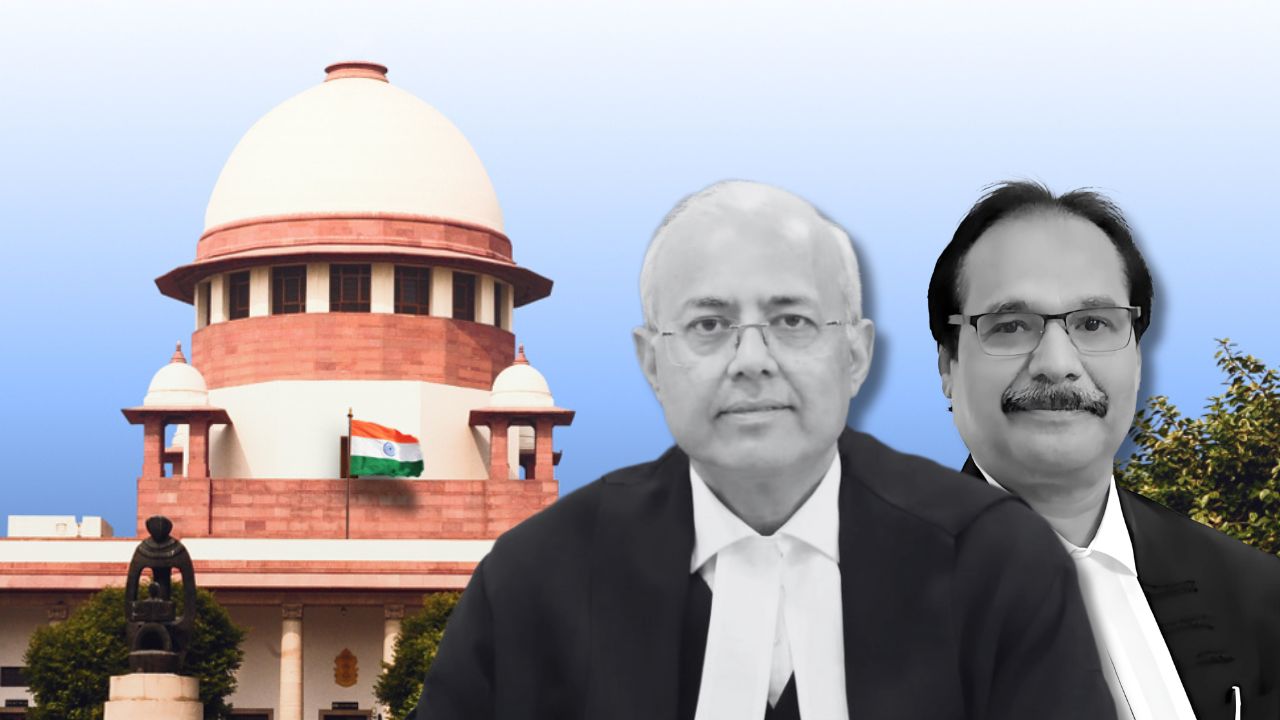
Judges Prashant Kumar Mishra and Manmohan.
Synopsis: The Supreme Court has ruled that a person born into a Scheduled Caste loses that status on converting to a religion other than Hinduism, Sikhism or Buddhism, and cannot access protections or benefits meant for SC communities. The court said the law addresses caste-based disabilities within Hindu society, and held that these disabilities cease after conversion, so the protections do not apply.
The Supreme Court has ruled that a person born into a Scheduled Caste (SC) loses that status on converting to a religion other than Hinduism, Sikhism or Buddhism, and becomes ineligible for statutory protections and benefits reserved for SC communities.
Citing the Constitution (Scheduled Castes) Order, 1950, the court said such conversion leads to the “immediate and complete loss” of Scheduled Caste status. It added that converts cannot access any statutory benefit, protection or reservation under the Constitution or laws enacted by Parliament or state legislatures for SC communities.
A two-judge bench of Justice Prashant Kumar Mishra and Justice Manmohan delivered the judgment on 24 March. It upheld an earlier order of the Andhra Pradesh High Court in Chinthada Anand v State of Andhra Pradesh and Others.
The case arose from a petition by six accused seeking to quash proceedings against them under the Scheduled Castes and Scheduled Tribes (Prevention of Atrocities) Act.
Booked for alleged assaults, caste-based abuse and death threats against the respondent, a Christian pastor who had converted from the Hindu Madiga community, the petitioners argued that the complaint was not maintainable under the Act because the complainant, after converting to Christianity, could no longer be treated as a member of a Scheduled Caste.
In its judgement, the court noted:
“In the present case, the facts are unequivocal. The appellant has been serving as a Pastor for the past ten years. The appellant’s occupation and conduct over this extended period constitute an open and public declaration of his Christian faith. Clause 3 of the Constitution (Scheduled Castes) Order, 1950 is categorical and unambiguous in its terms. It provides that notwithstanding anything contained in Clause 2, no person who professes a religion different from Hindu, Sikh, or Buddhist shall be deemed to be a member of a Scheduled Caste.”
“The appellant professes Christianity, which is not among the three religions specified in Clause 3. Irrespective of the appellant’s caste of origin, he cannot be deemed to be a member of a Scheduled Caste. However, the learned counsel for the appellant has sought to challenge this position by placing reliance on certain State Government Orders.”
The Supreme Court agreed with the Andhra Pradesh High Court’s earlier finding that the protections of the SC/ST Act could not be invoked in this case.
The High Court said the caste system is “alien” to Christianity, and a person who had converted and was serving as a pastor could not claim the Act’s safeguards.
“The SC/ST (Prevention of Atrocities) Act is a protective legislation introduced for preventing atrocities against members of Scheduled Castes and Scheduled Tribes. In the present case, the 2nd respondent has misused the protective legislation though he is not entitled to invoke the provisions of the Act,” the HC order held.
“The 2nd respondent had voluntarily converted to Christianity and was admittedly working as a Pastor in a Church for the last 10 years as on the date of incident. Thus, the 2nd respondent cannot be permitted to invoke the provisions of the protective legislation,” the High Court said.
The court said the invocation of the SC/ST (Prevention of Atrocities) Act in this case was itself “illegal”.
“It is also held that filing of charge sheet, in spite of the categorical statements of the listed witnesses specifically stating that the 2nd respondent is working as a Pastor for the last 10 years, the police could not have laid a charge sheet charging the petitioners for alleged offence under Sections 3(1)(r), 3(1)(s), 3(2)(va), SC/ST (Prevention of Atrocities) Act. Similarly, except for the listed witness Nos. 1 and 3, no other witness speaks about the altercation involving 30 people.”
The Supreme Court said the SC/ST (Prevention of Atrocities) Act is meant to protect vulnerable communities from caste-based discrimination and violence. Referring to a three-judge bench decision in C M Arumugam, it said these protections address the “social and economic disabilities” faced by Scheduled Castes, particularly in rural areas.
“It is the orthodox Hindu society still dominated to a large extent, particularly in rural areas, by medievalistic outlook and status-oriented approach which attaches social and economic disabilities to a person belonging to a scheduled caste and that is why certain favoured treatment is given to him by the Constitution. Once such a person ceases to be a Hindu and becomes a Christian, the social and economic disabilities arising because of Hindu religion cease and hence it is no longer necessary to give him protection and for this reason he is deemed not to belong to a scheduled caste…”
The court also referred to earlier rulings, including Guntur Medical College v Y Mohan Rao and M Chandra v M Thangamuthu, to set out who can be recognised as a member of a Scheduled Caste under the Constitution.
“the Constitution (Scheduled Castes) Order was issued in 1950. It sets out the castes, races and tribes in each State of India and provides under Para 2, that a person belonging to any of the castes specified therein be deemed to be a Scheduled Caste for the purpose of the Constitution. Para 3 contains a proviso to the effect that notwithstanding anything contained in Para 2, no person who professes a religion different from the Hindu, Sikh or Buddhist religion shall be deemed to be a member of a Scheduled Caste. Reading Paras 2 and 3 of the Presidential Order would show that if a person belongs to a caste which is notified in the Schedule to the Presidential Order he/she would have the status of a Scheduled Caste, provided he/she professes Hinduism or one of the other religions specified in Para 3 of the Order.”


