

Published Jul 13, 2026 | 7:00 AM ⚊ Updated Jul 13, 2026 | 7:00 AM

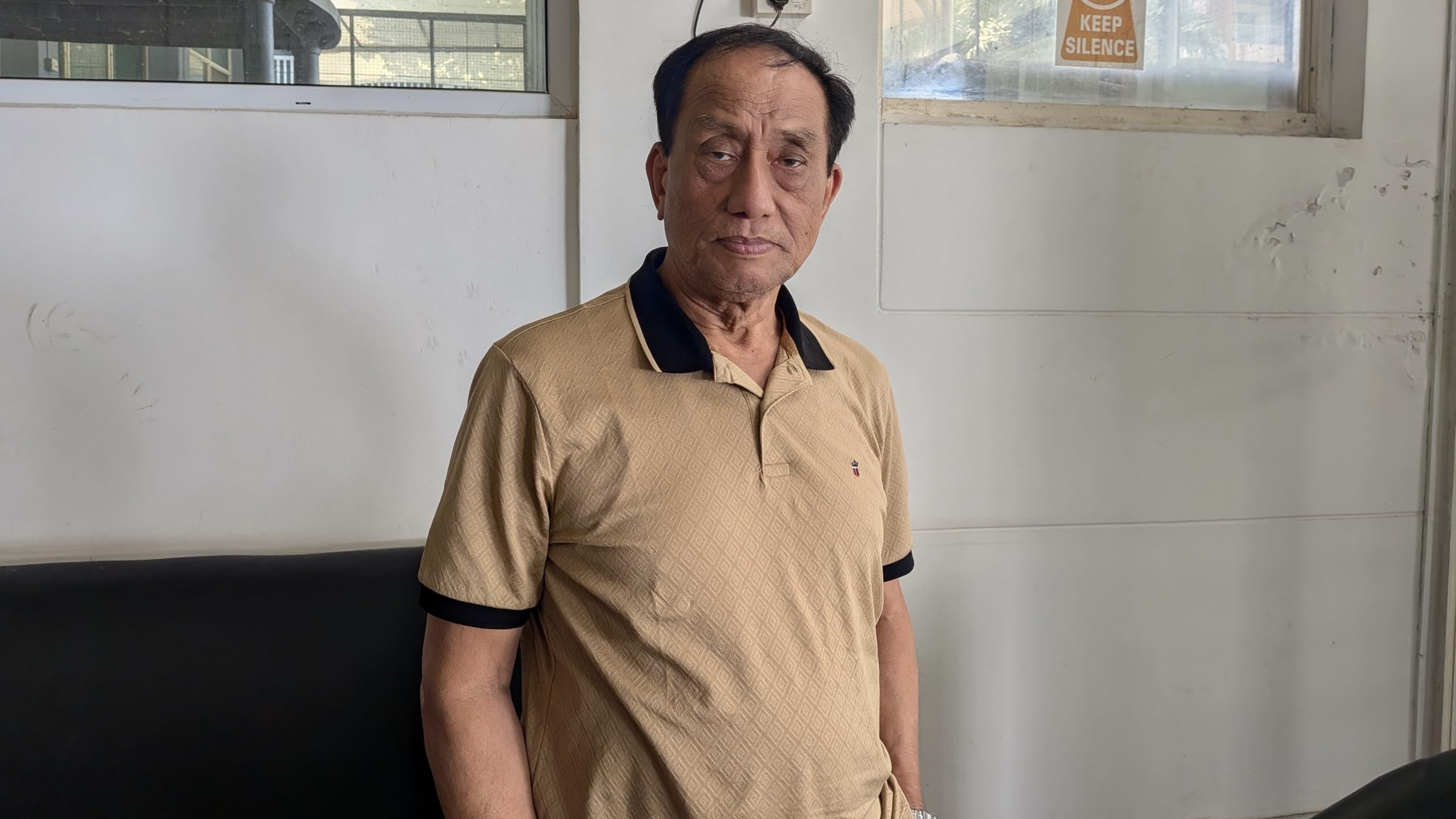
Meghen, once one of Manipur's most prominent insurgent leaders, headed the United National Liberation Front (UNLF).

Synopsis: Former United National Liberation Front (UNLF) chairman RK Meghen has called for a united, civilian-led effort to end the violence in Manipur, saying coexistence is the only sustainable path for the state’s future and urging dialogue across communities. In a conversation with South First, he said that delayed security intervention allowed the conflict to spiral and that many people have lost faith in the state’s response.
Nearly three years after ethnic violence erupted between the Meitei and Kuki-Zo communities in Manipur, former United National Liberation Front (UNLF) chairman RK Meghen has appealed for a collective, civilian-led effort to restore peace, arguing that the conflict has entered a dangerous cycle that threatens generations to come.
The violence, which began on 3 May 2023 has claimed hundreds of lives and displaced more than 1.5 lakh people. Entire villages remain segregated by buffer zones, while armed groups continue to carry out sporadic attacks despite the heavy deployment of central security forces.
Meghen, once one of Manipur’s most prominent insurgent leaders, headed the United National Liberation Front (UNLF), one of the state’s oldest Meitei insurgent organisations that sought an independent Manipur.
Arrested in 2010 after years underground, he has since emerged as a voice advocating dialogue and political engagement. His latest outreach focuses on uniting Manipuris across community lines.
Speaking to South First during a visit to Bengaluru, Meghen said he was not representing any organisation but had come on a personal initiative to engage with the Manipuri diaspora. His objective, he said, was not to debate politics or armed movements but to build a common humanitarian response.
“The violence has reached a level where the communities will be at risk for a long time to come… not just the present generation, their children, and the subsequent generations will be affected if this violence continues,” he said.
Also Read: Lakshadweep admin axes key degree programmes on eve of admissions, leaves students in limbo
The violence began after a Tribal Solidarity March organised to oppose the possible extension of Scheduled Tribe status to the Meitei community, a demand that followed an April 2023 Manipur High Court order directing the state government to consider recommending such status to the Centre.
The conflict has since seen recurring armed clashes, killings, arson, sexual violence and mass displacement, with both communities accusing each other of attacks.
Meghen was critical of the Centre’s and the state’s handling of the crisis.
He argued that the violence could have been contained had central forces such as the CRPF been deployed immediately when clashes broke out, rather than in the days that followed. “If it was stopped from the very beginning… it wouldn’t have taken five hours,” he said, adding that the delay allowed the conflict to spiral out of control.
Many ordinary citizens, he said, now doubt whether the authorities were “sincere enough to stop the violence.”
The view that a faster, more decisive central deployment could have prevented the crisis from escalating is not Meghen’s alone. It has been echoed by opposition leaders and civil society groups in Manipur, who point to the initial breakdown of law enforcement, including reports of police armouries being looted in the early days, and what they describe as an uneven and delayed security response as the violence rapidly escalated.
The Union and state governments, for their part, have maintained that the situation was logistically and ethnically complex and that it progressively worsened as the crisis unfolded.
While acknowledging competing political demands, Meghen argued that coexistence remains the only sustainable path forward. According to him, the Kuki demand centres on separate administration, while Meiteis primarily seek an end to the violence.
“They want interdependent coexistence. That interdependent coexistence… is the historical necessity for survival for every community,” he said.
Rejecting further militarisation as the solution, Meghen distinguished between armed groups and civilians, stressing that ordinary people across communities are suffering equally.
“Common people are suffering. On both sides. Common people have lost many lives,” he said.
He revealed that he has begun meeting leaders from different communities separately, hoping those conversations could eventually pave the way for broader dialogue.
“Time has not yet come to sit together. It is just the beginning,” he said.
For Meghen, the conflict has become larger than competing territorial claims or political aspirations.
“The people of Manipur should unite, in a single voice. They have a future only in interdependent coexistence. It is a historical necessity, no choice, no alternative,” he said.
His appeal, directed at both the diaspora and those still living in Manipur, is for a unified democratic voice calling for an immediate end to the violence before deeper social divisions become irreversible.



