

Published May 25, 2026 | 10:17 PM ⚊ Updated May 25, 2026 | 10:17 PM

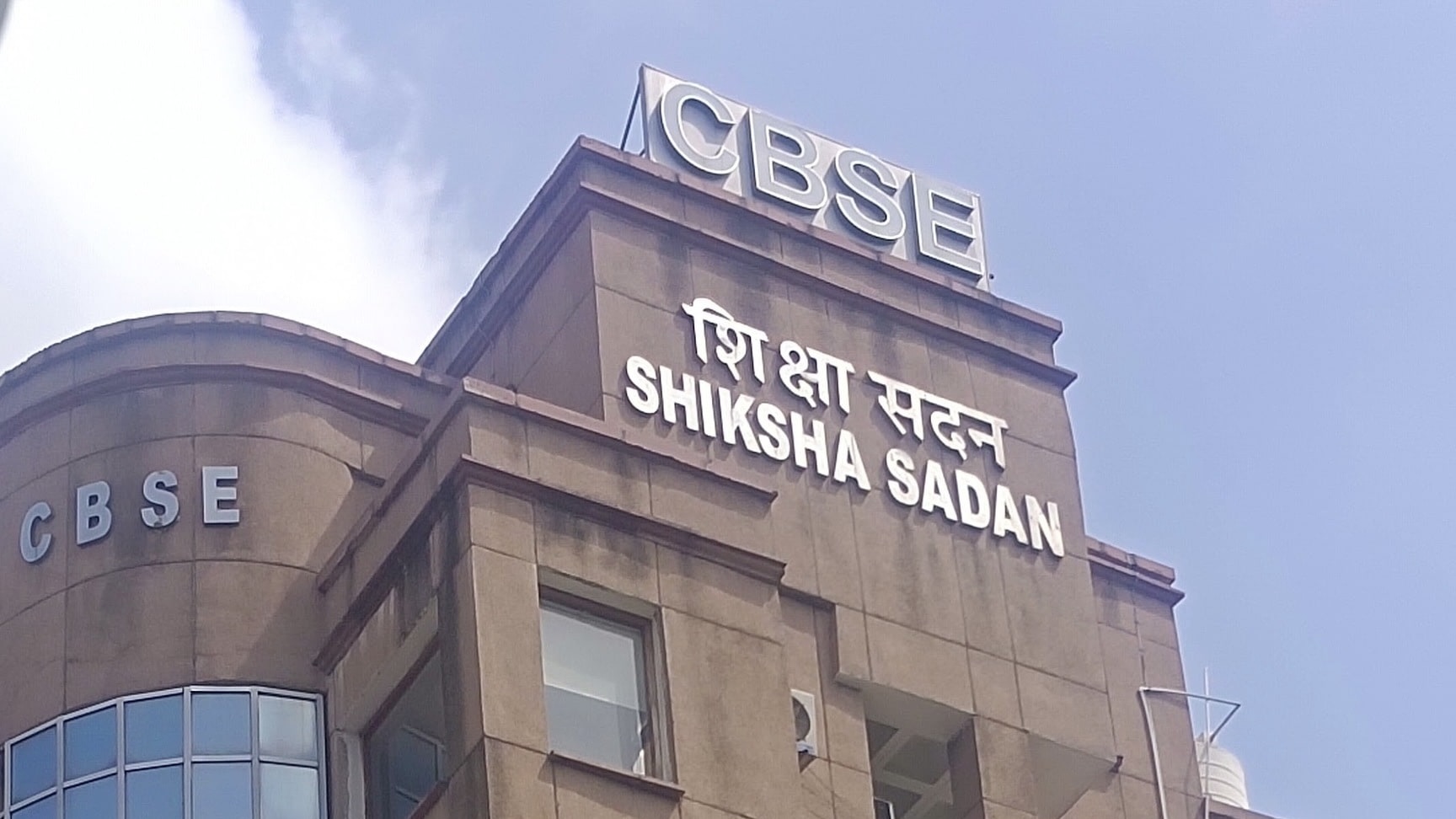
A technological upgrade has snowballed into one of the biggest post-result controversies CBSE has faced.

Synopsis: A digital overhaul of India’s Class 12 CBSE examinations has triggered a nationwide crisis. CBSE’s new On-Screen Marking (OSM) system, deployed across 98 lakh answer scripts, left students with blurry scans, unchecked answers, and, in some cases, answer sheets that do not match their handwriting. Students and parents are questioning the reliability of the board’s digital assessment overhaul.
Teenager Vedant Shrivastava sacrificed sleep, outings and peace of mind for an entire year preparing for the Central Board of Secondary Education (CBSE) Class 12 board examinations held from 17 February to 9 April 2026.
Today, he stands accused of being a ‘Pakistani’, a taunt once used to denote unpatriotic people, but now liberally used by right-wing ultranationalists to silence those criticising the political establishment.
The boy doesn’t deserve to be branded as a ‘Pakistani.’ His “fault” was pointing out a flaw in the CBSE exam reform that has left him — and many other students — devastated.
Vedant was confident of scoring well in Physics. However, when the results were declared on 13 May, he was shocked. The score was not what he had expected.
Convinced something had gone wrong, he applied for a scanned copy of his evaluated answer sheet through the board’s re-evaluation process.
The scanned copy he received left the boy aghast.
Also Read: India’s exam system has reached a breaking point after NEET fiasco
“The Physics answer sheet uploaded by CBSE is not mine,” Vedant posted on X. “I know this is not my handwriting, and it did not have the questions I attempted.”

Vedant alleged that while the English and Computer Science answer books matched each other, the Physics paper did not.
Vedant said his English and Computer Science answer sheets matched his writing style, while the Physics script looked entirely different.
“This is no longer just a rechecking issue,” he wrote. “This may be a serious answer-sheet exchange or tagging error in CBSE’s OSM system.”
The post made him ‘Pakistani,’ since his X handle emerged only recently.
Vedant’s brother Siddhant Srivastava explained the sudden emergence of his brother’s X handle. “Yes, Vedant did not have Twitter [sic] because he was busy studying instead of tweeting,” he posted on X.
Vedant was not alone. Across social media platforms, thousands of students and parents have raised concerns over unexpectedly low marks, allegedly mismatched answer sheets, unreadable scanned copies, and technical failures linked to CBSE’s newly introduced On-Screen Marking system.
I am a CBSE Class 12 student.
After receiving unexpectedly low marks in Physics, we applied for photocopies of my answer sheets through the CBSE reevaluation process.
Today we received the copies.
And I am shattered because the Physics answer sheet uploaded by CBSE is not mine
— VEDANT (@VEDANTSHRIV17) May 23, 2026
What began as a technological upgrade meant to modernise evaluation has now snowballed into one of the biggest post-result controversies CBSE has faced in recent years.
Also Read: Student branded ‘Pakistani’ after alleging answer-sheet mix-up
On-Screen Marking — or OSM — represents a major shift from the traditional system where teachers physically checked paper answer booklets.
Under the new system, students still write exams by hand. Answer sheets are transported to regional CBSE centres where they are scanned into high-resolution digital PDF files. Student identity details are digitally masked to prevent evaluator bias. These anonymised scripts are then uploaded onto a secure online platform and distributed randomly to evaluators across the country.
A teacher in Delhi can now assess a paper written by a student in Hyderabad or Chennai. Evaluators log into the system, review answers digitally, and award marks question by question, while the platform automatically calculates the total marks.
CBSE implemented the system for more than 98 lakh answer sheets during the 2026 Class 12 examinations, describing it as a move aimed at improving transparency, consistency, and reducing manual calculation errors.
Also Read: CBSE’s mental health push signals a shift in schools defining success
The controversy erupted almost immediately after the results were declared.
Students, particularly from Physics, Chemistry, Mathematics, and Accountancy streams, began reporting receiving low marks significantly below expectations and inconsistent with their academic record.
Reshmi, a Class 12 student who appeared for the examinations this year, said she began noticing complaints flooding social media platforms shortly after the results were announced.
“On X and Instagram, there are multiple videos where students are complaining that their answer sheets were not evaluated properly,” she told South First.
“When I was preparing for my boards, I had no idea that such a system was being introduced. Later, I came to know that answer scripts were being checked online and on computers,” the student said.
Reshmi pointed to the case of one of her relatives, a consistently high-performing student whose marks dropped sharply this year.
“One of my relatives scored around 96% in Class 10, which is why he opted for the Science stream. But this year he got only 83%. He is extremely disappointed because he genuinely deserved above 95%. He has always been a bright student,” she said.
Also Read: CBSE pushes ‘sugar boards’ in schools
Reshmi felt the sudden shift to digital evaluation may have created difficulties for evaluators unfamiliar with online systems.
“The people checking answer sheets belong to our parents’ generation. Many of them may not be fully comfortable using digital platforms or computers,” she said.
“It could be one of the reasons why so many students lost marks this year. I do not think the online evaluation system is working properly,” Reshmi did not hide her disappointment.
The student added that she was not blaming the evaluators, but questioned whether adequate preparation and training had been provided before rolling out such a major change.
“If the government really wanted to introduce an online system, teachers should first have been trained properly to use these digital platforms and basic computer systems,” she said.
“At least give them classes before implementing something like this. Right now, students are being treated like laboratory mice,” the student fumed.
Reshmi said board examination marks shape students’ academic future in India and should not become a tool for experimentation.
“Class 12 results are important for everything — from JEE to NEET, every major entrance process looks at these marks,” she said.
“People may never ask for your birth certificate, but they will definitely ask for your Class 10 and Class 12 results. Hence, the government should not have experimented with something this important,” Reshmi said.
Incidentally, the issue Reshmi referred to came close on the heels of the latest NEET gaffe.
Also Read: NEET UG-2026 cancelled after paper leak row
When CBSE opened its portal, allowing students to download scanned copies of evaluated answer sheets, complaints intensified further.
Several students alleged that the PDFs they received were blurry, pixelated, or partially unreadable. Many of them questioned how evaluators had assessed such documents if the scans were difficult to read.
The Union Education Ministry later acknowledged that around 13,000 answer sheets were found to be completely illegible on screen, primarily because students had used light-coloured ink or pencils for diagrams. It said such scripts were sent for manual evaluation.
However, students began asking a larger question: how many partially blurred or poorly scanned answer sheets may still have been evaluated digitally without being flagged?
Others reported missing marks for lengthy calculations, multi-page answers, and diagrams that appeared untouched by evaluators.
Another student, Sanjana, claimed that the Chemistry answer sheet uploaded by CBSE did not match her handwriting or responses to the questions.
“I applied for CBSE revaluation. The scanned copy of my Chemistry sheet I received does not match my handwriting or written responses,” she posted on X, attaching another answer sheet for comparison.
I applied for CBSE revaluation. The scanned copy of the chemistry sheet I received does not match my handwriting or written responses.
For reference, I am attaching my English answer sheet, which clearly reflects my actual handwriting. pic.twitter.com/laINaEMAP3— Sanjana (@Sanjanaopxe) May 25, 2026
Vedant’s case drew particular attention because he publicly compared the handwriting across subjects and alleged that the Physics paper uploaded under his roll number belonged to someone else.
“If this is true, then what exactly was evaluated under my roll number? My paper or someone else’s?” he asked.
The controversy soon expanded beyond marks and answer sheets.
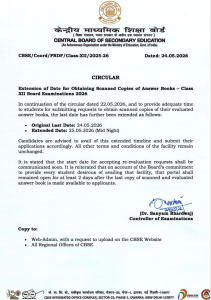
CBSE circular extending the deadline for getting answer sheets.
As lakhs of students attempted to apply for verification, rechecking, and scanned copies through CBSE’s online portal, the system struggled to handle the traffic.
Students reported repeated server crashes, failed payment transactions, authentication issues, and delays in application processing. Several claimed that money was deducted from their accounts even though their applications were not successfully submitted.
For many students applying to universities with strict deadlines, each technical failure added to their anxiety.
The issue escalated. Union Education Minister Dharmendra Pradhan reportedly intervened directly.
Technical experts from the Indian Institute of Technology-Madras and the Indian Institute of Technology-Kanpur were roped in to stabilise the digital infrastructure, while four public sector banks were involved to address payment gateway problems.
CBSE extended the deadline for obtaining scanned answer sheets twice within three days. An official circular signed by Controller of Examinations Dr Sanyam Bhardwaj extended the deadline until midnight on 25 May 2026, stating that the move was intended to provide “adequate time to students for submitting requests.”
However, the board did not immediately clarify when the re-evaluation process would begin.
The controversy swirled against the backdrop of a noticeable decline in CBSE Class 12 performance statistics this year.
The overall pass percentage stood at 85.20%, down from 87.98% in 2024.
Girls outperformed boys by 6.73 percentage points, recording a pass percentage of 88.86% compared to 82.13% among boys. Transgender candidates achieved a 100% pass rate.
Nearly 94,000 students scored above 90%, while more than 17,000 crossed the 95% mark. At the same time, over 1.63 lakh students, approximately 9.26% of candidates, were placed in the compartment category.
CBSE conducts compartment exams for students who have failed the Class 10 and 12 exams.
Continuing its policy aimed at reducing unhealthy competition, CBSE did not release an official topper or merit list. Instead, merit certificates are being issued digitally through DigiLocker to the top 0.1% of performers in each subject.
The supplementary examination for compartment candidates and students seeking improvement in a single subject is scheduled for 15 July 2026.
Reshmi said the controversy has had a particularly severe emotional impact on students already under pressure regarding admissions and career choices.
“You never really know your full capability if marks suddenly drop like this,” she said. “Students work hard for years, and then one sudden change in the system affects everything.”
She also pointed to the challenges faced by Arts students, who already deal with social stereotypes about their academic stream.
“People already think the Arts subjects are easy. So if students start getting low marks even there, it becomes a very serious issue,” she said.
“A lot of juniors from my stream are now just borderline pass. It is bad because this is the stage where they have to apply for admission in colleges,” Reshmi added.
Meanwhile, students like Vedant are demanding answers.
He has publicly urged CBSE to verify his original physical answer sheet, audit the OSM tagging and scanning process, and investigate whether answer sheets were exchanged during digitisation.
(Edited by Majnu Babu).



