

Published Nov 12, 2026 | 11:56 AM ⚊ Updated Nov 12, 2026 | 12:32 PM

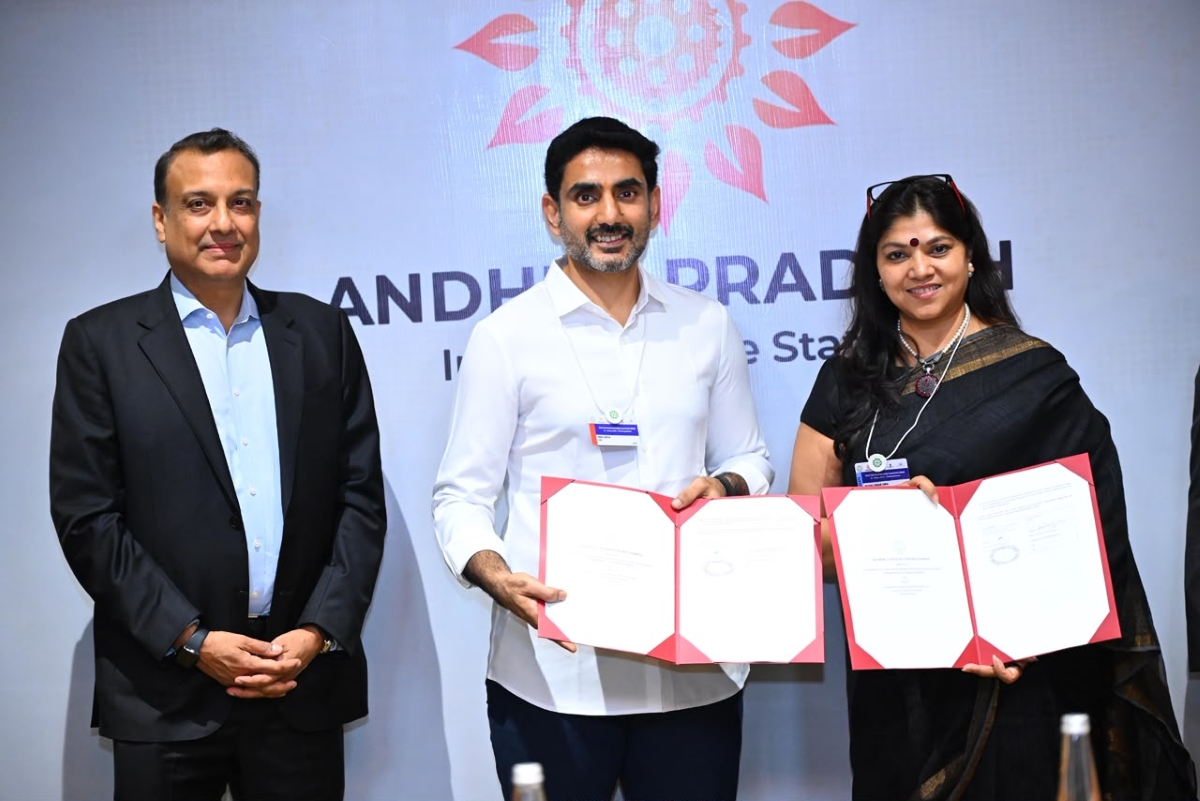
ReNew has signed an agreement to invest ₹29,500 crore

Ahead of the upcoming CII Partnership Summit in Visakhapatnam, key projects in the renewable energy and battery manufacturing sectors are being finalized, with massive investments pouring into Andhra Pradesh.
While ReNew has signed an agreement to invest ₹29,500 crore to set up two more mega projects in the state, an Indo-South Korean joint venture in the battery raw materials industry, worth ₹4,000 crore, is set to be established in Naidupeta, Tirupati district.
The combined investment value of these two projects stands at ₹33,500 crore.
The agreement for these new investments was reached during a meeting held in Visakhapatnam between Minister Nara Lokesh and ReNew Chairman and CEO Sumant Sinha.
Under this, ₹12,500 crore will be invested in a 2-gigawatt (GW) pumped storage project, and ₹17,000 crore in a green ammonia and e-fuel project.
Additionally, ReNew has agreed in principle to set up a polysilicon and metallurgical-grade silicon project in Andhra Pradesh at an investment of ₹11,000 crore. Once this project materializes, the total new investment proposals announced by ReNew will reach ₹40,500 crore.
Also Read: Visakhapatnam gears up for 31st CII Partnership Summit; delegates from 58 nations to attend
Meanwhile, ReNew is already making massive investments in the state. It is constructing the country’s largest hybrid renewable energy project in Guntakal at a cost of ₹22,000 crore, featuring 1.8 GW of solar, 1 GW of wind power, and 2 gigawatt-hours (GWh) of battery storage capacity.
In August, the State Investment Promotion Board (SIPB) approved the establishment of a 1,000-megawatt (MW) green data center in Makavarapalem, Anakapalli district, at a cost of ₹85,200 crore.
The foundation stone was also laid for a 6.5 GW ingot and wafer manufacturing plant in Rambilli worth ₹4,200 crore. Furthermore, ReNew announced plans to undertake a 2 GW pumped storage project, a green ammonia plant with an annual capacity of 300 kilotons, and 5 GW of hybrid projects.
This industry will be established across 230 acres in Naidupeta, Tirupati district, under the name Carbon Cosmo Advanced Materials Private Limited. India’s Carbon Resources Private Limited and South Korea’s Cosmo AM&T are jointly undertaking this project.
The facility will manufacture ferric phosphate and lithium iron phosphate (LFP) cathode materials, which are crucial for electric vehicles and lithium-ion batteries. To be built in three phases, the first phase of this industry will become operational by mid-2028, producing 30,000 tons per annum of each of the two products.
Upon completion of the three-phase expansion by 2031, the plant will produce 1.8 lakh (180,000) tons of ferric phosphate and another 1.8 lakh (180,000) tons of lithium iron phosphate annually. Approximately 1.3 lakh (130,000) tons of these products are expected to be exported abroad. This industry will generate direct employment for 700 people and indirect employment for 3,500 to 5,000 people.
Also Read: Andhra Pradesh tops India’s aqua exports; new challenges emerge despite rising revenue
Minister Nara Lokesh suggested giving priority to technological research alongside battery manufacturing. He requested setting up a dedicated laboratory in collaboration with IIT Tirupati for research on battery quality testing and recycling technologies to recover valuable materials from used batteries.
He also urged ReNew to partner with the solar cell prototyping center to be established at IIT Tirupati in collaboration with the University of New South Wales.
ReNew began its operations in Andhra Pradesh in 2015 with a 24 MW wind power project in Kalyandurgam. Currently, it operates 717 MW of wind and 60 MW of solar power projects across ten locations in the state.
The government aims to transform Andhra Pradesh into a key industrial hub in the country by attracting investments in electric vehicles, batteries, solar equipment, and green energy manufacturing sectors. Once implemented, these projects will bring significant benefits to the state in terms of employment, exports, and technological advancement.
(Edited by Sumavarsha)



