

Published Nov 11, 2026 | 12:09 PM ⚊ Updated Nov 11, 2026 | 12:09 PM

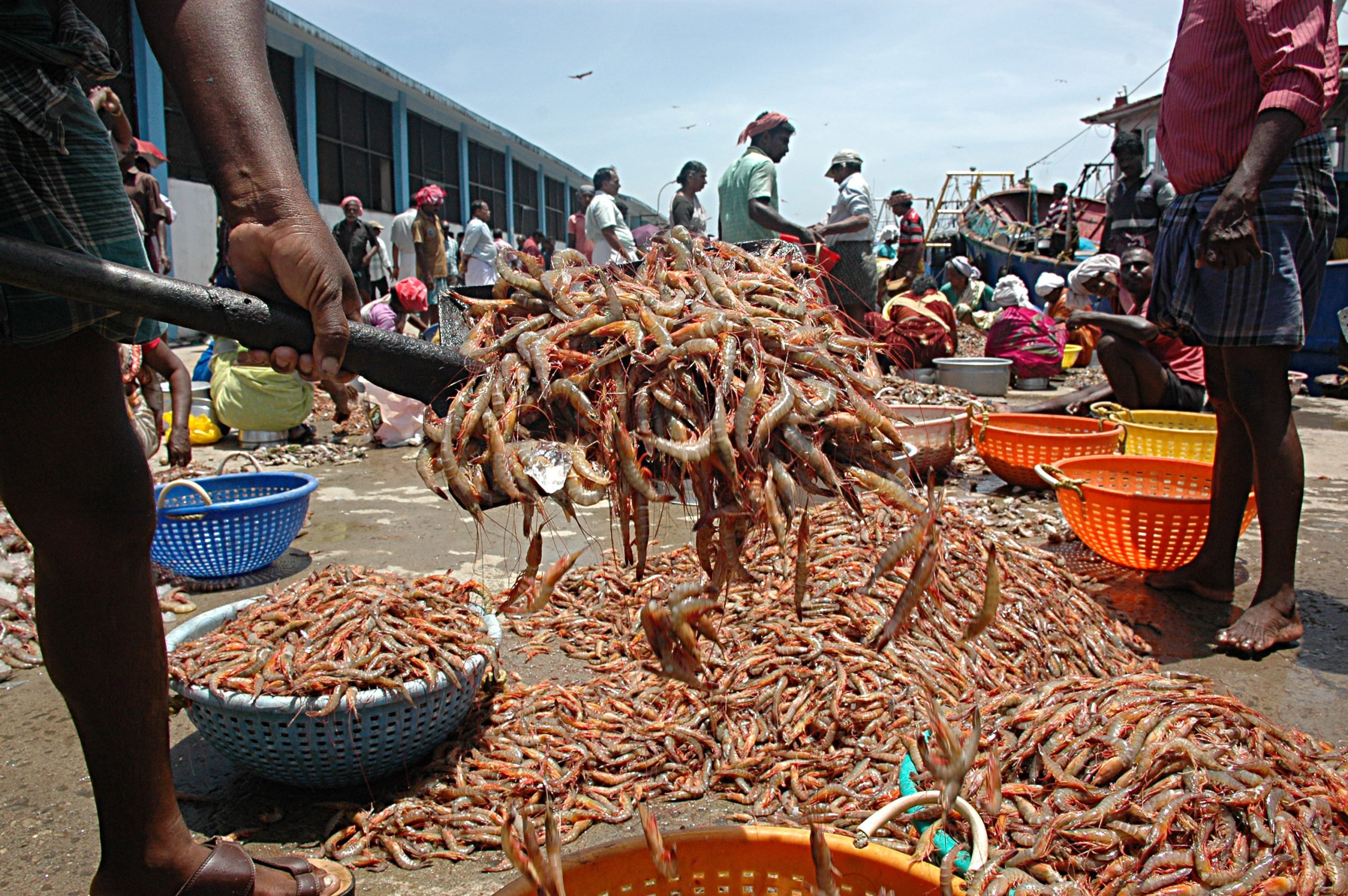
Frozen shrimp accounts for the largest share of Andhra Pradesh's aqua exports.

Despite facing international trade challenges such as restrictions, import duties, and strict quality standards, Andhra Pradesh has retained its top position in India’s marine product exports.
Nearly one-third of the country’s total marine export revenue comes from the state.
Although record exports were registered in the 2025-26 financial year, the volume of products exported from Andhra Pradesh declined during the first seven months of the current financial year, while revenue in US dollar terms also fell.
Notably, the export value in rupees increased during the same period, driven by the falling value of rupee against US dollar.
While exports to the US market are rising, shipments to Europe, the Middle East, and Southeast Asian countries are declining.
Last week, the Supreme Court refused to grant an interim stay on the state government’s decision to hike the agricultural market fee on shrimp exports from Andhra Pradesh.
In April 2022, the state government increased the market fee on aqua exports from 0.25 per cent to 1 per cent. Challenging this decision, 15 aqua export companies, including Akshay Food Impex and Wellcome Fisheries, initially approached the Andhra Pradesh High Court, where they faced a setback.
Challenging the High Court verdict that upheld the government decision, the export companies filed Special Leave Petitions in the Supreme Court, which were heard by a two-judge bench comprising Justice JB Pardiwala and Justice Manmohan.
Following the Supreme Court’s refusal to stay the government’s decision, notable details regarding aqua exports from Andhra Pradesh have come to light.
Exporters reportedly earn ₹12,000 crore to ₹15,000 crore annually through processed shrimp exports. Government sources explain that these firms are unwilling to pay even 1 per cent of this revenue to the government and are instead approaching the courts.
Also Read: The missing rural agenda in Karnataka’s urbanisation story
In the 2025-26 financial year, India exported a record 19,72,018 metric tonnes of marine products, generating ₹73,890.46 crore in revenue and $8,455.76 million in foreign exchange. In 2024-25, 16.98 lakh tonnes of products valued at $7,453.7 million were exported. Within a year, export volume increased by approximately 16 per cent and dollar revenue rose by 13 per cent. These are the highest exports recorded in the 11 years from 2015-16 to 2025-26, surpassing the previous record of $8,094 million registered in 2022-23.
Of these total exports, Andhra Pradesh ranked first, exporting 4,09,274 metric tonnes. The value of marine products exported from the state stood at ₹23,765.11 crore, or $2,724.38 million in dollar terms. Andhra Pradesh accounted for 20.7 per cent of the country’s total export volume and 32.1 per cent of its foreign exchange earnings. Coastal states accounted for 99 per cent of India’s marine product exports in terms of both volume and value.
State-wise, Maharashtra generated ₹9,057.83 crore in revenue from 2,81,147 tonnes of exports. Kerala earned ₹8,466.77 crore from 1,94,224 tonnes, Tamil Nadu ₹7,660.48 crore from 1,52,144 tonnes, and Gujarat ₹7,145.67 crore from 3,12,259 tonnes. Odisha recorded an export value of ₹5,431.95 crore, Karnataka ₹5,371.85 crore, and West Bengal ₹5,240.90 crore. Products worth ₹903.60 crore were exported from Goa, and ₹846.30 crore from other regions.
In annual dollar export revenue growth, Maharashtra led with 18.1 per cent, followed by Kerala at 16.8 per cent, Gujarat at 15.8 per cent, Andhra Pradesh at 7.4 per cent, and Tamil Nadu at 4.5 per cent. However, the unit value of exports fell by 3.9 per cent in Andhra Pradesh. While Maharashtra recorded a decline of 4.3 per cent and Tamil Nadu 10.5 per cent, the unit value increased by 8 per cent in Kerala and 4.7 per cent in Gujarat.
Andhra Pradesh’s aqua export statistics from April to October in the 2026-27 financial year indicate a contrasting trend. During these seven months, 2,38,166.39 tonnes of marine products were exported from the state, valued at ₹15,096.01 crore, generating $1,603.17 million in revenue.
During the same period in the previous year, 2,47,058.09 tonnes of products were exported. With a decrease of 8,891.70 tonnes this year, volume registered a 3.60 per cent decline. However, export value in rupees increased from ₹14,276.39 crore to ₹15,096.01 crore, achieving a 5.74 per cent growth. Conversely, dollar revenue dropped from $1,664.76 million to $1,603.17 million, marking a 3.70 per cent decline.
Also Read: Sixth extinction: Humanity’s assault on Earth’s biodiversity
Frozen shrimp accounts for the largest share of Andhra Pradesh’s aqua exports. In the first seven months of the current financial year, 2,25,552.52 tonnes of frozen shrimp were exported, compared to 2,24,262.37 tonnes during the same period last year, registering a 0.58 per cent growth in volume. Their value rose from ₹13,918.56 crore to ₹14,801.93 crore. Despite achieving 6.35 per cent growth in rupee terms, dollar revenue declined from $1,623.14 million to $1,571.90 million.
Frozen shrimp accounts for 94.70 per cent of the state’s total aqua export volume and 98.05 per cent of its revenue, meaning the state’s aqua export earnings depend almost entirely on shrimp. Any changes in shrimp prices, import policies, or demand in international markets directly impact the state’s exports.
At the national level, shrimp holds the primary share. In 2025-26, frozen shrimp worth $5,624.5 million was exported from the country, accounting for 66.5 per cent of total export revenue. Frozen fish fetched $643.7 million, other marine products $630.6 million, and dried items $577.4 million. Frozen squid recorded an export value of $513.8 million, cuttlefish $332 million, chilled products $71.3 million, and live marine products $62.4 million.
Alongside shrimp, frozen fish exports from Andhra Pradesh increased significantly. While 1,159.84 tonnes of frozen fish were exported during April-October of the previous year, the figure reached 2,791.13 tonnes this period, registering a 140.65 per cent growth in volume. Their value rose from ₹20.98 crore to ₹43.82 crore, achieving 108.84 per cent growth.
Also Read: YSRCP tells cadre to stay silent on Pawan Kalyan’s separation; BJP reportedly intervened
The United States continues to be the largest market for Andhra Pradesh’s aqua exports. Last year, widespread concerns were expressed over aqua exports due to trade restrictions imposed by President Donald Trump. Notably, between April and October 2026, 1,13,962.31 tonnes of products were exported to the US, up from 1,00,785.75 tonnes during the same period last year, registering a 13.07 per cent growth. Export revenue from the US rose from ₹7,265.58 crore to ₹8,650.60 crore, achieving 19.06 per cent growth in rupees and an 8.30 per cent increase in dollar revenue to reach $918.93 million.
The US accounts for approximately 57.3 per cent of the state’s total aqua export revenue and 47.8 per cent of its volume. Although rising exports in the US market are a positive development for the state, the trade restrictions reflect persistent risk factors.
Trade measures implemented by the US, such as Section 301 tariff actions, Anti-Dumping Duties (ADD), and Countervailing Duties (CVD), pose ongoing challenges to Indian marine product exporters. Environmental protection regulations are also having an impact. The US also imposed a ban on imports of wild-caught shrimp, citing reasons related to the implementation of Turtle Excluder Devices (TED) required for the protection of sea turtles. While this ban primarily pertains to marine-caught shrimp, farm-raised shrimp produced in aquaculture ponds are the main exports from Andhra Pradesh.
While growth was recorded in the US market, Andhra Pradesh’s exports declined in other major markets. Exports to the European Union dropped from 21,418.04 tonnes last year to 14,948.46 tonnes this period, recording a 30.21 per cent decrease in volume. Their value fell from ₹1,329.12 crore to ₹1,000.28 crore, declining by 24.74 per cent.
Exports to Southeast Asian countries fell from 19,123.17 tonnes to 15,698.70 tonnes, registering a 17.91 per cent drop in volume and a 23.49 per cent decline in revenue as value fell from ₹825.56 crore to ₹631.64 crore.
A steeper fall was recorded in the Middle East market, where exports plummeted from 21,310.32 tonnes last year to 7,616.99 tonnes this period. Volume registered a 64.26 per cent decline, while value dropped from ₹521.95 crore to ₹320.79 crore, marking a 38.54 per cent decrease in revenue.
Meanwhile, exports to China stood at 51,753.74 tonnes, recording a marginal volume growth of 0.25 per cent and a value increase from ₹2,371.74 crore to ₹2,428 crore. 7,603.26 tonnes of products were exported to Japan, registering a 1.29 per cent growth in volume and a 6.38 per cent rise in rupee value. Exports to other countries rose from 25,287.45 tonnes to 26,582.92 tonnes.
Nationwide in 2025-26, marine products worth $2,328.7 million were exported to the US, $1,611.3 million to China, and $1,592.1 million to the European Union. Exports stood at $1,349 million to Southeast Asian countries, $452.9 million to Japan, $283 million to Middle Eastern countries, and $838.7 million to other markets.
Also Read: Andhra chainsaw attack survivor receiving treatment at Bengaluru hospital shifted to general ward
In international markets, marine product quality and the control of antibiotic residues have become critical compliance issues. While the European Union tests up to 50 per cent of imported consignments, Japan conducts 100 per cent testing on Whiteleg (Vannamei) shrimp imports. Data indicate that instances of Indian product imports facing rejection in the US are increasing.
Pathogens and biosecurity issues in shrimp farming are also affecting exports. Regulations enforced in countries such as Australia, Saudi Arabia, South Korea, China, and Thailand pose continued challenges for exporters. Additional issues involve export unit approvals in Russia, Saudi Arabia, and Vietnam, as well as the registration of new species and products in China.
(Edited by Fayisa CA)



