

Published Aug 11, 2026 | 9:00 AM ⚊ Updated Aug 11, 2026 | 9:00 AM


Synopsis: Recent headlines and messages on X have spoken of Andhra Pradesh recording the highest-ever GST revenues and robust year-on-year growth. Does the narrative hold when we dive deeper?
X (formerly Twitter) and recent news headlines have been buzzing with “record-breaking GST collections” for Andhra Pradesh.
As a citizen and avid observer of Andhra Pradesh’s progress, reading these headlines filled me with a genuine sense of happiness at first glance.
We all want the state to thrive. Higher GST collections intuitively suggest that citizens in the state have more disposable income to spend, local businesses are scaling their operations, and the state treasury is adequately funded to support public infrastructure and welfare programs.
Driven by that optimism, I decided to dig deeper and evaluate whether this momentum represents sustained financial performance. To do this, I examined the annual GST data across eight fiscal years (FY 2018–19 to FY 2025–26) and attempted to trace the trajectory that was being charted.
Why? Because judging an economy by its best 30-day window is like measuring a marathon runner’s overall endurance by timing their fastest hundred-meter sprint.
Before analysing Andhra Pradesh’s recent performance, it is essential to understand exactly what the Goods and Services Tax (GST) measures and what it says about the economy.
At its core, GST is a destination-based consumption tax. This means the tax revenue accrues to the state where a product or service is consumed, rather than to the state where it was manufactured or originated.
It has three components: SGST (State), CGST (Central), and IGST (Integrated – Across State transactions)
Because GST is applied to almost everything we buy, sell, and consume, it functions as a real-time macroeconomic thermometer. A steady rise in GST collections generally reflects several positive economic indicators:
• Consumer Spending: Higher consumption tax revenues often mean citizens have the disposable income and willingness to make retail purchases.
• Business Activity: Increased yields suggest that local businesses are generating sales, restocking inventories, and expanding their operations.
• Supply-Chain Movement: Consistent tax generation indicates that raw materials and finished goods are moving efficiently from manufacturers to distributors and ultimately to end consumers.
• Economic Confidence: When both individuals and corporations are actively spending, it points to a broader optimism regarding the state’s economic future.
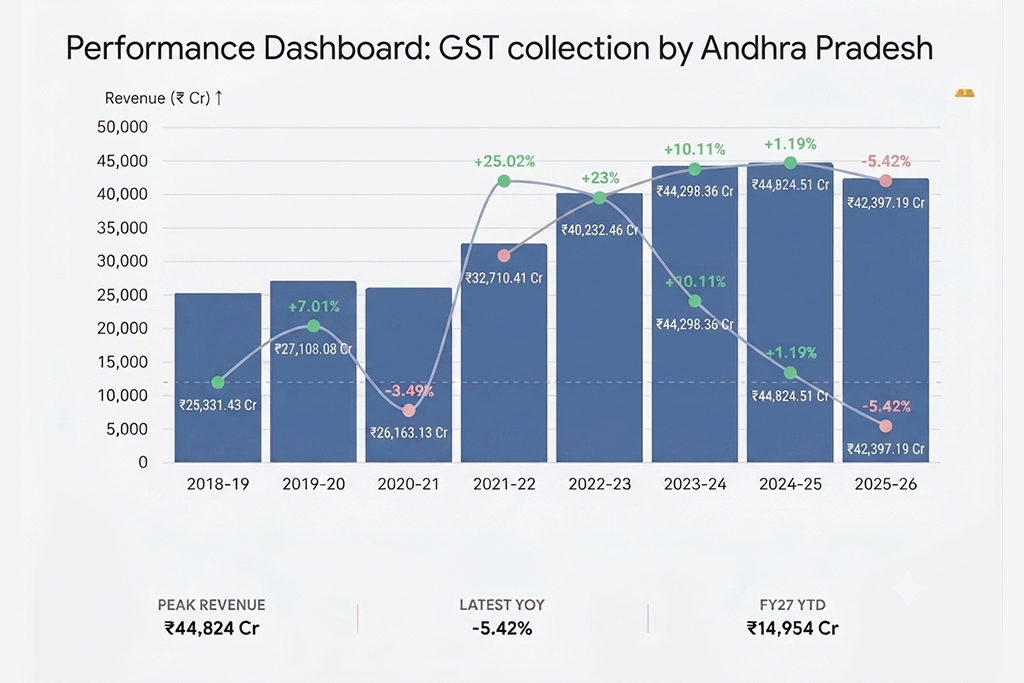
To accurately evaluate the state’s trajectory, we must first establish a historical baseline. The data below outlines Andhra Pradesh’s annual GST collections during the last eight years.
These are substantial numbers, and on the surface, everything seems fine. But to understand how well the state is actually faring when it comes to consumption, we need to look past the totals and analyse the growth rates.
The YS Jagan Mohan Reddy-led YSRCP administration came to power at the start of FY20, and presided over a 7% baseline growth. Despite an understandable -3.49% contraction during the FY21 COVID-19 pandemic, the state’s subsequent recovery trajectory was characterised by consistent, robust, double-digit growth.
With the government transition in June 2024, at the start of FY 2024-25, growth immediately stalled to a mere 1.19%. In the subsequent year, the economy contracted sharply, posting a severe negative growth rate of -5.42%.
To put this overall performance into perspective, we can compare Andhra Pradesh with 17 larger states across India, excluding smaller states and Union Territories to ensure a fair macroeconomic assessment. These states include Maharashtra, Punjab, Bihar, Kerala, Rajasthan, Tamil Nadu, West Bengal, Haryana, Uttar Pradesh, Chhattisgarh, Jharkhand, Telangana, Madhya Pradesh, Karnataka, Odisha, and Gujarat.
As you can see, the year-over-year growth rates are completely inconsistent. The collections oscillate between slight growth and outright contraction month to month.
When presented with this complete picture, the initial enthusiasm fades, giving way to a sobering ground reality. A fundamental contradiction remains: you cannot have an expanding, developing economy alongside shrinking GST revenues.
Currently, the promised “better development” exists primarily as words on social media, unsupported by the numbers.
It is time for transparency. Our leaders must explain this annual economic contraction rather than celebrate isolated, monthly data points.
Also Read:
Finally, take-off time: The story behind the Bhogapuram International Airport
Fact check: Is PM Modi right? Did India name all its airports after one family before 2014?
(Views are personal. Edited by R Rajesh Kumar.)



