

Published Jul 30, 2026 | 7:00 AM ⚊ Updated Jul 31, 2026 | 6:06 PM

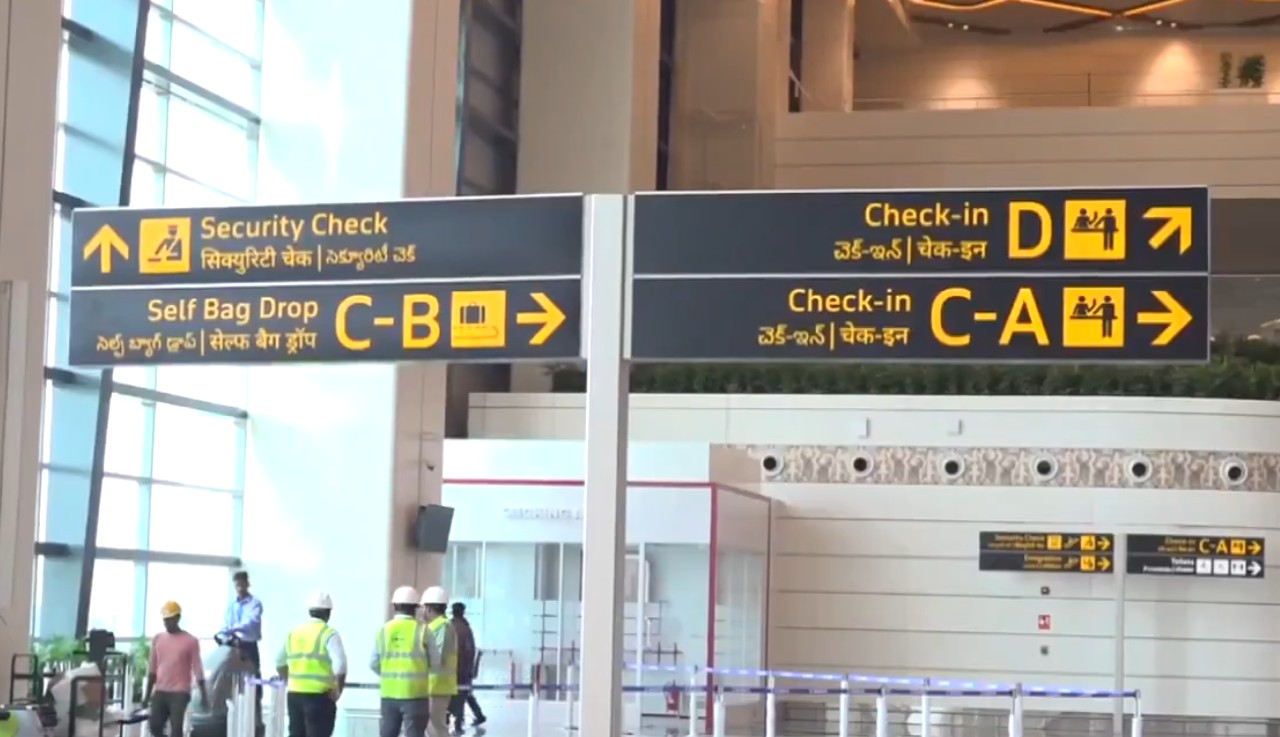
Bhogapuram airport entrance. (Special Arrangement)

Synopsis: Designed to handle six million passengers and built in 31 months at Rs 4,727 crore, the Alluri Sitarama Raju International Airport at Bhogapuram ranks among the fastest-completed Greenfield airports in the world. But before all this was a long birthing struggle…
The new Alluri Sitarama Raju (ASR) International Airport at Bhogapuram, being commissioned on August 17, marks a fundamental shift in the economic geography of Andhra Pradesh. For North Andhra, this project marks a definitive leap forward. The Rs 4727-crore airport stands as a testament to the region’s broader ambitions—a massive bet on the state’s future.
Aviation hubs fundamentally rewire local economies. They act as gateways for investment, generating employment and integrating local potential directly into the global supply chain. Bhogapuram is positioned to be exactly that anchor for Andhra Pradesh.
But to truly appreciate this inauguration, let’s revisit the entire journey to understand how exactly we arrived here.
Birth and bottlenecks
In the 2000s, Visakhapatnam’s air connectivity was limited by two formidable realities: the operational dominance of the armed forces and a runway that a mere flash of rain could flood. Recognising that the existing facility was structurally inadequate for a growing city, then-Chief Minister Dr YS Rajasekhara Reddy directed officials to begin drafting proposals for a new greenfield airport for the Government of India’s review in 2005.
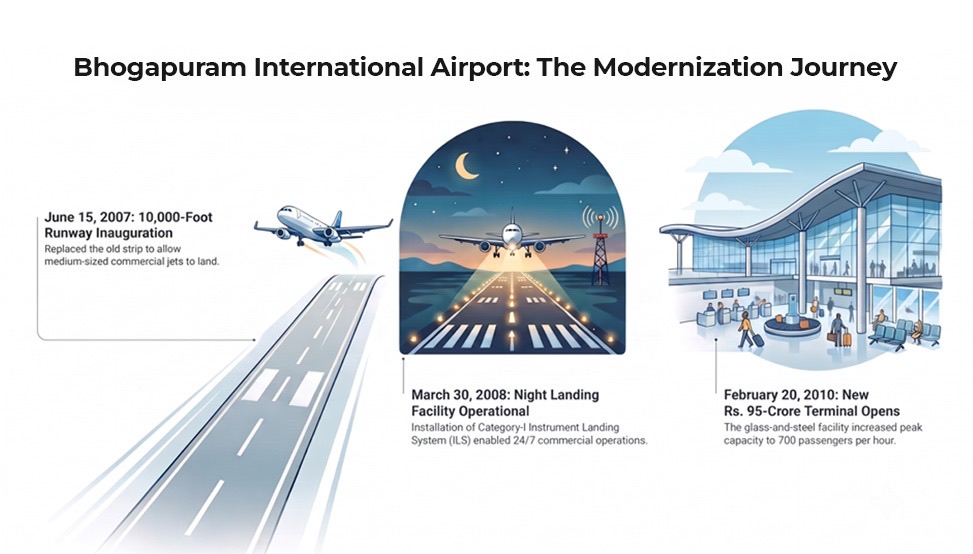
Bhogapuram airport timeline. (AI generated)
As the state could not afford to wait for long-term development approvals, and to bridge the timeline gap, the then YSR administration simultaneously influenced and pushed for a critical modernisation of the existing airport by the Government of India. Upgrades to extend the runways, installing night-landing infrastructure and a brand new terminal have unlocked the latent demand.
In parallel, the then YSR government established Parawada Pharma City and Rushikonda IT SEZ to boost the local economy.
These developments and the modernisation of the airport led to Vizag’s commercial activity skyrocketing. As passenger footfall and cargo demands surged, a structural reality set in.
The old airport belonged to the armed forces. There were fundamental limits on how much civilian aviation could expand within a naval base. The very economic boom triggered by the initial airport upgrades made it glaringly obvious that a completely new, massive greenfield international airport was no longer a luxury, but a vital necessity to sustain North Andhra’s future.
Following the YSR administration’s push, the search for a viable location began in earnest. During the 2007–08 period, the Airports Authority of India (AAI) formally evaluated four potential sites: Sabbavaram, Atchutapuram, Bhogapuram, and Koruprolu (S Rayavaram).
Pertinently, before the selection of Bhogapuram, early discussions explored S Rayavaram and Atchutapuram. However, these were eventually ruled out.
S Rayavaram faced technical hurdles due to power plant turbines, while Atchutapuram faced serious objections from the Navy and the Bhabha Atomic Research Centre (BARC).
By 2010, there were leadership changes both at the state and central level and intensifying agitations demanding the state’s bifurcation. Yet, even as the political landscape fractured, the geographical logic of Bhogapuram remained intact.
In April 2014, just before the official bifurcation of Andhra Pradesh, then Union Minister V. Kishore Chandra Deo formally mooted the development of the greenfield international airport at Bhogapuram. The destination for the region’s aviation future was finalised.
Thus, before the political earthquake of 2014, the central thesis was already written.
The official bifurcation of Andhra Pradesh in 2014 escalated Bhogapuram from a strategic goal to an immediate economic necessity. Having lost Hyderabad to Telangana, the residual state of Andhra Pradesh desperately needed a metropolitan aviation hub.
On June 8, 2014, N Chandrababu Naidu came to power.
In 2015, his administration established the Bhogapuram International Airport Corporation Limited (BIACL). Their initial vision was staggering: a 15,000-acre “Aerotropolis” slated for completion within four to five years.
To understand why this proposal immediately ran into systemic trouble, we must look at the actual land footprints of India’s busiest international airports: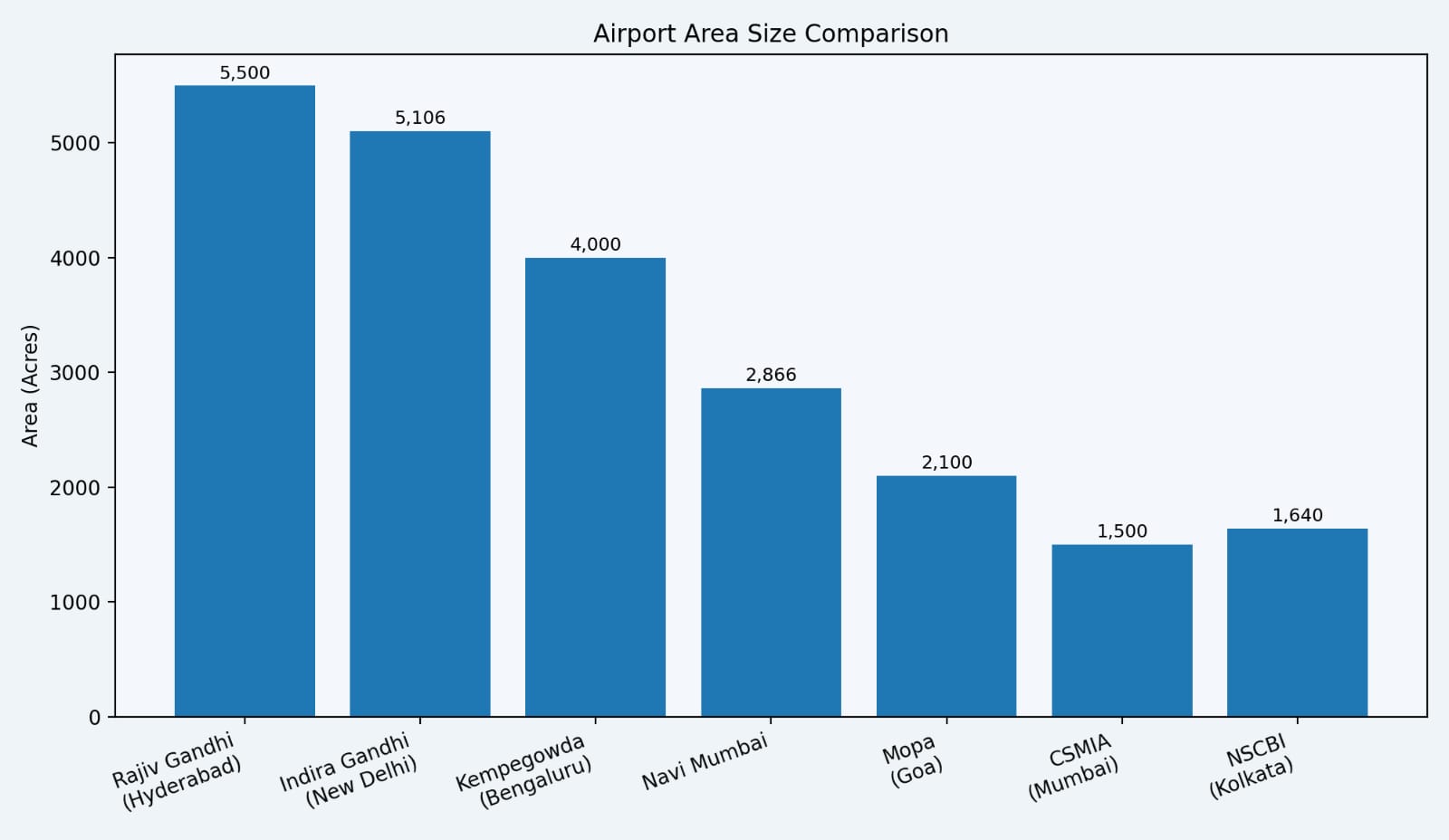
Attempting to pool 15,000 acres—nearly triple the size of Hyderabad’s expansive airport and ten times the size of Mumbai’s—inevitably collided with ground realities. The massive land-pooling drive triggered intense backlash from local farmers and state opposition parties.
Grassroots resistance quickly escalated into High Court interventions, effectively stalling the acquisition process. Weighed down by the sheer scale of its own ambitions, the project spent the next few years mired in legal battles and administrative red tape.
Eventually, the administration scaled down to 2,700 acres for airport development and laid the foundation stone in February, 2019 just before the state elections, with no definitive concession agreements finalised with the developer.
It had been 12 years since the Airports Authority of India’s initial 2007–08 site study. Despite the ceremonial plaque, the heavy machinery had yet to arrive.
The trajectory of the Bhogapuram airport changed dramatically post the 2019 Andhra Pradesh General Elections.
Recognising that massive land disputes were stalling the project, the new government under YS Jagan Mohan Reddy made a pragmatic pivot. The administration significantly reduced the project footprint to minimise displacement.
They finalised the core airport area to a highly efficient 2,203 acres, ending the widespread farmer protests and clearing the runway for actual development.
The state government moved the development process in the following way: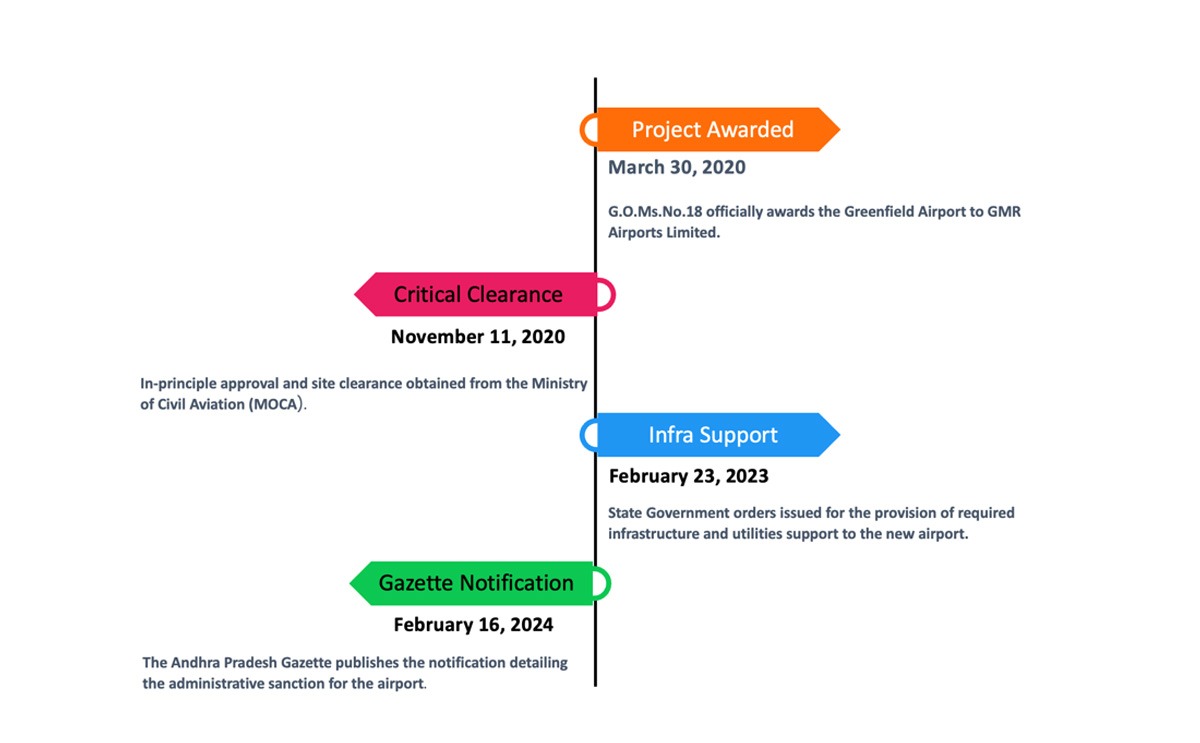
For nearly two decades, the Bhogapuram International Airport had been trapped in political disputes, legal battles, and bureaucratic gridlock. But the rapid development phase between 2020 and 2024 finally broke the deadlock.
Following the 2024 Andhra Pradesh general elections, the N Chandrababu Naidu administration executed the final push. The transition from construction to active aviation culminated on January 4, 2026, when an Air India aircraft completed the site’s first validation flight. Just months later, on July 15, 2026, the project reached 100% completion and secured its official aerodrome license.
Now, with Prime Minister Narendra Modi scheduled to formally inaugurate the airport on August 1, 2026, and commercial operations launching on August 17, Visakhapatnam’s aviation is finally free from the constraints of a restricted naval enclave. Bhogapuram is no longer a delayed promise. It has the potential to be the economic engine that will integrate North Andhra with global markets and secure the region’s future.
(Edited by R Rajesh Kumar.)



