

Published Aug 20, 2026 | 1:28 PM ⚊ Updated Aug 20, 2026 | 1:28 PM

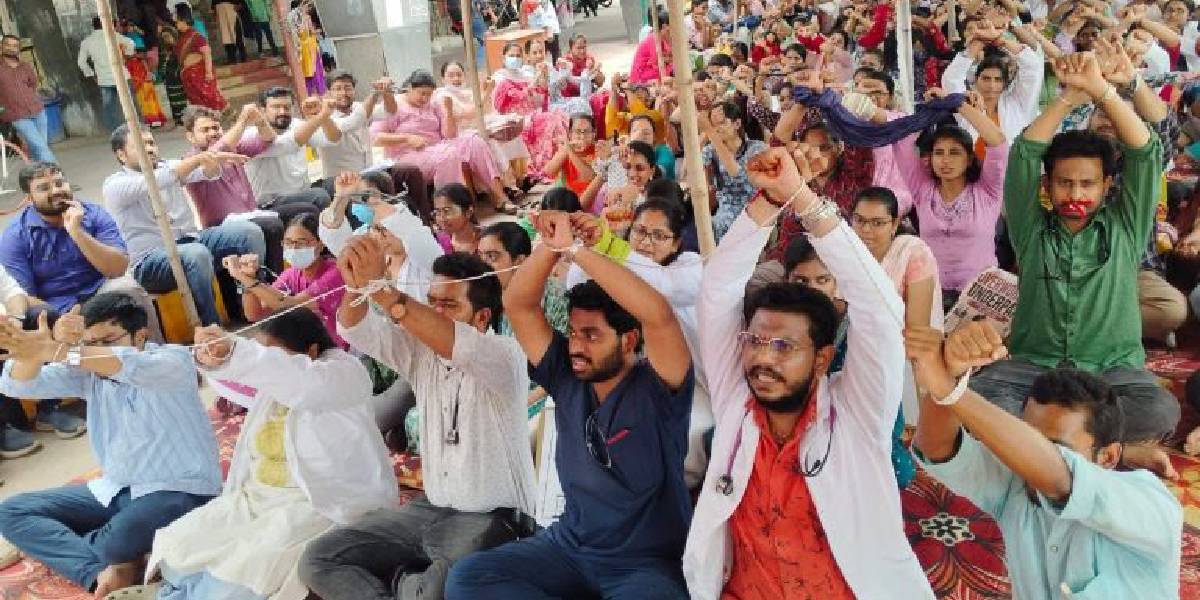
Junior Doctors protesting with their hands tied at the Government General Hospital, Vijayawada

Synopsis: The Andhra Pradesh Government responded to the 10-day protests and strike being held by junior doctors across the state, with a proposed 5 percent stipend hike. AP JUDA rejected the offer and criticised the government’s unilateral decision-making process.
The Andhra Pradesh government on Wednesday, 19 August, announced a revised stipend structure for junior doctors, days into a strike by the Andhra Pradesh Junior Doctors Association (AP JUDA) over a long-pending pay revision. AP JUDA rejected it as inadequate and confirmed that its strike would continue.
In a statement, G Veera Pandian, Secretary for Health, Medical & Family Welfare department, said the state government approved a permanent, annually reviewed stipend mechanism. Under the plan, interns will get a 5 percent hike effective from 1 January, followed by a 3 percent increase every subsequent year.
Postgraduate and super-speciality medical students will get a 3 percent annual increase. The government said the mechanism, discussed by the Cabinet on Tuesday, 18 August, would replace one-time, ad hoc revisions with automatic yearly hikes, similar to systems already in place in Tamil Nadu and Kerala since 2021.
The government said current annual stipend spending for junior doctors is roughly ₹586.08 crore, and that a 15 percent hike would add a ‘burden’ of ₹87.91 crore a year to that bill.
AP JUDA originally demanded a 30 percent hike, but now scaled it back to 20 percent, considering the state’s financial position. The association, however, said several states with higher inflation and deficits have been paying better stipends to residents.
The government also acknowledged that interns currently earn ₹25,906 a month, much less than their counterparts in Tamil Nadu, Kerala, Karnataka and Telangana.
AP JUDA said the government’s announcement was unilateral and sudden, issued without any negotiations in the last eight days. The association said it had held only two formal meetings about the stipend hike with officials, on 10 and 11 August. A further meeting on 15 August focused mainly on postponing the doctors’ planned withdrawal from emergency services.
The association also said the release made no mention of Senior Residents, clarifying that they remain part of AP JUDA and have featured in all its representations to the state.
AP JUDA argued that the proposed 5 percent and 3 percent increases would neither offset current inflation nor cover the shortfall accumulated in stipend revisions over the past two years. They also disputed the government’s comparison between junior doctors and Assistant Professors, noting that Assistant Professors are yet to receive a due Pay Revision Commission benefit and that, unlike them, junior doctors are barred from private practice.
The association renewed two demands the government failed to address in its statement. They called for strict adherence to National Medical Commission norms while recruiting MSc and PhD-qualified faculty and opposed a proposed increase in the retirement age for doctors from 62 to 65.
Apart from the Health Secretary and the Director of Medical Education, no senior officials or ministers had met AP JUDA representatives since the strike began. They sought a meeting with the Chief Minister, Deputy Chief Minister, Finance Minister, and Health Minister.
The protesting doctors said they remained open to further talks but reiterated that the agitation would continue until a satisfactory resolution is reached. The government appealed to doctors to resume duty, and directed officials to make arrangements to avoid inconveniencing patients.
The strike began on 10 August, with doctors demanding a long-overdue stipend revision. The agitation escalated to Phase III, with a boycott of emergency services, ICUs, and operation theatres from 17 August, as the state government had failed to respond.
The protests have drawn support from the Federation of All India Medical Associations (FAIMA), Indian Medical Association (IMA), the Andhra Pradesh Government Doctors Association (APGDA), and the Healthcare Reforms Doctors Association – Andhra Pradesh (HRDA – AP).
Roughly 9,000 resident doctors, interns and postgraduates across the state’s 19 government medical colleges have taken part in the phased protest.



