

Published Mar 05, 2026 | 5:55 PM ⚊ Updated Mar 05, 2026 | 5:55 PM

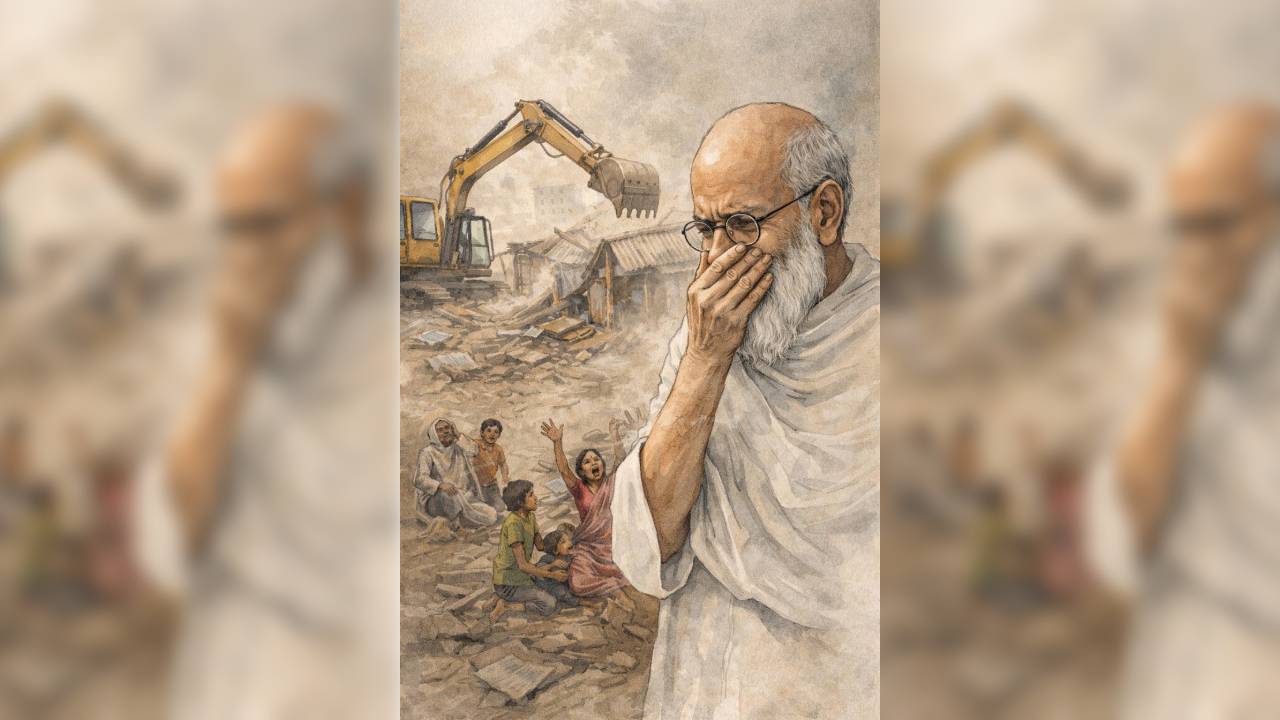
Bhoodan lands fell victim to some of the most atrocious encroachments and illegal occupations — not something Vinoba Bhave had envisaged.
Synopsis: Illegalities committed by the wealthy, political leaders, officials, and their associates are pardoned wholesale. The poor, the middle classes, and the oppressed are further suppressed; their resources are looted; and efforts are made to ensure they have no access to common social resources.
Imagine this: In the uneasy haze of early dawn — so dense that you cannot even tell whether the morning is pleasant or not — you shake off your sleep and prepare to step into the daily grind of your toiling life.
You open the front door of your house, and what confronts you is an entire street swarming with hundreds of armed police personnel. Under their protection and supervision, countless bulldozers stand lined up in formation. On the streets, your neighbours — men, women, the elderly, children — are wailing, clutching whatever belongings they can gather, running out in panic.
For a fleeting second, you may think that in the pitch darkness of the previous night some earthquake, deluge, or catastrophe struck; that the people have been thrown into chaos and helplessness; and that, in response, rescuers have arrived to save them, with bulldozers to clear debris and pull out the trapped.
But they are not rescuers protecting unfortunate citizens. They are guards deployed to shield a colossal, destructive, and malevolent force that is about to uproot a thousand families in one sweep. Those machines are not instruments of relief that save lives from the brink of death. They are monstrous mechanical arms that will flatten human beings, their lives, their dreams, their hopes, and their modest possessions into the dust.
This is not a scene from a film; nor is it fiction. It is one among many real scenes from the atrocity carried out at dawn in the Navodaya Colony and Vinoba Nagar of Velugumatla village on the outskirts of Khammam on 25 February — an atrocity executed by the government itself and its officials. A horror that crushed the future of a thousand families under an iron heel. Ironically, the first part of the name of the village means light, and the village witnessed darkness at that dawn.
When one observes the arguments put forward by the government, ministers, officials, and their direct and indirect supporters — arguments attempting to portray this devastation as natural, lawful, and justified — it becomes painfully evident how deeply our society has decayed. One may or may not possess the moral courage necessary to condemn an injustice. But to brush aside the helpless cries of people and declare that what happened ought to have happened; to insinuate that the victims must have done something wrong; to justify governmental cruelty; to ignore the political self-interest underlying the action—can this even be called a minimum human response?
Since such unjust justifications are indeed being made, it becomes necessary to examine thoroughly the entire background of this devastation.
According to available records, in the 1954–55 pahani (land record), in Survey Nos. 147, 148, and 149 of Velugumatla, an extent of 62 acres and 7 guntas stood in the name of Vinoba Bhave. Since in the adjoining survey numbers the land was recorded in the name of one Kalva Venkata Rangarao, it may reasonably be inferred that he donated this land to Vinoba Bhave.
It is well known that Vinoba Bhave initiated the Bhoodan (Land Gift) movement in the then Hyderabad State. Recognising that the extreme inequalities in land ownership in Telangana—where a handful possessed hundreds and thousands of acres while lakhs of landless poor peasants had none—had led to the Telangana peasant armed struggle and bloodshed, Vinoba Bhave sought a solution.
As early as 1951, even before the formal withdrawal of the Telangana peasant armed struggle, he conceived the idea of resolving land inequality through a bloodless revolution. He proposed to meet large landowners, persuade them, bring about a change of heart, obtain land as a voluntary donation, and distribute it to the landless poor.
Thus began the Bhoodan movement on 18 April 1951, in Pochampally village of the then Nalgonda district, when Vedire Ramachandra Reddy, a landlord owning about 3,500 acres, first donated 100 acres. Later, he donated another 800 acres. There were reports that Mir Osman Ali Khan donated 14,000 acres; however, since the Sarf-e-Khas was abolished in 1949, it is uncertain whether the Nizam possessed that much private land.
Subsequently, village donations (Gramdan) were also incorporated, and Vinoba Bhave undertook a nationwide padayatra propagating the movement. In total, in Hyderabad State and later in Andhra Pradesh, he collected about one lakh acres. All these lands were immediately mutated in the pahani records in the name of Vinoba Bhave.
To regulate the distribution of Bhoodan lands, the Government of Andhra Pradesh enacted the Andhra Pradesh Bhoodan and Gramdan Act in 1965 and constituted the Bhoodan Yagna Board.
The Board’s function was to identify eligible landless poor persons and allot small extents either for cultivation or as house sites. Copies of the proceedings were given to beneficiaries and also forwarded to the taluk or mandal revenue authorities concerned with recommendations to issue pattas and incorporate the beneficiaries’ names in revenue records.
However, Bhoodan lands — both nationwide and in undivided Andhra Pradesh — fell victim to some of the most atrocious encroachments and illegal occupations. The moment it became known that a parcel of land was Bhoodan land, political leaders, officials, wealthy persons, and real estate dealers conspired to grab it. They occupied lands, created pattas in the names of their associates, and amassed benami properties.
Since the Bhoodan Yagna Board consisted of government and political appointees, it too was influenced to allot lands to individuals, institutions, and even government departments. Vinoba Bhave’s vision of distributing land to the landless poor was long ago shattered.
Out of the 62 acres and 7 guntas that ought to have remained in Velugumatla, the government has now “reclaimed” only 31 acres through bulldozer justice. The remaining 31 acres, according to the Dharani/ Bhoobharathi portal records, are shown as having pattadars, and have even been converted to non-agricultural use.
In fact, Bhoodan land was never meant to be allotted in five- or ten-acre chunks to individuals. Yet Bhoobharathi shows some owners holding such larger extents. Clearly, these have become benami assets of local political leaders.
The very location of this land appears to be the root of the problem. After the Khammam Collectorate was shifted to a new complex on the outskirts, land prices in the surrounding areas skyrocketed, attracting the attention of real estate interests and their political patrons. From the time of the TRS regime until now, former and current ministers and legislators have, either in their own names or through benamis, encroached upon hundreds of acres and built empires.
The Velugumatla Bhoodan land forms part of this. Half of it had already been appropriated. The remaining half became a thorn in their flesh. In April 2014, the Andhra Pradesh Bhoodan Yagna Board issued proceedings allotting 100 square yards each as house sites to several hundred beneficiaries. For 12 years, these people built houses and settled there, continuously petitioning for rightful pattas and civic amenities, even approaching courts.
Meanwhile, in 2015, the Telangana Rashtra Samithi government abolished the Bhoodan Yagna Board. This was one among many measures undertaken by the KCR government to consolidate land ownership in favour of affluent and traditional landed classes and to strengthen the hold of encroachers over common lands. When this abolition was challenged in the High Court, a single judge upheld the government’s action; upon appeal, a division bench did the same. It was ordered that all records with the Board be transferred to the Chief Commissioner of Land Administration (CCLA).
Today, it is claimed that those records are untraceable. When the Dharani portal was launched, it was proclaimed that all earlier revenue records would be digitised and that Dharani would henceforth be authentic. Now, the very records seem to have vanished.
Thus, apart from whatever little land reached the landless poor, the rest of the Bhoodan lands have effectively been left open for fresh encroachments and grabs. Even lands legitimately allotted to the poor can now be swallowed by the wealthy, politicians, and officials. The bulldozer attack on the colonies established by poor and lower-middle-class families in Velugumatla must be understood in this context.
Whenever news spreads that house sites are to be distributed in the expanding outskirts of a city, a scramble among the houseless poor is inevitable. Middlemen thrive, collecting money by promising allotments; plots obtained in one name are transferred to others; irregularities undoubtedly occur. No one can guarantee that no such wrongdoing happened here. If illegalities occurred, they are subject to investigation and punishment under the law. If the government truly had good intentions, it could have acted against such middlemen. Instead, it chose to descend upon the residents themselves—perhaps to prepare the land afresh for new middlemen.
To use the police to dispossess the poor of land lawfully obtained; to ignore the half of the Bhoodan land already under encroachment; to demolish in a single blow the modest homes built by poor and middle-class families who gathered brick by brick; to promise rehabilitation only after the controversy escalates; to attack journalists attempting to report the devastation; to unleash police upon those who question the promised rehabilitation—every action of the government in this episode is unjust, illegal, unlawful, and oppressive.
This is not merely a housing issue concerning the victims of Velugumatla’s destruction. It reflects the development model being pursued—and intended to be pursued—by the Telangana state government. In this model, illegalities committed by the wealthy, political leaders, officials, and their associates are pardoned wholesale. The poor, the middle classes, and the oppressed are further suppressed; their resources are looted; and efforts are made to ensure they have no access to common social resources.
(Views are personal. Edited by Majnu Babu).


