


Kerala Finance Minister KN Balagopal said State governments are increasingly dependent on their own revenues to meet rising expenditure needs, even as fiscal space continues to shrink.

Published Jan 12, 2026 | 10:37 PM ⚊ Updated Jan 12, 2026 | 10:37 PM

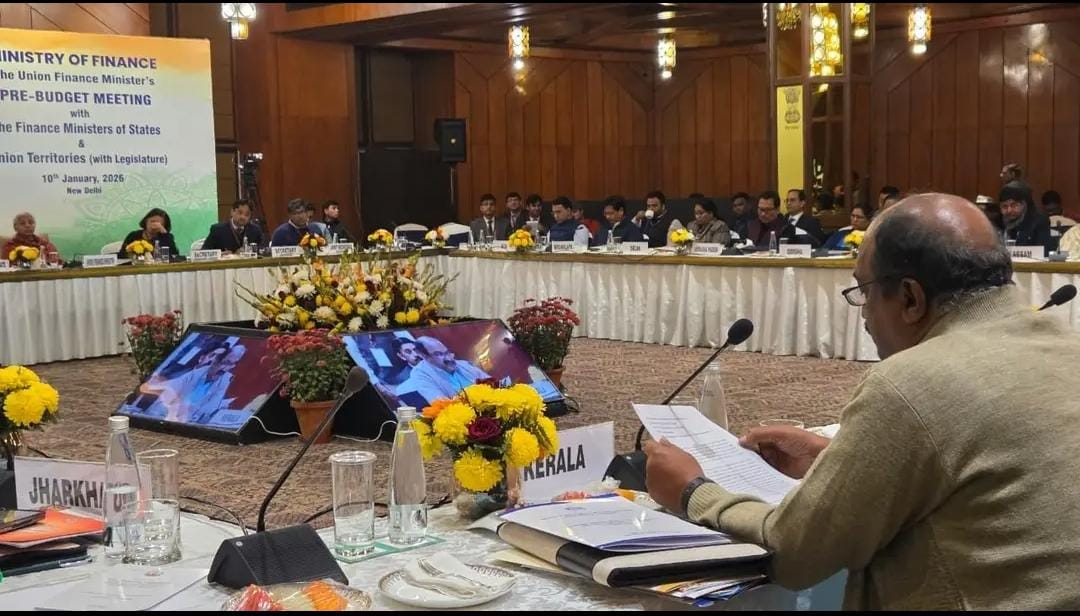
Kerala Finance Minister K N Balagopal presenting the state's demands in the Pre-Budget Consultation Meeting at New Delhi on 10 January
Synopsis: Kerala has put forward a set of demands before the Union Government ahead of the Union Budget 2026–27, citing shrinking fiscal space, revenue losses and external trade shocks. Chief among these is a demand for a special fiscal correction package and greater borrowing headroom, with the State saying that cuts in borrowing limits, GST rationalisation, lower Central transfers and US tariffs have created a resource gap of over ₹21,000 crore.
Kerala has submitted an expansive memorandum to the Union Government ahead of the Union Budget 2026–27, seeking structural corrections to what it describes as an increasingly centralised fiscal architecture. The State has called for a special fiscal correction package, greater borrowing flexibility and targeted investments.
The memorandum was presented at the Pre-Budget Consultations in New Delhi on Saturday, 10 January. Kerala flagged revenue losses caused by cuts in its borrowing limit, GST rationalisation and a decline in Central transfers, along with export shocks triggered by tariff measures announced by the United States.
At the centre of its demands is a Special Fiscal Correction Package to address a severe resource gap estimated at over ₹21,000 crore.
The gap is attributed mainly to a cut of nearly ₹17,000 crore in the State’s borrowing limit, compounded by a revenue loss of about ₹4,250 crore arising from GSDP estimation methods that differ from the recommendations of the Fifteenth Finance Commission.
Kerala said these systemic discrepancies, when applied retrospectively, have led to cumulative losses running into several thousand crore rupees, weakening the State’s ability to sustain capital expenditure, social welfare programmes and development infrastructure.
The proposed special package, the State said, is necessary to restore fiscal space and uphold the principles of equitable federalism.
During the meeting, Kerala Finance Minister KN Balagopal said State governments are increasingly dependent on their own revenues to meet rising expenditure needs, even as fiscal space continues to shrink.
While Kerala remains committed to fiscal consolidation, he said overlapping economic shocks have placed unprecedented pressure on the State’s finances.
A mid-year GST rationalisation alone is estimated to have resulted in an annual revenue loss of nearly ₹8,000 crore.
This has sharply constrained Kerala’s ability to fund essential services, welfare programmes and infrastructure projects.
Adding to the strain, the Minister said reciprocal tariff measures imposed by the United States have affected key export-oriented sectors, including marine products, spices, cashew and textiles.
The State estimates an additional loss of about ₹2,500 crore a year on this account.
These pressures are compounded by Kerala’s declining share in the divisible pool of Central taxes, reduced Central assistance under Centrally Sponsored Schemes, and unexpected cuts in borrowing limits.
Taken together, these factors have weakened Kerala’s revenue base, growth outlook and long-term fiscal sustainability, the memorandum said.
The state has urged the Centre to grant additional borrowing space of 0.5 percent of GSDP exclusively for capital expenditure and to allow borrowing for State-funded land acquisition for National Highways.
It has also sought earmarking 25 percent of the Union’s 50-year interest-free capital expenditure loans as an Asset Renewal Fund for developed States.
On GST, the State has called for a GST 2.0 revenue protection framework, rule-based compensation for States affected by rate rationalisation, and open protocols in e-commerce to curb tax evasion.
Kerala has also expressed strong reservations over the restructuring of MGNREGA into VB GRAM G, warning that the higher cost burden on States could weaken employment guarantees.
Kerala has proposed positioning itself as a hub for advanced manufacturing and defence technology.
Citing its naval orientation and strong institutional ecosystem, the State has sought the establishment of a Defence Research and Development Corridor, drawing on assets such as the Indian Naval Academy, DRDO’s Naval Physical and Oceanographic Laboratory, Cochin Shipyard and BrahMos Aerospace.
The State has also pitched the strengthening of rubber-based engineering, food processing and marine product value chains, along with the modernisation of MSMEs through shared facilities, export facilitation and green upgrades. Kerala said defence innovation corridors are vital not only for national security but also for industrial competitiveness.
Highlighting India’s demographic dividend, Kerala presented itself as a model for addressing ageing populations and migration-related challenges.
The State proposed dual-track skilling systems that combine IT skills with domain-specific expertise, backed by apprenticeships in sectors such as healthcare, shipbuilding, renewable energy and tourism.
Kerala has also sought policy support for building geriatric-focused public health systems, promoting assisted living and reskilling the elderly for part-time employment.
A key demand is the launch of a National Skilled Mobility Framework to reintegrate returning NRIs, particularly from GCC countries, into the domestic economy.
Measures to improve women’s workforce participation, including flexible work hubs and cooperative enterprises, also feature prominently.
Calling MSMEs the backbone of India’s economy and future growth drivers, Kerala proposed blended finance and credit guarantees for MSME modernisation and green transitions.
The State suggested incentivising returning NRIs as angel investors and entrepreneurs, setting up district-level MSME accelerators with shared testing, packaging and cold-chain facilities, and providing scale-up funding at lower interest rates for projects with long gestation periods.
On technology and innovation, Kerala pitched the establishment of a government-owned AI and Digital Public Infrastructure sandboxing facility to pilot ethical and citizen-centric solutions.
Proposals also include integrating AYUSH with modern medicine through evidence-based research and development, expanding health-tech sandboxes, setting up biotech clusters, strengthening marine technology research and development, and establishing AI labs for local-language applications.
To boost capital expenditure, Kerala has sought greater Central support for integrating Vizhinjam Port with Bharatmala and Dedicated Freight Corridors, developing logistics parks, expanding coastal shipping, strengthening electric bus fleets, metros and resilient bridges, and improving rural digital infrastructure through fibre connectivity and public Wi-Fi.
On services exports, Kerala argued for redefining tourism as an export sector. Proposals include positioning the State as a model silver-care economy, developing medical and wellness tourism hubs, eco-cultural circuits, and promoting women-led enterprises in tourism and AYUSH.
Placing Kerala’s expectations within India’s long-term vision of becoming a globally competitive, socially inclusive and environmentally resilient economy by 2047, Balagopal said the State’s demographic profile, social indicators and strategic location make it well suited as a national pilot for future-ready initiatives.
Kerala, he said, is willing to position itself as a demonstration site for innovative policies that can be replicated across the country, especially in areas such as ageing populations, migration management, sustainable tourism, climate resilience and high-value manufacturing.
Given its vulnerability to climate risks, Kerala has proposed national-level sustainability pilots, including a Coastal Resilience Fund, catastrophic bonds for natural calamities, renewable energy microgrids, and blue economy initiatives such as sustainable fisheries and seaweed farming.
A major strategic proposal is the creation of a Dedicated Rare Earth Corridor linking Vizhinjam Port, Chavara and Kochi, aimed at tapping Kerala’s mineral sand reserves rich in monazite.
The State has sought ₹1,000 crore in Union Budget support to develop domestic production of permanent magnets critical for defence, aerospace and other strategic industries.
With Vizhinjam Port already surpassing capacity utilisation benchmarks, Kerala has sought major Central investment in rail connectivity, port-led industrial corridors, green hydrogen hubs and maritime security infrastructure.
Additional demands include ₹2,000 crore from the Food Corporation of India to clear pending paddy procurement dues, enhanced Central assistance for plantation sector rejuvenation, and the creation of a ₹1,000 crore Rubber Price Stabilisation Fund with greater Central participation.
Beyond its immediate fiscal concerns, the State strongly pressed for action on several long-pending demands that it described as critical to Kerala’s sustainable development.
Foremost among them is the establishment of an AIIMS in Kerala.
Despite being a national leader in public health outcomes and a preferred destination for patients from across India and abroad, Kerala continues to lack an institution of national importance to support its growing clinical load, advanced research needs and medical education ecosystem, Balagopal noted in the memorandum.
The memorandum also underlined the urgency of commencing the Sabari Rail Project, for which the Government of Kerala has already expressed its willingness to bear 50 percent of the project cost. Immediate execution is essential, it said, adding that the project’s commercial and strategic viability would improve significantly if the rail line is extended to the Kollam–Shengotta corridor, enabling direct connectivity to the Vizhinjam International Port.
The State also highlighted the distress faced by traditional small-scale industries such as cashew, coir and handloom, which are major sources of employment for women.
Currency depreciation and market shocks have hit these sectors disproportionately, particularly the cashew industry, making state-specific rescue packages necessary to protect livelihoods and preserve Kerala’s industrial heritage.
The State further flagged mounting pressure in the social sector, calling for urgent Union support.
The Finance Minister alleged that Central funding for honoraria to Anganwadi workers, ASHA workers and scheme workers, as well as allocations for social security pensions, mid-day meal cooking costs and housing for the poor, has remained unchanged for years. This, he said, has eroded real value and weakened frontline service delivery.
Kerala is also facing an acute human-animal conflict, worsened by high population density and its proximity to the Western Ghats.
Rising human fatalities, widespread crop damage and ecological loss have created a serious socio-economic emergency, prompting a demand for a dedicated ₹1,000 crore allocation for mitigation and conservation measures.
At the same time, Kerala is undergoing a rapid demographic transition, with the elderly population projected to reach 22.8 percent by 2036, far above the national average. This has created unprecedented demand for geriatric healthcare, long-term care and social support systems.
The State also highlighted the vulnerability of Non-Resident Keralites and return migrants from Gulf countries.
Fiscal stress faced by the Kerala Non-Resident Keralites Welfare Board and the rehabilitation challenges of low- and semi-skilled returnees have led to a demand for annual Union Budget support and a special rehabilitation package to ensure social security, reintegration and entrepreneurship opportunities.
(Edited by Dese Gowda)


