


Published Mar 17, 2026 | 4:03 PM ⚊ Updated Mar 17, 2026 | 4:04 PM

Restaurant owners that South First spoke to said the charge was meant to cover rising costs from buying LPG cylinders.
Synopsis: Several Bengaluru cafés and restaurants have begun charging consumers a “gas crisis charge” amid the ongoing LPG shortage. Some say the fee is “optional” and meant to cover rising costs from buying LPG on the black market to maintain regular service, as commercial supply is curtailed and induction stoves are in short supply. Legal experts say the charge is illegal, regardless of whether it is “optional”.
The ongoing shortage of LPG has hit the hospitality sector especially hard, forcing some restaurants, cafés and other commercial kitchens, such as those in PGs and workplaces, to cut menu items, reduce operations or temporarily shut down.
Some others in Bengaluru, however, have decided to levy a “gas crisis charge” on consumers. Several social media posts showing bills with such charges have gone viral in recent days.
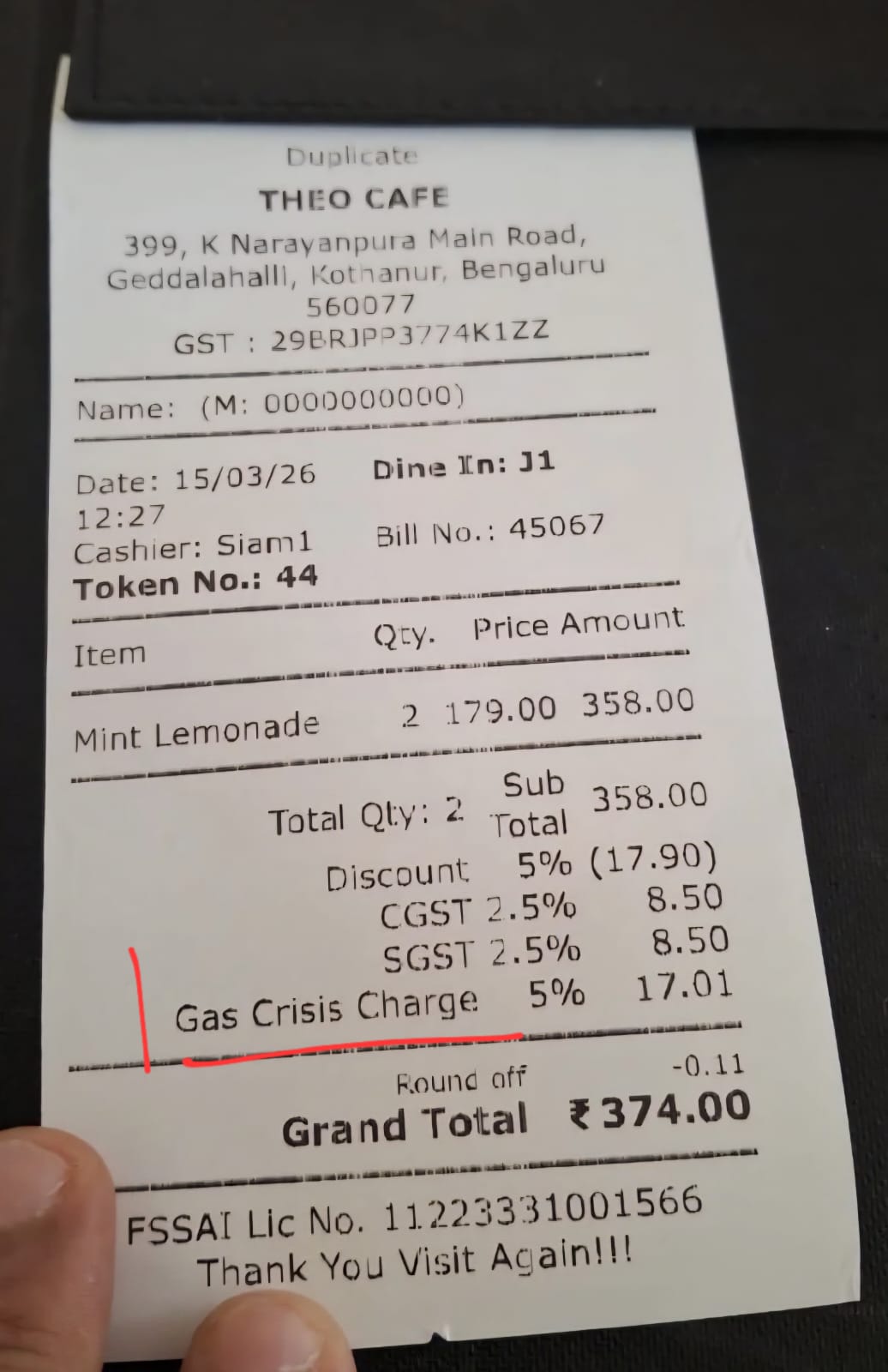
A bill from a cafe charging a “gas crisis charge”.
In one such bill, a gas crisis charge was levied on a lemonade. The bill shows the customer ordered two mint lemonades, ₹179 each, at Theo Café. Along with CGST, SGST and a discount, the restaurant added a five per cent gas crisis charge, amounting to ₹17.
Another bill shared by a different user, from a restaurant called Mr Andhra Meals, shows a flat ₹30 charge for a “gas supply issue”.
“Already in Bangalore PG announced food shortages and won’t be varieties. Went to hotel they are charging for gas shortage. Such a scam, they looting us every possible way,” the user wrote.
The owner of one such establishment that South First spoke to confirmed it was levying the charge but said it was optional.
“It is explained to consumers beforehand. Only if they understand and agree do they pay the charge,” he added.
Already in Bangalore PG announced food shortages and won’t be varieties. Went to hotel they are charging for gas shortage. Such a scam, they looting us every possible way @BlrCityPolice @CPBlr pic.twitter.com/ssBmc26DaA
— naresh kumar (@naresh__kumar_) March 11, 2026
Not at all, according to lawyer Vijay Gopal.
“It is illegal to do so. The product cost is their right, rest is illegal and an unfair trade practice,” he told South First.
He referred to the Consumer Protection Act, 2019. Section 2(47) defines an “unfair trade practice” as a practice that, for the purpose of promoting the sale, use or supply of any goods or services, adopts any unfair or deceptive method.
Even if it is termed “optional”, Gopal said the validity of such consent is questionable.
“There is no real question of agreement. The cost of the product includes all such expenses. You cannot separately charge for cooking, gas, electricity or kitchen costs,” he said.
Restaurant owners that South First spoke to said the charge was meant to cover rising costs from buying LPG cylinders on the black market at exorbitant prices.
“The supply of commercial gas cylinders has stopped. We have to buy from the market, where prices have risen to ₹6,500. I used to pay ₹1,500 earlier,” the owner of a café said.
Amid the shortage, the Karnataka government has prioritised supply of existing stock to domestic households and essential services: hospitals, educational institutions, pharma manufacturing, government and corporate offices, and the food processing industry.
On Monday, 16 March, the state introduced a priority-based framework to regulate LPG distribution. In a letter to oil marketing companies, the food, civil supplies and consumer affairs department said Karnataka’s average daily consumption of commercial LPG is around 44,000 cylinders.
Of this, around 8,800 cylinders fall under the regulated 20 percent allocation, with about 7,000 to be distributed daily through a priority mechanism.
Restaurants, dhabas, hotels and industrial canteens fall under ‘priority 3’. Under this classification, an average of 1,000 cylinders will be released daily to restaurants.
More than 40,000 eateries operate in Bengaluru. To make up for the shortfall, the state government has urged commercial kitchens to make alternative arrangements, such as cooking with induction stoves.
Supply of induction stoves, however, has not met demand since the crisis began, with most retailers running out of stock in the first few days.
“We understand a lot of people depend on our food, so we are keeping everything open. We are also not finding induction stoves because they have run out of stock. It is actually a crisis,” the café owner told South First.
The Bangalore Hotels Association said restaurants are trying to manage with induction stoves and firewood. Its president, PC Rao, told South First it has also advised members against raising prices or levying additional charges during the crisis.
“We have told them this is not right,” he added.
(Edited by Dese Gowda)


