

Published Feb 06, 2026 | 8:18 PM ⚊ Updated Feb 06, 2026 | 8:18 PM

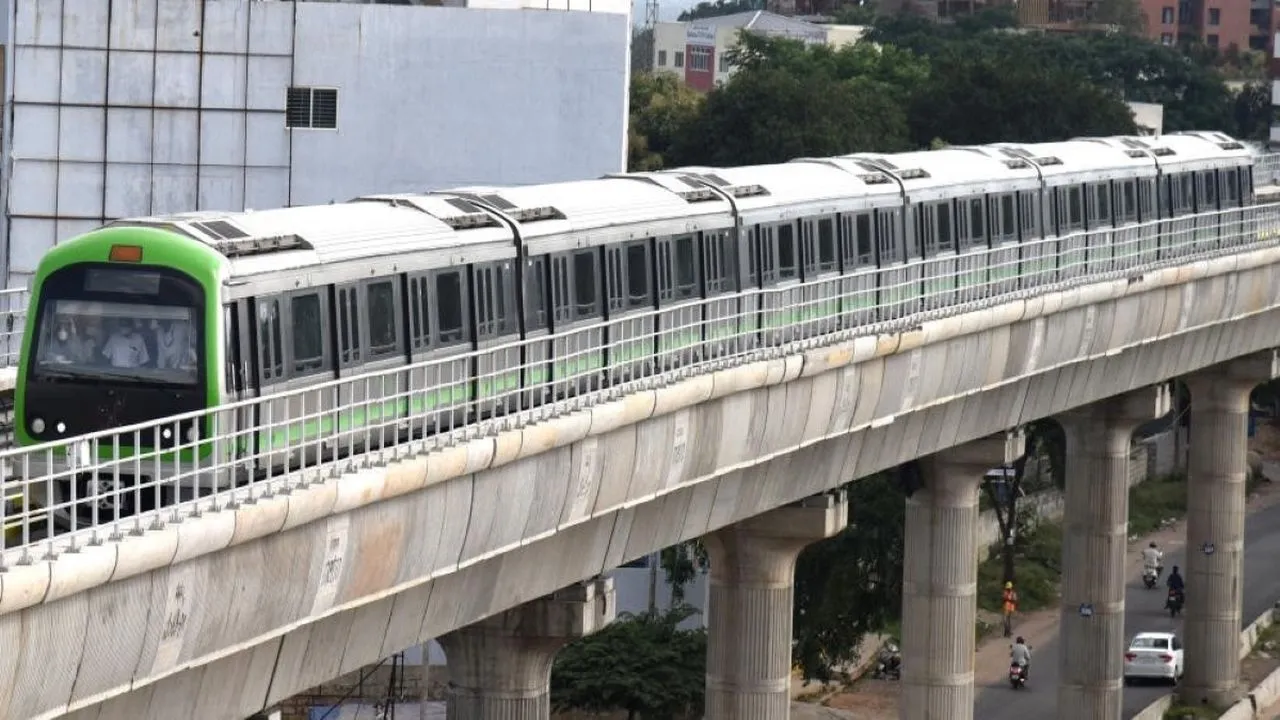
The Save Bangalore Committee and Bengaluru Metro Commuters’ Association called the move a ‘betrayal of public trust’.
Synopsis: Bengaluru Metro commuters are facing another fare increase from 9 February under the Bangalore Metro Rail Corporation Limited’s annual revision, even as many are still adjusting to the steep hikes introduced in February 2025. Students, daily riders and civil society groups say that repeated increases, though small on paper, add up over time and place a growing strain on those who depend on the metro for long-distance travel.
For Girija, a college student in Bengaluru, the Namma Metro has been a lifeline. She travels every day from Silk Institute Metro Station on the Green Line to Cubbon Park on the Purple Line to reach her college in Vasanth Nagar.
From 9 February, however, her daily commute will cost more. Her fare will increase from ₹70 to ₹74.
The hike is part of the Bangalore Metro Rail Corporation Limited’s (BMRCL) annual fare revision, following the recommendations of the First Fare Fixation Committee (FFC) constituted under the Metro Railways (Operation and Maintenance) Act, 2002.
In a press release, BMRCL defended the hike, stating that the committee noted that the previous fare revision, carried out after a gap of 7.5 years, resulted in an average increase of 51.55 percent. To avoid such steep hikes in the future, it recommended moving to an annual fare revision mechanism.
The hike might seem marginal when seen in isolation. However, it comes close on the heels of a sharp hike introduced by BMRCL barely a year earlier in February 2025, with some slabs witnessing hikes exceeding 100 percent.
After widespread protests from commuters, BMRCL attributed the anomaly to technical issues and later capped the increase at 71 percent from 14 February 2025. The recently announced hike will make Namma Metro one of India’s most expensive metro systems.
“For students and other people like me who travel long distances every day, even small fare hikes add up. In a city like Bengaluru, where every other mode of transport is already expensive, it becomes very difficult,” Girija told South First.
Civil society groups echoed these concerns. The Save Bangalore Committee and Bengaluru Metro Commuters’ Association called the move a ‘betrayal of public trust’, coming at a time when citizens are grappling with persistent inflation and economic strain.
“This hike represents a failure of governance and imagination. Instead of seeking innovative, non-burdening revenue models — such as enhanced commercial exploitation of metro property or operational efficiencies the administration chooses the easiest path: digging deeper into the pockets of its riders,” the group said in a statement last month.
The group also warned that this increase will force many back onto already choked roads and :then the very goals of reducing traffic and pollution that the metro was built to achieve would be completely defeated.”
The latest fare hike has further angered regular commuters, many of whom have also been raising concerns about overcrowding during peak hours.
One such commuter, who works as a lawyer at the High Court (travelling from Banashankari on the Green Line to Vidhana Soudha on the Purple Line), said that travelling during peak hours had become inconvenient due to the heavy rush of passengers.
“Despite being in the women’s compartment, we hardly get any personal space to stand let alone sit. It could soon become a safety concern. Instead of addressing this, they are trying to make travel more inconvenient by increasing prices,” the commuter said.
For many commuters who own private vehicles, the metro remains the preferred option in a city that was ranked the second most congested city in the world in 2025, with an average speed of 16.6 km per hour, an average motorist spending 15 minutes to commute 4.2 km, according to the 2025 congestion data released by Netherlands-based location technology firm TomTom.
Another commuter, Rashi, who travels for work from RV Road to Bommasandra (19.15 km), explained how the launch of the Yellow Line of Namma Metro eased her daily commute, reducing travel time from upwards of an hour while crawling at a snail’s pace through heavy traffic to just 33 minutes.
“The crowd rush is a negative but I was willing to overlook it as it cut down my time on the road. But now that fare revision is going to happen every year, it could push regular commuters back to the roads,” Rashi told South First.
Independent mobility expert Satya Arikutharam pointed out that citizens will not just have to pay the hiked fares, but they will also factor in the added costs of first-mile and last-mile connectivity.
“Even if people use private scooters, there are parking charges at both ends. They will start asking themselves whether it is worth riding to the station, paying to park, and then squeezing into a jam-packed metro, only to lose the flexibility of starting whenever they want and still endure traffic,” Arikutharam told SouthFirst.
“This is where price elasticity comes in,” he said, adding that whether that would be significant enough to erode the revenue gains which BMRCL is expecting is yet to be seen.
Many commuters said they were still adjusting to the sharp fare hike introduced in February 2025. In February 2025, the maximum fare for metro travel increased from ₹60 to ₹90, marking a 50 percent rise.
While the minimum fare for travel up to two km remained unchanged at ₹10, the fare for the second stage (two to four km) increased from ₹15 to ₹20. The fare for distances beyond 25 km was fixed at ₹90.
Before the fare hike in 2025, the Bengaluru metro recorded a daily ridership of over eight lakh passengers. However, since the hike came into effect on 9 February, there was a steady decline in ridership, falling by almost one lakh passengers a day. Ridership stood at 2,49,14,736 in January 2025, but dropped to 2,09,90,894 in February. The numbers eventually picked up after a few months.
This was the first fare hike in more than seven years, after 2017, when fares were raised by 10–15 percent. At the time, a commuter travelling from Mysuru Road to MG Road, who earlier paid ₹30, began paying ₹35. The same route will cost ₹63 after the latest hike.
Experts say that even if commuters avoid the metro for a few weeks after a fare increase, dealing with Bengaluru’s traffic often forces them back to it. Calling this a “double whammy”, Arikutharam said the metro’s lack of competition leaves commuters with few real alternatives, allowing the operator to push fare hikes unfairly.
However, low-income groups could be the worst affected. A 2023 study by researchers from the National Institute of Advanced Studies (NIAS), based on interviews with 5,073 respondents from 1,350 low- and low-middle-income households across 16 wards, found that the Bengaluru metro was already unaffordable for the urban poor.
The study noted that the average monthly income of metro users in these households was ₹13,544, with ₹1,152 spent on travel alone.
The BMRCL, in its press release announcing the hike, referred to audited financial data that showed a 10.20 percent rise in costs when comparing figures from 2024–25 (as of 31 March 2025) with the base data from 2023–24 (as of 31 March 2024).
Despite this increase in operational expenses, the fare hike has been capped at five percent in line with FFC guidelines, the press release said.
It further said that the existing discounts of five percent during peak hours, 10 percent during non-peak hours and a 10 percent discount on Sundays and three designated national holidays will continue.
Calling it a “small, annual revision”, BMRCL said it was intended to ensure financial sustainability and service reliability, while avoiding the need for large and sudden fare increases in the future.
(Edited by Dese Gowda)


