

Published Jan 28, 2026 | 10:24 PM ⚊ Updated Jan 30, 2026 | 6:42 PM

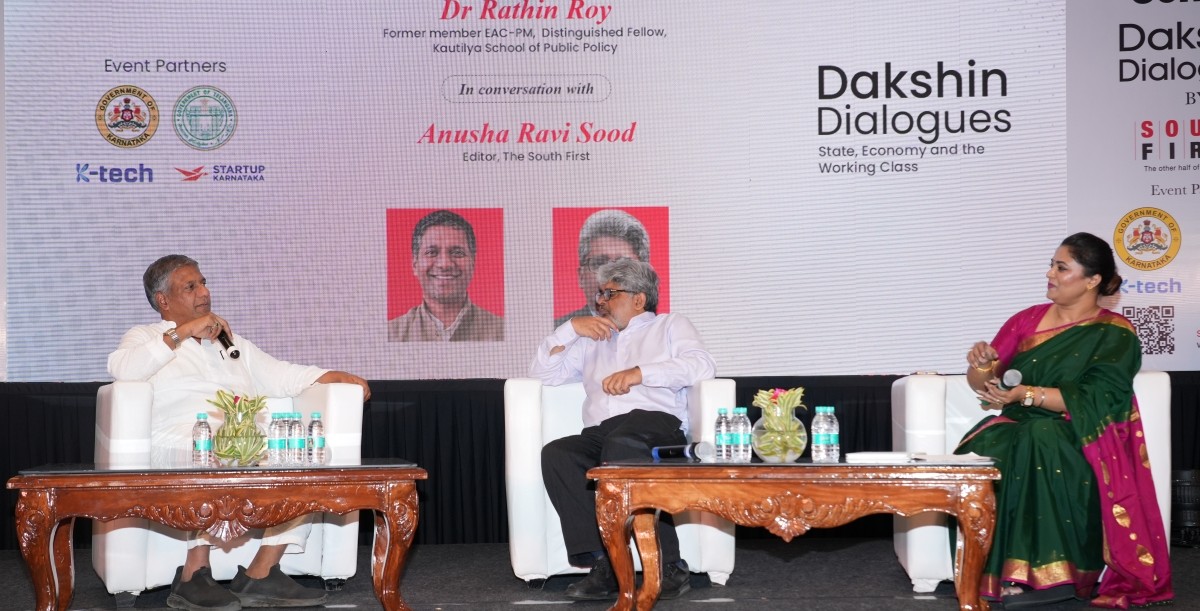
Arvind Bellad and Rathin Roy at the concluding session of Dakshin Dialogues-2026. Anusha Ravi Sood is also seen. (South First)
Synopsis: The tragedy of the south is that despite its economic success, the two major cross-cutting social failures — patriarchy and caste — remain largely unresolved, and that is where the real development conversation should be focused. Dakshin Dialogues is the annual thought conclave of South First. Government of Karnataka, Government of Telangana, K-Tech and Startup Karnataka were event partners for Dakshin Dialogues 2026: States, Economy and the Working Class.
Are South Indian states different from their northern counterparts? No, asserted Rathin Roy, Economist and former Member of the Prime Minister’s Economic Advisory Council.
Roy pointed at the reasons hiding in plain sight. Even as the southern states took pride in the giant strides made, they conveniently ignored aspects that put them on an equal footing with their northern underdeveloped counterparts.
For instance, caste, Roy cited while speaking at the concluding session of Dakshin Dialogues, the annual thought conclave of South First, in Bengaluru on Wednesday, 28 January.
“There is no difference between Karnataka and Bihar in terms of punctuality, because there are other low points, which we don’t expect to see in relatively rich states, but witness in all southern states. Number one is caste and its impact,” he said at the session on South: Highs, Lows, and In-between.
Roy’s observation hit the audience hard.
“In Tamil Nadu, Karnataka, or Telangana, 96% of people marry within their caste. This is called caste endogamy. We don’t expect this in a high productivity and high per capita income space,” he shared the ugly truth.
The eminent economist did not spare Kerala either, a state that highlights its impressive human development indices at the slightest opportunity.
“Another aspect is patriarchy. Kerala is an example. No matter the state’s education, human development index or low maternal mortality, patriarchy is surprisingly robust,” Roy walked across the dais, microphone in hand.
His words, food for introspection, kept coming. “The progress of a place that has done well socially and economically in the first round, when it passes into the second round, depends very critically on making social progress,” he said.
“It involves embracing a model mentality, which doesn’t have room for discrimination or staying put in the caste and patriarchal zones.” the audience, including several students, remained silent as his words cut across the hall in The LaLit Ashok Hotel.
A comparison he further made singed many like ember. “If a large proportion of a woman’s time is going to caregiving and unpaid labour in a family, you will never reach South Korea. You will end up in some zone like Thailand,” he continued.
He reminded that Thailand was not only about its picturesque beaches and serene wats — or temples — many of them flanking the mighty River Chao Phraya.
Roy’s energetic tone continued, even as the summit extended beyond schedule.
“Nobody usually cares about Thailand, but for ‘certain’ popular things. It is one of the world’s largest chicken exporters. I can see India going there. We are not making the kind of progress that we should make here. What economists call this is the lack of ability to raise your game: to summarise it in one word, ‘Productivity’,” he said.
“The median wage of a worker in a formal high-value manufacturing job in Tamil Nadu is ₹25,000 a month. Why? The productivity of the average worker in Tamil Nadu is 25 percent that of a Korean,” he kept raking thought.
“How can a state with Indonesia’s per capita income still sell tea for ₹10? A rich economy should not have poor prices. The tea is not cheap because the state is poor. It is cheap because the labour comes from poorer states. Prices in rich cities reflect the poverty of migrant labour, not the state’s prosperity.” Roy’s words took time to sink in.
“When the labour is cheap, people replace machines. When labour is expensive, machines replace people. What we call convenience is actually dependence. What we call affordability is actually underpaid labour. Feudalism today is not about land. It is about how many people you can afford to keep serving you,” he continued before mentioning the present-day collective mentality.
“Why buy a dishwasher when a human being is cheaper? That single decision holds back productivity. In a feudal society, status is measured by how many people wait on you. In a modern society, it is measured by time and efficiency. We became rich as states, but poor in behaviour. Wealth arrived, modernity did not. The audience listened with rapt attention like students attending an all-important lecture.
“India’s problem is not inequality of income. It is the continued misuse of labour in a rich economy,” Roy shifted gears.
“Despite having per capita incomes comparable to Indonesia, the south still sells tea at ₹10, which raises a basic question: who is making and selling tea at such prices?”
He did not wait for an answer. “This persistence of cheap services is not a sign of efficiency but of a society clinging to feudal habits even after becoming wealthy, substituting human labour for productivity-enhancing systems and technology,” he added.
Roy said he had repeatedly warned southern governments that this socioeconomic trajectory has gone off the rails — the region risks stagnating like Thailand instead of aspiring to move up the ladder like China or South Korea.
Who is to be blamed? Roy answered. “Development is not just about income or government policy; it is deeply social. You see it in how people drive (vehicles), how hygiene is maintained,” the words immediately struck a chord with the audience.
The moderator intervened and raised a question that has crossed many minds in the hall: Can the South be analysed in isolation, given its internal diversity and its place within a larger country?
“Yes,” pat came the answer. “It can be looked at in isolation. Despite migration and the apparent diversity, social behaviour remains deeply close. In Karnataka, including Bengaluru, nearly 96% of people still marry within their caste. Caste endogamy is not regional endogamy — it travels with people,” he once again reminded the caste consciousness ingrained in the Indian psyche.
“A Punjabi living in Bengaluru will still look forward to marrying within his caste rather than crossing the caste boundaries. These social structures reproduce themselves wherever people settle, and hence, the issue can be examined regionally. The isolation is not geographic or economic — it is social,” he explained.
After Roy, it was the turn of Arvind Bellad, Deputy Leader of the Opposition in the Karnataka Assembly.
Responding to a question on jobs, regional imbalance, and the role of the state and the Centre, Bellad said the roots of Karnataka’s imbalance were historical. He cited the regions ruled by the Maharajas and the British.
While the Maharajas encouraged development, it was localised under the British. The British developed areas where they lived and worked, while the hinterlands stagnated.
“In contrast, princely states like Mysore (Mysuru), Baroda, Patiala, and Travancore saw more even development. These historical distortions were never corrected after Independence, which is why public sector units and, later, jobs clustered around Bengaluru, reinforcing the imbalance,” he said.
Bellad said the situation remained the same even now. “Massive investments flow into Karnataka, but almost none of them reach the northern districts, barring pockets like Ballari-Hospet. This neglect continues,” the political leader, who rushed to the summit after a hectic day in the Assembly, was candid.
However, on the Centre-state relations, he said there was no evidence of discrimination against opposition-ruled states.
“Karnataka has received record funding for highways, railways, metro projects, and airports. The real issue is the lack of sustained engagement by the state leadership. Governance requires active negotiation; the Centre governs many states, and it is up to Karnataka’s leaders to make their case forcefully,” he said.
Bellad reserved kind words for leaders like Andhra Pradesh Chief Minister N Chandrababu Naidu. He said they “understood how to extract maximum value from the Centre, regardless of political alignment.”
Naidu’s TDP is aligned with the NDA.
“Development does not happen by default; it has to be pursued relentlessly,” the BJP leader added.
He agreed with the moderator’s view that certain parts of Karnataka are left underdeveloped.
“You are absolutely right,” Bellad said. “If you look at development indices — maternal health, child health at birth, primary health centres per population, or schools per student — the bottom-performing districts are in North Karnataka and Kalyan Karnataka,” he pointed out.
“Bengaluru’s per capita income is around ₹6.5 lakh to ₹7 lakh, but in districts like Kalaburagi, it is barely ₹1 lakh to ₹1.5 lakh, which shows the scale of disparity,” he drew a bleak picture.
Bellad further said such “historic mistakes” were never corrected. “Even today, new health centres and schools are allocated on a per-capita basis instead of correcting the past neglect,” he added.
He said the gap would continue until deliberate corrective action was initiated.
Roy chipped in, saying the situation was not unique to Karnataka. “You cannot look at development only as an economic outcome — social outcomes matter too,” he offered his view.
“Kerala is often praised for infant mortality and health indicators, but the everyday patriarchy you see there is deeply troubling. Tamil Nadu speaks loudly about social reforms, but caste continues to play a determining role in economic outcomes. It is not very different from Karnataka, Telangana, or Andhra Pradesh,” he said.
Roy summed up. “The tragedy of the south is that despite its economic success, the two major cross-cutting social failures — patriarchy and caste — remain largely unresolved, and that is where the real development conversation should be focused.”
Anusha Ravi Sood, Editor of South First, moderated the session that marked the culmination of Dakshin Dialogues 2026, which deliberated on the State, Economy and the Working Class.
Dakshin Dialogues is the annual thought conclave of South First. Government of Karnataka, Government of Telangana, K-Tech and Startup Karnataka were event partners for Dakshin Dialogues 2026: States, Economy and the Working Class.
(Edited by Majnu Babu).


