

Published Jan 28, 2026 | 9:00 PM ⚊ Updated Jan 30, 2026 | 6:43 PM

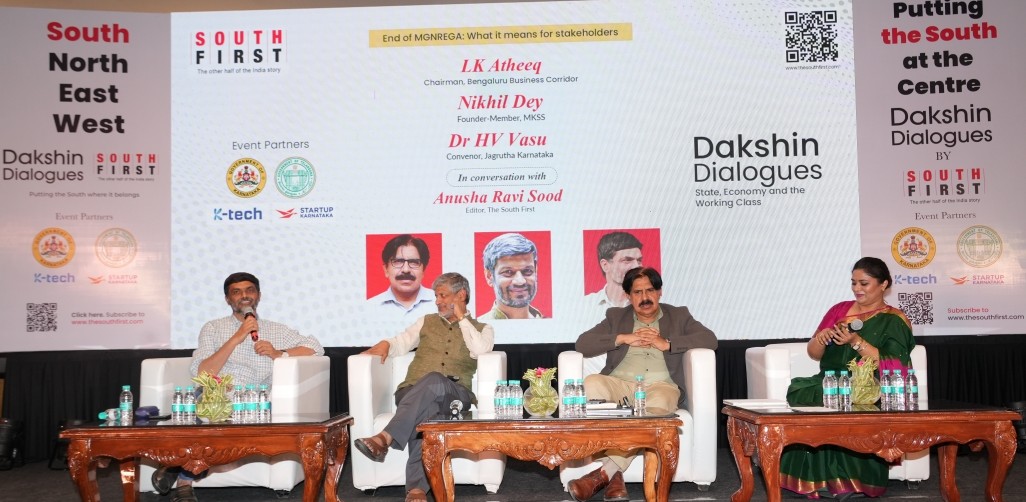
Panelists discussing the VB—G RAM G Act at the Dakshin Dialogues in Bengaluru on Wednesday. (South First)
Synopsis: The ‘guaranteed’ 125 days work is the one which is being fed every day in all the newspapers. But you have reduced the right to a scheme which is actually not going to be implemented because states have to face this burden. In all probability, states will see to it that they don’t implement this at all. So that 125 days does not come to picture at all. It is only a farce. Dakshin Dialogues is the annual thought conclave of South First. Government of Karnataka, Government of Telangana, K-Tech and Startup Karnataka were event partners for Dakshin Dialogues 2026: States, Economy and the Working Class.
The Viksit Bharat – Guarantee for Rozgar and Ajeevika Mission (Gramin) Act, 2025, which replaced the MGNREGA in December 2025, has sparked serious concerns among activists and policy experts.
They argued that despite promising 125 days of guaranteed work—up from 100 days—the new law may actually undermine rural employment rights through structural changes and lack of consultation.
At the fourth edition of Dakshin Dialogues, the annual thought conclave of South First held in Bengaluru on Wednesday, on 28 January, a panel of experts dissected the implications of the VB-G RAM G Act for rural workers, state governments, and democratic processes.
The discussion brought together Dr HV Vasu, Convenor of Jagrutha Karnataka; Nikhil Dey, activist and founder member of MKSS; and LK Atheeq, Chairman of Bengaluru Business Corridor.
Atheeq identified four major problems with the act, foremost being the absence of a mechanism to enforce the promised guarantee.
“Guarantee is embedded in the title of the act, but there is no mechanism to enforce guarantees,” he said.
“What it does is that the central government determines unilaterally a particular normative allocation for each state. Once that money is exhausted, then you cannot really operationalise this,” Atheeq said.
Under MGNREGA, states could request supplementary grants when allocations were exhausted, typically increasing budgets from around ₹60,000 crore to ₹1 lakh crore annually. This demand-driven mechanism ensured the employment guarantee could be honoured. The new act eliminates this flexibility, potentially leaving workers without recourse when normative allocations run out.
Dr Vasu emphasised the disconnect between the Act’s promises and its likely implementation.
“This 125 days work is the one which is being fed every day in all the newspapers,” he said. “But you have reduced the right to a scheme which is actually not going to be implemented because states have to face this burden. In all probability, states will see to it that they don’t implement this at all. So that 125 days does not come to picture at all. It is only a farce.”
The shift from a 90:10 cost-sharing ratio (where states bore 10% of material costs) to a 60:40 split between centre and states represents a significant financial burden.
“Through a law, they have legislated a centrally sponsored scheme,” Atheeq explained. “You have imposed a burden on the state governments, and if you fail to provide employment, the state government will have to provide unemployment allowance.”
For Karnataka, which spent around ₹800 crore (10% of material costs on total expenditure of ₹8,000 crore), the new requirement would be ₹3,200 crore—a four-fold increase.
“This was not anticipated, and they would have given an award,” Atheeq said, referring to the 16th Finance Commission’s recommendations made before the act was passed.
“This 3,000 crores will go, which was not anticipated. We are not very sure how legal it is, definitely not ethical to impose through a central legislation certain financial liabilities on the state governments whether they like it or not,” he added.
Dr Vasu questioned how poorer states would manage. “How will Uttar Pradesh and Bihar fund these schemes?” he asked. “So with this, how will UP and Bihar implement this with this 40% burden?”
The Act’s provision allowing states to notify a 60-day pause during peak agricultural seasons drew sharp criticism.
Dey described it as “openly pro-employer, because it deals with actually blocking off… that you will not on a government programme take anyone for those 60 days, so that they can get cheap labour, whoever. Maybe landlords, it’s also contractors, it’s also corporates.”
Atheeq argued that if farmers need labour, they should compete with MGNREGA wages rather than having the state provide cheap labour. “Once you have come up with an idea that there has to be some floor wage, then if the farmers are not willing to hire people at this, they should increase the wage and then they should hire people, or they should mechanise.”
Dr Vasu challenged the narrative around farmers being negatively affected, noting that in Karnataka, “at least 80% of the farmers are small and marginal farmers, who many of them themselves are MGNREGA workers. And the other farmers will get benefited with MGNREGA because some of the provisions also help the farmers directly.”
Perhaps the most scathing criticism was against the manner in which the Act was passed. Dey contrasted it with MGNREGA’s passage, showing video clips from Parliament.
When MGNREGA was passed in 2005, there was “complete consensus in Parliament. Not an empty seat. Whips from all parties to come and vote in favour,” he said. The Bill went through a standing committee headed by a BJP member and underwent “several rounds of discussion” before returning to Parliament with significant changes.
The VB-G RAM G Act took “three days to pass both houses” with “huge controversy. Papers being thrown,” according to footage from Sansad TV. “Nobody was given a chance. Nobody anywhere was given a chance to be able to give feedback. It was not sent to a standing committee,” Dey said.
“The south was not asked. No part of the country was asked. States were not asked. Panchayats who are affected were not asked, and people who are affected were not asked,” he emphasised, adding that “to not consult, to pass this through in the manner that it has been passed, to not for people to know what exactly is being passed at all on something as important as this is just very damaging to democracy.”
Atheeq also highlighted the top-down approach: “How much is the normative allocation will be decided by the centre, objective parameters they will use, but what parameters are those, they will decide. In which areas of the state it has to be implemented, those will be notified by the Centre.”
Dr Vasu outlined the stakeholders affected, highlighting that women are particularly impacted. “For the first time in this country, a government policy implemented equal wages for both men and women,” he said.
In Karnataka, 58% of MGNREGA workers were women—proportionately more than their population—whilst scheduled castes comprised 28% of workers despite being only 18% of the state’s population.
He also made a symbolic point about the Act’s name (VB-G RAM G).
“I would also like to add that there are two more stakeholders, the new stakeholders with the new Act, and they are losers from day one. So one is Ram and the second one is Ram Bhakta. All of this is being done in the name of Ram. So that is the tragedy. All Ram Bhaktas actually should come out and say that this should not happen in the name of Ram,” he said.
Beyond individuals, panchayats stand to lose significant autonomy. Atheeq explained that MGNREGA “was kind of a lifeline for a panchayat. In Karnataka, there are 6,000 panchayats, and we spend anywhere between 6,000 to 8,000 crores. So, on average, every panchayat gets a crore rupees of budget. Panchayats feel free to do whatever work they want. If there is a road that had to be fixed immediately, they have the money.”
When asked about the possibility for protests similar to the farmers’ agitation, Dey argued this was “a completely different kind of group that is affected” and predicted “the world’s largest decentralised protest.”
“It will take time. There are groups coming up, they will start making themselves be heard. The nature will be different. We have seen many places where women are turning up at their panchayat,” he said. “Many don’t even know, and that is the biggest problem.”
Unlike Punjab farmers who “had all the mighty force behind them, their solidarity, the langars that they had,” MGNREGA workers lack the resources for extended sit-ins.
“I don’t think that the MGNREGA workers will have such a privilege to protest in sit-ins which can happen for years,” Dr Vasu observed.
However, he noted that organisations are mobilising. The Gramina Kulikarada Sanghatane (GRAKUS), Karnataka’s biggest MGNREGA workers’ organisation, is planning a protest in Bengaluru on 2 February—20 years after MGNREGA was enacted—with a national protest scheduled for 8 March.
Atheeq acknowledged that MGNREGA required reform, particularly addressing why relatively richer southern states like Tamil Nadu, Telangana, and Andhra Pradesh utilised the scheme more intensively than poorer states like Uttar Pradesh and Bihar.
“These states which are relatively richer utilise higher amount of MGNREGA in terms of percentage target compared to UP and Bihar. UP and Bihar are poorer states. Their per capita income is way low. In fact, it is half of the per capita income of Karnataka or Telangana,” he said.
However, he argued that reform didn’t require a complete overhaul. “A lot of this reform could have been done within the existing law. There was no need to really overhaul the law the way they have done.”
He shared an anecdote from Raichur district, where 100,000 people turned up for work daily during peak periods. “What do we do with them? As long as you are not creating alternatives, you are not structurally transforming your economy so that rural workers have required education and skill, and in the non-farm sector there are adequate jobs for us to shift them, this is a problem.”
Dey suggested that “90% is copy-paste” from MGNREGA, but “the four things that have changed, essentially, I don’t see as redeeming qualities.” He noted the Act mandates alignment with Viksit Bharat, whereas MGNREGA allowed for bottom-up planning. “Whatever money will go, will go into big infrastructure, including PM Gati Network,” he said.
Addressing arguments that MGNREGA needed replacement due to corruption, Dr Vasu countered: “Tell me one scheme in this country which does not have corruption. And when a Supreme Court tells you that electoral bond was nothing but corruption, and you are happy with it. All the hue and cry is about the decentralised small corruption. I do agree that there is corruption in MGNREGA also. But decentralised corruption is much, much better than centralised corruption.”
He questioned whether the new Act would reduce corruption. “Is the new Act going to reduce corruption? You have introduced contractors into it. So there is more chance for corruption here.”
Dey defended MGNREGA’s environmental credentials, noting it is “probably the world’s largest climate mitigation programme” through its work on earthworks, check dams, and green cover that create carbon sinks.
He also challenged Prime Minister Modi’s 2015 criticism about “digging pits” after 60 years of independence. “You cannot have a tree without digging a pit. You cannot have food on your table without agriculture’s digging of earth. You cannot have this building without digging the foundation and construction.”
As the VB-G RAM G Act begins implementation, the questions raised by the panel at Dakshin Dialogues remain unanswered: Can a guarantee function without enforcement mechanisms? Can states bear the increased financial burden? And most fundamentally, can a law passed without consultation serve the people it claims to protect? The coming months will reveal whether the enhanced promise of 125 days translates into reality or remains, as Dr Vasu put it, “only a farce.”
Dakshin Dialogues is the annual thought conclave of South First. Government of Karnataka, Government of Telangana, K-Tech and Startup Karnataka were event partners for Dakshin Dialogues 2026: States, Economy and the Working Class.
(Edited by Majnu Babu).


