

Published Oct 26, 2026 | 12:08 PM ⚊ Updated Oct 26, 2026 | 12:08 PM

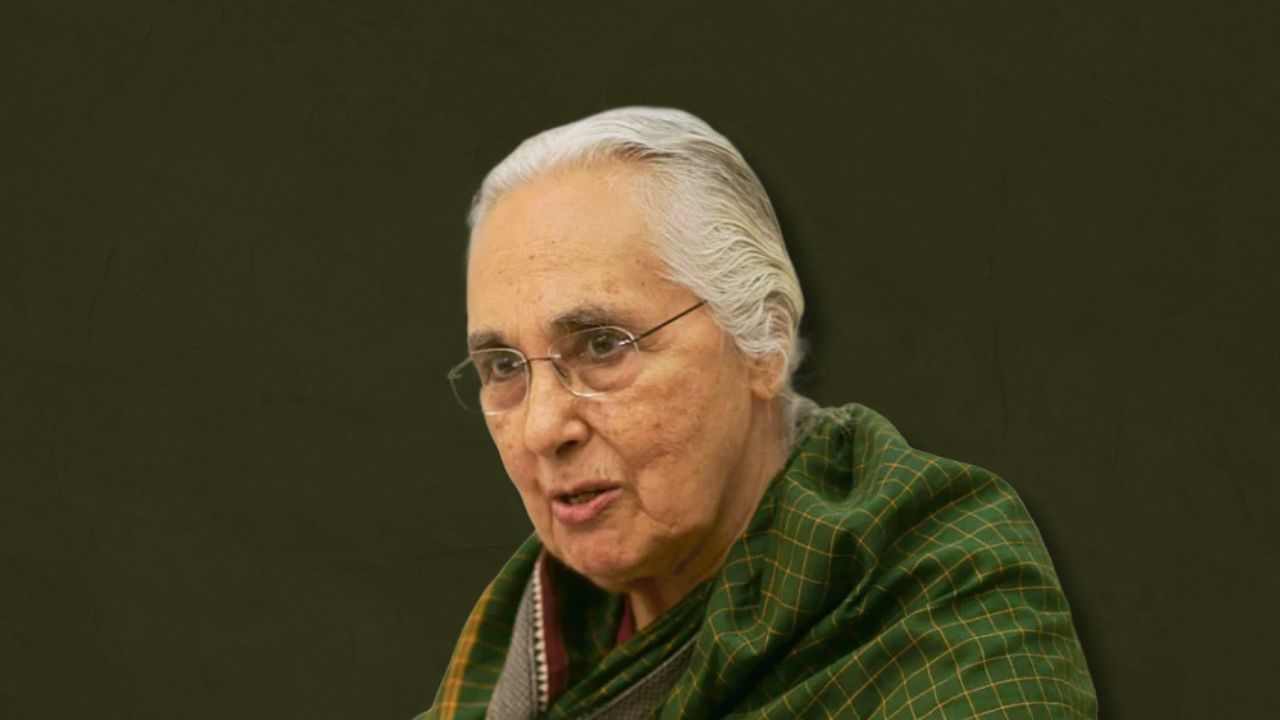
Prof Thapar said that decolonising Indian history required questioning both colonial and Hindutva interpretations.

Synopsis: Romila Thapar said the study of history needed to retain space for debate, evidence-based interpretation and further research. She said interpretations that denied the centrality of secularism and democracy as essential components of the nation emerging from colonial rule were already being challenged, despite attacks on those who questioned them. Professional historians continued to investigate the historical evolution of Indian society and its economy, she said, in contrast to the past imagined and propagated by Hindutva groups.
Historian Romila Thapar has said that the Hindutva interpretation of Indian history seeks to justify the establishment of a Hindu Rashtra by presenting Hindu majoritarianism as the defining feature of the country’s past, while ignoring evidence that challenges this account.
Delivering the Second Sitaram Yechury Memorial Lecture on “Historiography and Early Indian History” at Harkishan Singh Surjeet Bhawan in New Delhi on Sunday, 25 October, Prof Thapar said decolonising Indian history required questioning both colonial interpretations and the Hindutva ideology that sought to replace them with a partisan account of the past.
“The supporters of the Hindutva ideology speak of the need to decolonize history. Certainly, this is a crying need. This has been and is being done already by professional historians. Decolonization would need to question the Hindutva ideology itself and refute it,” she said.
She argued that historical writing had to be based on reliable evidence, rational explanations and methods that allowed interpretations to be questioned. The use of history for contemporary political purposes, she said, had become increasingly apparent, particularly when ideological interpretations entered textbooks, school curricula and official presentations of the past.
“In this interpretation, the purpose of history is not to explain what happened in the past, but instead to construct statements for contemporary political use,” she said.
Prof. Thapar said the Hindutva account of early Indian history portrayed the Hindu community as dominant in an idyllic past and described the period as a long golden age that ended with the arrival of Muslim rulers, who were held responsible for the victimisation of Hindus.
“There is strong evidence to the contrary in the work of professional historians, but this evidence is ignored or dismissed as prejudiced,” she said.
Those who rejected this interpretation, including historians researching social and economic history, were often labelled Marxists regardless of whether their work actually followed Marxist approaches, she said.
Official versions of history, she said, failed to reflect the debates and different explanations through which historians had examined changes in Indian society.
Also Read: From the coast to Old Mysuru: How Karnataka’s communal politics is shifting inland
Prof. Thapar said historical research had changed substantially from the mid-20th century, when historians began questioning colonial interpretations and moved beyond recording when and where events occurred to examining why and how they happened and what consequences followed.
The change required historians to study society’s economic structures, social relations and belief systems together rather than treating them as separate, unchanging categories. It also required scrutiny of the people who produced historical sources, their intellectual approaches and the purposes that shaped their accounts.
“The method requires determining a theme to be researched and locating the sources to be consulted, both textual and material objects where they exist,” she said.
Evidence from different sources could not be used indiscriminately. Historians had to establish the reliability of sources, assess how they had been interpreted and correlate the evidence with events to arrive at rational explanations.
“Insistence on using only proven, reliable evidence differentiates professional historians from those who write what they claim to be history, but where personal views, whether verified or not, are often upfront,” she said.
Prof. Thapar distinguished professional historical research from popular accounts circulated on social media without a systematic method of analysis. Such accounts became a matter of concern when they informed textbooks, curricula and official representations of history to advance an ideology.
She said applying an ideology to historical interpretation was not itself the problem. The explanation had to rest on reliable evidence and remain open to questioning.
The movement of history towards the social sciences had also expanded the range of methods available to researchers. Studies of early India now drew on anthropology, sociology, demography, archaeology, linguistics and genetics, depending on the questions being examined.
Research into the Vedic period, for instance, could not be confined to Vedic texts. Archaeology provided evidence of material culture, linguistics enabled closer examination of languages, and genetics offered evidence for studying the populations that came together to form new cultures.
Also Read: Jana Krishnamurthi: The Pied Piper of Hindutva in South India
Prof. Thapar traced several influential interpretations of Indian history to colonial scholarship, which had portrayed Asian societies as static and governed by despots who controlled peasants through bureaucracies. This account, commonly described through the idea of Oriental despotism, treated historical change in Europe as fundamentally different from that in Asia.
Colonial interpretations of India also claimed that the country lacked a sense of history and had no historical traditions comparable to those of ancient Greece and Rome.
Prof. Thapar challenged this view by pointing to Indian texts, dynastic genealogies, biographies, chronicles and inscriptions that recorded political succession, governance and social change.
The term Itihasa, she said, reflected an Indian way of representing and interpreting the past. It was neither identical to modern historical writing nor simply mythology.
The Vishnu Purana, composed in the early to mid-first millennium CE, contained genealogies of historical dynasties and traced the history of Magadha to the Guptas, she said. Post-Gupta inscriptions also recorded dynastic successions.
Historical biographies such as Banabhatta’s seventh-century Harshacharita, concerning Harshavardhana of Kanauj, and Sandhyakar Nandi’s Ramacharitam, concerning the Pala king Ramapala, contained information about royal authority and political conflict. These works were more than the hagiographies colonial scholars had dismissed them as, Prof. Thapar said.
The Harshacharita recorded complaints by rural people about the disruption caused when royal armies and their followers camped in their areas during military campaigns. The Ramacharitam referred to a revolt involving local leaders who rode buffaloes. Historians had interpreted the latter episode variously, as a peasant revolt or resistance by feudal lords.
She also cited Kalhana’s 12th-century Rajatarangini, a history of Kashmir that examined rulers and governance, as evidence of developed historical writing in pre-colonial India.
Persian texts produced in the Sultanate and Mughal courts, alongside Sanskrit biographies and chronicles, further demonstrated that interest in the past continued across periods. Mughal rulers wrote memoirs or supervised biographies, while Sanskrit texts were translated into Persian.
Prof. Thapar also cited Firoz Shah Tughlaq’s interest in the pillars of Ashoka Maurya. Although their inscriptions could no longer be read at the time, the pillars remained imposing objects from the past and could serve as symbols of authority and legitimacy.
Also Read: Interview: Hindutva just another name for Indianness, says BJP national general secretary CT Ravi
Inscriptions on stone and copper plates, many of which recorded royal genealogies, dates and events, provided another substantial body of historical evidence. From the post-Gupta period onwards, they documented land relations, taxation, governance, commercial transactions, caste relations, donations to religious institutions and other aspects of society.
The edicts of Ashoka contained an early statement of the ethics of Dhamma, or Dharma, while later inscriptions supplied information about the changing structures of society and the economy.
“Thus, the body of information for writing histories was not sparse,” she said.
Prof. Thapar noted that colonial scholars had insisted that India lacked a historical tradition even after deciphering inscriptions that revealed the complexity of its past. She raised the possibility that records produced by non-Brahmin scribes and preserved by bards and genealogists of lower social status had received less attention than religious texts associated with Brahmins.
She said the claim that India had no history had made it easier for colonial officials to impose their own interpretations of the past.
An influential example was James Mill’s The History of British India, published from 1817 onwards. Mill divided India into two permanently hostile nations, Hindu and Muslim, a framework that confused religion with nationalism.
Prof. Thapar said the concept of the nation, understood as a territorial and unified political community, emerged in Europe only about three centuries ago. Religious identities had existed for millennia and could not be treated as equivalent to nations.
She also rejected the idea that conflicts between Hindu and Muslim rulers were invariably religious confrontations. Political struggles over territory and power had occurred between Hindu rulers before the arrival of Muslim rulers, while religious conflicts had also taken place between Brahmanical traditions and the Sramana religions, including Buddhism, Jainism and Ajivikas.
Even when Hindu and Muslim rulers fought each other, she said, their conflicts could not be explained solely through religion.
The Battle of Haldighati in 1576, fought between Rana Pratap’s forces and the Mughal army, was an example. The struggle concerned territorial rights, the recovery of kingdoms and control over territory.
Rana Pratap’s army included a substantial contingent of Afghan soldiers led by Hakim Khan Suri, who sought to re-establish Suri power in the Middle Ganges Plain. The Mughal army was commanded by the Rajput Raja Man Singh and won the battle.
Prof. Thapar said the battle had since been recast as a confrontation between Muslim invaders and Hindu rulers defending Hinduism.
“To maintain that every conflict was an expression of religious antagonism, and that this antagonism pervaded all activities, is utterly untenable,” she said.
Mill’s theory of two permanently hostile religious communities later informed the two-nation theory and contributed to the historical arguments used to support the Partition of 1947, Prof. Thapar said. Although later historians discarded this framework, it continued to be invoked to encourage religious conflict.
The same colonial framework had divided Indian history into Hindu, Muslim and British periods, a classification she said historians had since abandoned.
Also Read: The story of Vidya Bharathi schools, RSS ‘Hindutva’ ideology and how its alumni benefit the BJP
Prof. Thapar identified the theory of the Aryan race as another colonial interpretation that continued to influence accounts of early Indian history.
The linguistic relationship between Sanskrit, Greek and Latin, discussed by William Jones and Friedrich Max Müller, had led some scholars to assume that speakers of related languages belonged to the same race. Max Müller himself criticised that assumption, but the belief persisted even after social scientists abandoned race as a valid basis for classifying human groups.
The theory also encouraged claims that upper-caste Indians descended from Aryans. Some Indian writers argued that the British, as Celtic Aryans, and upper-caste Indians, as Indo-Aryans, were distant cousins.
Prof. Thapar said colonial accounts had also treated Vedic texts as the principal, and often the only, foundation for understanding ancient Indian civilisation.
Archaeological excavations subsequently revealed the Indus civilisation as an advanced urban and literate culture, different from the pastoral society described in the Vedic texts, where some agriculture was practised but urbanisation was not depicted.
Some scholars had more recently argued that Indo-Aryan showed indications of the presence of another language, suggesting cultural contact between speakers of different languages. Prof. Thapar said this argument required further investigation but was instead meeting with denial.
She raised questions about whether Aryan-speaking populations migrated gradually across the subcontinent, what prompted their movement, and whether caste maintained separation during the early stages. She also questioned the Hindutva position that Aryan speakers were indigenous to the subcontinent.
“Genetic evidence tends to seriously question this view, and we await definitive genetic readings to help solve a historical problem,” she said.
Prof. Thapar said Indian historians initially adopted several premises of colonial scholarship without fully examining their implications. The need to defend Indian nationalism also encouraged the use of historical arguments that presented the country’s past as a golden age of largely unblemished civilisation.
A generation of historians who entered the field from the 1960s began questioning colonial interpretations and re-examining some nationalist generalisations through systematic analysis and theories of historical explanation.
They also examined who produced historical sources, whose experiences those sources represented and how accounts of the past served the interests of particular groups.
The debate over whether the early medieval period, extending from the post-Gupta era to the early second millennium CE, was characterised by feudalism illustrated the importance of this approach. The debate among Indian historians in the 1970s and 1980s did not produce a definitive answer, but it led to new investigations of a period earlier described as a dark age.
Prof. Thapar said such debates showed the difference between repeatedly imposing a general pattern on the past and investigating the changes that occurred across different periods.
Historical research also required examining changes in political organisation, from chiefships and ganasanghas to kingdoms, or rajyas, and the emergence of empires. It had to establish how these political systems functioned rather than assume that all empires were centralised and uniform.
Questions about land relations, the reach of Mauryan administration, long-distance trade and the sources of wealth used to construct temples and mosques were equally important. The evidence could reveal how political power, economic resources and social structures changed over time.
Also Read: Social engineering the RSS way: Injecting Hedgewar into Malayali psyche, one jab at a time
She said changes in caste relations also required investigation. References to varna and jatis appeared in early sources, but Ashoka’s edicts, which addressed society across the subcontinent, did not mention them. Differences in regional economies, social norms, kinship systems, ownership of resources and religious institutions could help explain how social relations evolved.
Prof. Thapar also questioned why Christianity and Islam, despite professing equality as a major religious principle, had permitted caste discrimination to continue among converted elite groups against lower castes.
Colonial scholars had often presented Hinduism as an exotic religion because they assumed that religions were fundamentally monotheistic. Prof. Thapar said the history of Indian religions instead revealed a range of beliefs, practices, sects and forms of worship.
Bhakti traditions, for example, showed the plurality of religious devotion. Vishnu worshipped as Jagannath in Odisha and as Vitthal in Maharashtra involved distinct regional identities, even though devotion formed the basis of both traditions.
The Sramana religions, the materialist philosophy of Charvaka and the teachings of some Bhakti figures also challenged Brahmanical beliefs and practices. Debate between opposing philosophical positions was an established procedure through which competing arguments could be examined.
She said treating Hinduism as a single, simple monotheistic religion failed to reflect the historical evidence of its diverse traditions and practices. Such a description reflected belief rather than historical research and could serve the political objective of establishing Hindu Rashtra.
“Religion is always embedded in a society, and knowing the ambience of that society is necessary to fully comprehend the religion,” she said.
Also Read: Murugan a vegetarian god? Unraveling the debate with literary and historical evidence
Prof. Thapar said historiography—the study of how history is written and interpreted—was essential to understanding how accounts of the past were shaped by the intellectual positions and political purposes of their authors.
The central questions, she said, were whose past historical sources represented, who produced them, why particular groups sought to appropriate the past and how far their interpretations were supported by evidence.
She argued that decolonisation should not simply replace colonial historians such as Mill and Max Müller with Indian interpretations that continued to rely on colonial assumptions. It should instead open the study of the past to different explanations capable of accounting for the complexity of Indian society.
The use of history to support religious nationalism, she said, had consequences for India’s political present. Nationalism had developed into Hindu and Muslim variants, while secular nationalism was struggling to survive.
“The new national identity brought diverse groups into a single nation, which was also a historical process of change,” she said.
Prof. Thapar said the study of history needed to retain space for debate, evidence-based interpretation and further research.
“This will not happen through a Hindutva reading of Indian history, which is single and fixed, with no scope for further discussion,” she said.
She said interpretations that denied the centrality of secularism and democracy as essential components of the nation emerging from colonial rule were already being challenged, despite attacks on those who questioned them.
Professional historians continued to investigate the historical evolution of Indian society and its economy, she said, in contrast to the past imagined and propagated by Hindutva groups.
“We look forward very much to the new dimensions that historiography will reveal about our history,” she said.
(Edited by Dese Gowda)



