


Published Jan 28, 2026 | 6:43 PM ⚊ Updated Jan 30, 2026 | 6:43 PM

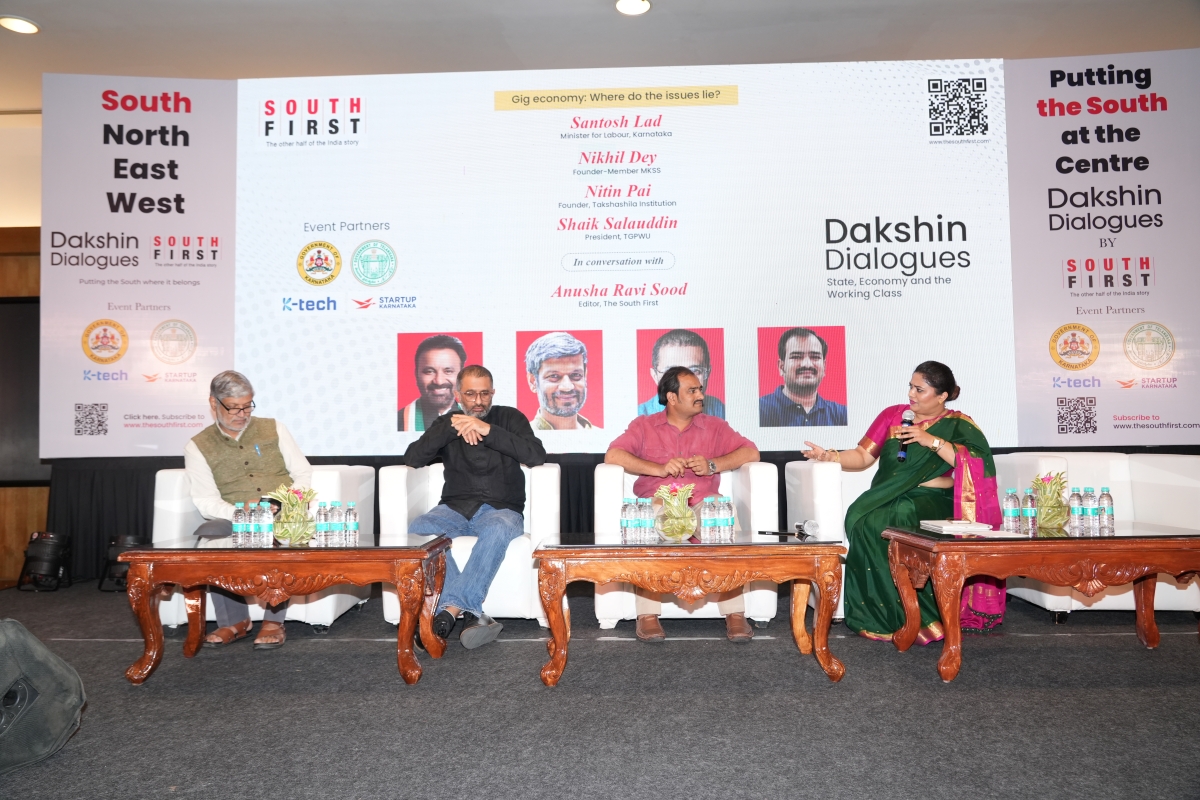
Panel discussion on 'Gig economy: Where do the issues lie?' at the Dakshin Dialogues 2026. (South First)
Synopsis: Dey argued that Karnataka’s law could serve as a model for Tamil Nadu, Telangana and Kerala, where platform work is expanding rapidly. Salauddin insisted that without data transparency and grievance mechanisms, social security promises would remain symbolic. Pai warned that poorly designed regulation could unintentionally reduce employment and introduce exclusion.
India’s gig economy stands at the centre of a growing debate between employment generation and worker protection, with speakers at the Dakshin Dialogues 2026 arguing that while digital platforms have absorbed millions into work, they have done so by transferring risk entirely onto workers.
At a panel discussion titled “Gig Economy: Where do the Issues Lie?” held as part of South First‘s event that concluded in Bengaluru on Wednesday, 28 January, Telangana Gig and Platform Workers’ Union president Shaik Salauddin, Founder, Takshashila Institution, Nitin Pai, and MKSS founder-member Nikhil Dey presented sharply different views on whether state intervention would stabilise or destabilise the sector.
Anusha Ravi Sood, the Editor of South First, moderated the session.
Nitin Pai, framed the gig economy through the lens of national security and social stability.
He argued that India avoided the kind of youth-driven unrest seen in Pakistan, Sri Lanka, Bangladesh and Nepal because sustained economic growth over the past two decades had absorbed large numbers of people into work.
“Economic growth combined with aspiration produces stability,” Pai said. “Even inequality has not led to mass unrest because people believe there is a ladder they can climb.”
Drawing attention to India’s employment challenge, Pai said the country needs to generate 15 to 30 million jobs annually just to keep pace with workforce growth — equivalent to creating employment for the population of Australia every year.
“Even optimistic estimates show we create five to seven million jobs. Independent estimates say closer to two million. That gap will become a crisis in the next decade,” he warned.
Manufacturing failed to scale, he said, partly because of rigid labour laws and union resistance to large factories. “The IT sector could not absorb large numbers. What remains is the service economy — including gig work,” he added.
“For a worker with basic education, a smartphone and willingness to work hard, the gig economy is one of the few available pathways,” Pai said. “Something works here. Don’t break it without knowing what replaces it.”
Over-regulation, he cautioned, could push more people into unemployment — which he described not just as loss of income, but loss of dignity and psychological stability.
“Unemployment is not just economic deprivation. It destroys status and self-worth,” he said. “If regulation reduces jobs by even 10 percent, imagine the human cost.”
Pai also warned against expanding government oversight, arguing that regulation inevitably leads to inspectors, compliance burdens, and misuse over time. “Laws created for good reasons are later used for very different purposes. Be careful what power you create,” he said.
Shaik Salauddin, president of the TGPWU, countered that platforms have built billion-dollar companies by externalising costs and exploiting opacity.
“In the last ten years, platform companies have grown through IPOs and funding, but workers’ pay keeps falling,” he said. “Drivers, delivery workers, and home service workers carry all the risk.”
He pointed to algorithmic control, ID blocking, and lack of grievance mechanisms as core problems.
“Thousands of IDs are blocked every month. That is instant job loss without due process,” he said.
Salauddin highlighted how women workers in home-service platforms often invest large sums — sometimes up to ₹50,000 — to join platforms, only to face sudden deactivation. “How will they repay loans taken on gold or microfinance?” he asked.
He said several states — including Karnataka, Telangana, Jharkhand and Bihar — had moved toward social security frameworks, but platforms refused to share worker data needed to implement them.
“Companies say they create jobs, but they block IDs daily. Where is the dignity in that?” he said.
He also described how insurance systems fail in practice, forcing injured workers to pay hospital bills upfront and navigate complex reimbursement processes. “We are not anti-platform,” Salauddin said. “We are asking for transparency, social security and due process.”
Nikhil Dey, activist and founder member of the Mazdoor Kisan Shakti Sangathan (MKSS), argued that the issue was not a binary choice between unions and government intervention.
“The real relationship is defined entirely by aggregators,” he said. “They depend on workers full-time but deny being employers.”
He noted that many gig workers now come not only from the informal sector but also from among college graduates who enter the sector temporarily and remain trapped.
“They know the system is stacked against them. Frustration is building,” he said.
Dey defended Karnataka’s recently notified gig workers’ law, saying it avoids rigid employer–employee definitions while still protecting workers.
The law creates a tripartite board with representation from workers, aggregators and the government. Its foundation is data transparency. “Platforms extract value entirely through worker data routed via apps,” he said. “The law requires that the same data flow to a statutory board.”
“ID blocking is equivalent to firing,” Dey said. “If platforms can deactivate workers, they can also accept minimal obligations.”
He argued that the law avoids inspectors and physical enforcement by relying on digital governance — mirroring the digital control platforms already exercise. “Digital platforms created the problem. Digital governance can correct it,” he said.
However, Pai remained sceptical that such mechanisms would work at scale, arguing that pooled funds would be too small to cover insurance meaningfully and that state-run systems often fail in delivery.
He suggested multi-source social welfare accounts funded by workers, employers, philanthropy and CSR rather than relying on statutory levies.
Dey countered that without legal frameworks, redistribution and dignity would never be guaranteed. “Markets alone will not correct inequality,” he said. “Social security must be part of earnings.”
Dey argued that Karnataka’s law could serve as a model for Tamil Nadu, Telangana and Kerala, where platform work is expanding rapidly.
Salauddin insisted that without data transparency and grievance mechanisms, social security promises would remain symbolic.
Pai warned that poorly designed regulation could unintentionally reduce employment and introduce exclusion.
The panel closed with agreement on one point that the gig economy now employs millions, and its future will shape India’s labour market for decades.
Dakshin Dialogues is the annual thought conclave of South First. Government of Karnataka, Government of Telangana, K-Tech and Startup Karnataka were event partners for Dakshin Dialogues 2026: States, Economy and the Working Class.
(Edited by Sumavarsha).


