

Published Oct 07, 2026 | 8:27 PM ⚊ Updated Oct 07, 2026 | 8:27 PM

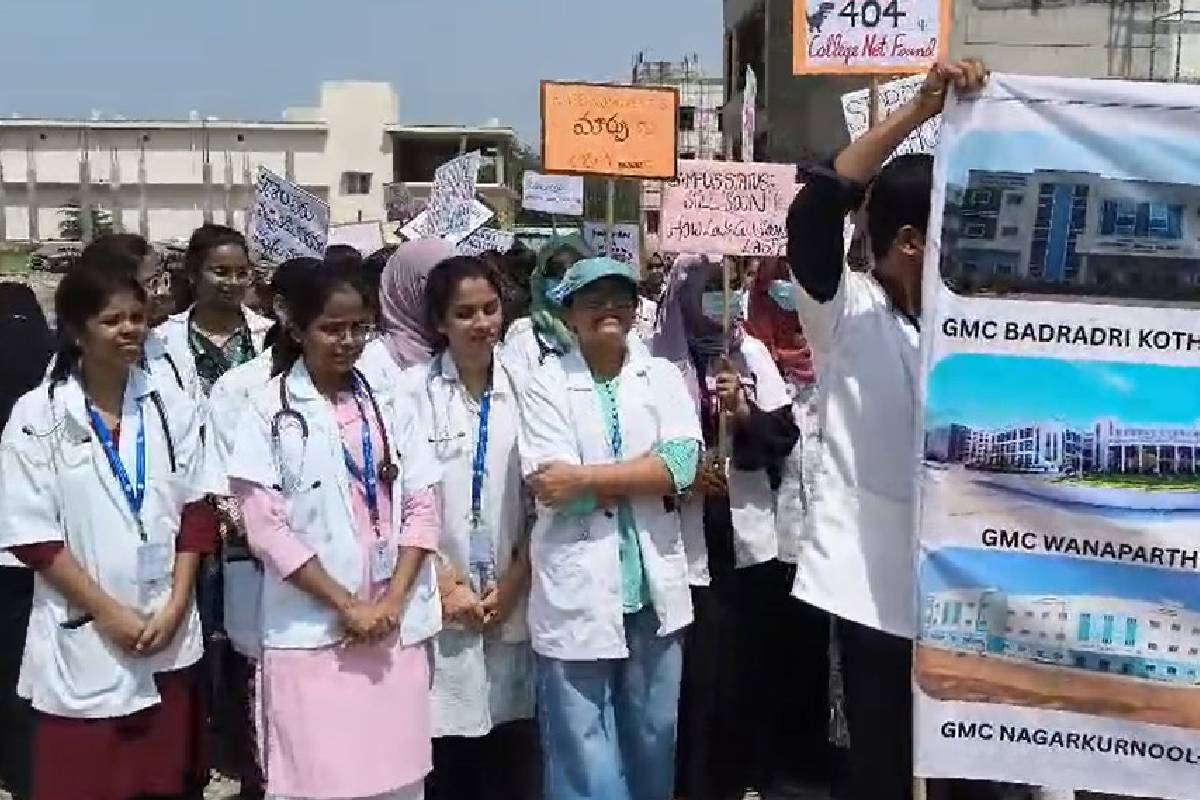
The students said they have been studying in temporary facilities for nearly four years.

Students at Government Medical College (GMC), Jagtial, are protesting over what they describe as years of delay in completing the construction of the permanent college campus and hostel buildings, with another batch expected to join soon.
The students said they have been studying in temporary facilities for nearly four years since the foundation stone was laid for the college and hostels. With the next batch expected to join after Dussehra, they fear the already strained infrastructure will be stretched further, leaving nearly 600 existing students and another 150 incoming students without adequate academic and residential facilities.
“If the next batch comes in, we will sit under the trees and study,” said Rishika Reddy, a student from the 2023 batch.
According to the students, only three lecture halls are currently available for multiple batches. One of the original lecture halls has reportedly become unusable because of ongoing construction, while other spaces, including a reading room and a storeroom, have been converted into makeshift lecture halls.
The students said the situation has become particularly difficult for senior batches preparing for their university examinations.
“We don’t even have a lecture hall. We don’t have a proper mess in our hostel,” Rishika said.
The students have also raised concerns about laboratory facilities. At present, they said, only three laboratories are available and are shared by departments catering to first, second and third year students.
On 5 July 2025, South First published a report on the inadequate infrastructure and other basic facilities in medical colleges, including the GMC, hastily launched between 2022 and 2024 in Telangana.
Also Read: Telangana Cyber Security Bureau arrests 101 in six-state operation against cyber fraud
The lack of a proper library and reading spaces is another major concern. Female students said they do not have dedicated reading rooms because of space constraints in the hostels.
The hostel situation has emerged as one of the key concerns of the protesting students. They said rooms are overcrowded, with six to eight students being accommodated in some rooms.
The students said the lack of space is particularly concerning for senior batches approaching their final-year examinations.
“Without basic reading room facilities in the hostels, it has become incredibly difficult for us to manage our studies and prepare for these crucial exams,” the students said in their representation.
They have demanded that the construction of the hostel buildings be completed by the end of October 2026. They have also sought furnished accommodation for at least 75% of students, interns and resident doctors, along with dedicated reading rooms and internet access.
Rishika said students have been raising the issue with authorities for years.
“We have been waiting for a long time. We have been given a lot of fake promises. We have been waiting for almost three and a half years,” she said.
The students said they had approached the local MLA, District Collector, Roads and Buildings Department and construction contractors over the past two-and-a-half years, but claimed that repeated assurances had not resulted in the completion of the works.
Also Read: POCSO case: Bandi Bageerath requests Telangana HC to restrain media houses, social media
The problems, students said, extend beyond classrooms and hostels.
The college reportedly does not have a dedicated student mess or canteen. Students said they are sometimes forced to eat in lecture halls or other unsuitable spaces because there is no proper dining facility.
They also pointed to the absence of adequate facilities to wash plates and utensils.
“We don’t have a proper place to wash our plates. We don’t have a proper tap to wash our clothes,” Rishika said.
The students have demanded a dedicated and hygienic dining facility with adequate seating, clean drinking water, hand-washing facilities and sinks for washing utensils.
They also said the campus lacks proper internal roads and drainage. During rains, parts of the premises reportedly become muddy and waterlogged.
“There is no proper road. Whenever it rains, the area turns into muddy terrain with overflowing water,” the students said in their representation.
The students also said there is no proper sports ground or recreational facility on campus.
“You tell us if we are physically fit, mentally fit, socially fit. We don’t have a ground here. We don’t have a ground, a lecture hall, a mess,” Rishika said.
Also Read: Telangana SHRC intervenes after woman’s family alleges wrong-eye surgery at Sircilla hospital
The students have also demanded immediate provision of college buses.
They said the lack of dedicated transportation is affecting mandatory academic activities, including the Family Adoption Programme, Rural Health Training Centre and Urban Health Training Centre postings, as well as community medicine field visits.
“We don’t have a bus to reach the college. We come in an auto. We go by ourselves,” Rishika said.
According to the students, they have had to arrange their own transportation for activities that form part of their medical curriculum.
They have therefore demanded immediate provision of college buses to ensure students can attend community postings and other field-based academic activities.
The protesting students have submitted five key demands. They want the hostel buildings completed and handed over by the end of October 2026. They have also demanded completion and handover of the permanent college building by the end of December 2026, with four functional gallery-style lecture theatres, a central library, adequate reading rooms and fully equipped laboratories.
Other demands include college buses, proper internal roads and drainage, development of sports grounds and a hygienic student mess.
(With inputs from Sumit Jha. Edited by Fayisa CA)



