

Published Feb 15, 2026 | 11:41 AM ⚊ Updated Feb 15, 2026 | 11:41 AM

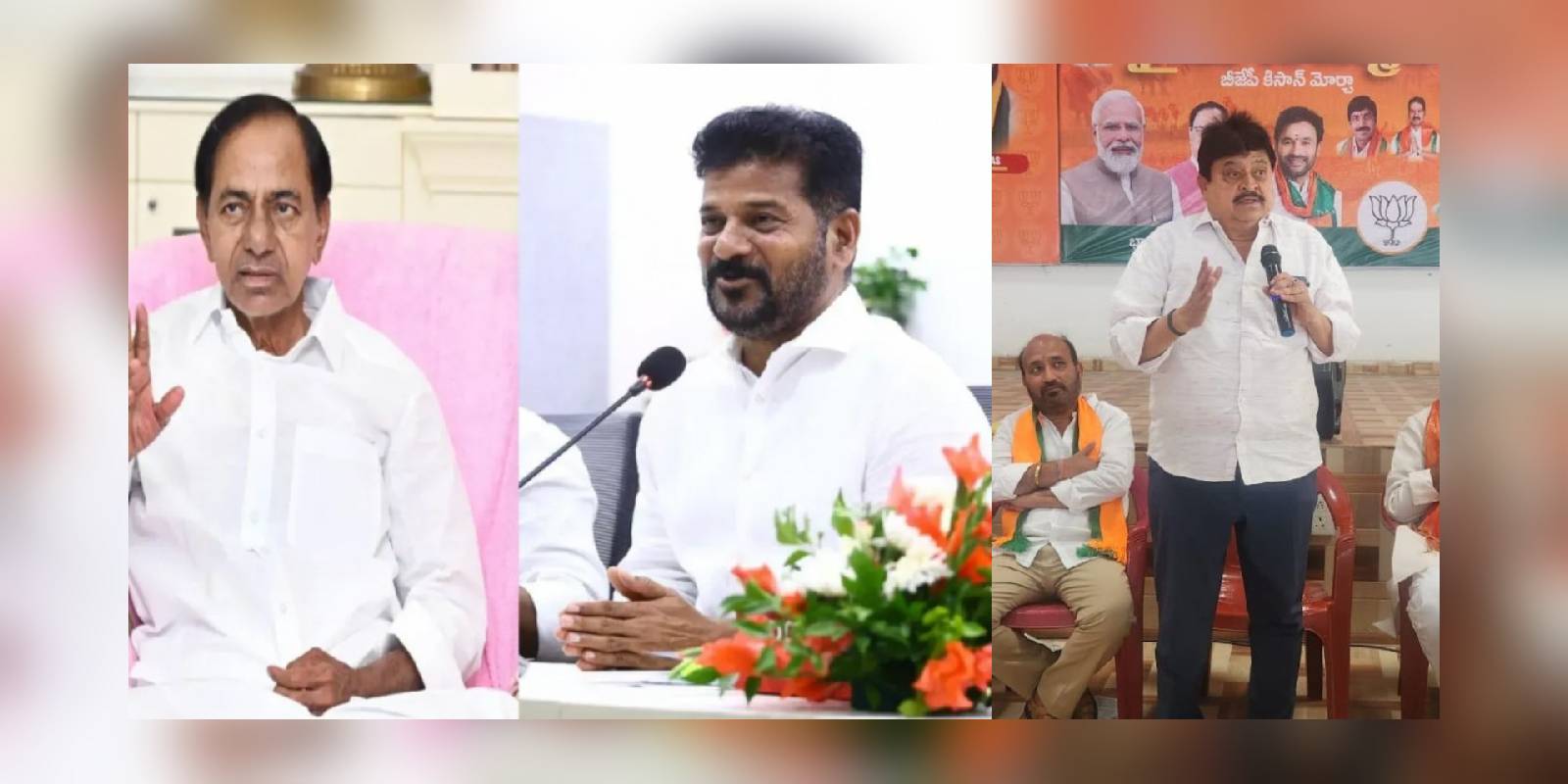
KCR, Revanth Reddy, and Ramachander Rao. (X)
Synopsis: The recent municipal body elections in Telangana reflected the people’s attitude towards the Congress, BRS and BJP. The results show that all three parties should reflect on their performance if they intend to win the 2028 Assembly elections.
Results of the just concluded elections to municipal bodies in Telangana have served as warning bells to all three main players, the ruling Congress, the Opposition BRS and the BJP, which still survives more on hype.
For all the grandstanding by Congress leaders and “sweeping” judgments by pliable media singing peans, the truth is that the results are hardly comforting for the grand old party.
If one were to ignore screaming headlines in print media and rabble-rousing on television and get down to the fine print, here is the outcome: Congress won 66 of the 116 municipalities at stake, the BRS notched up 13, and the BJP 0, while it was a hung verdict in more than 30 municipalities.
Generally, local body elections are supposed to be majorly in favour of the party in power for a variety of reasons: People do not wish to go against a ruling dispensation for fear of development getting stalled or antagonising sitting MLAs and MPs, and the ability of those in power to spend resources far higher than rivals.
A rough estimate by Congressmen themselves suggests that the party spent around ₹150–200 crore in the elections. In every division of a corporation, the candidates reportedly cashed out ₹15–20 lakh.
Mainstream media has long stopped doing any research, but it does not require a lot of digging to understand why Congress should be worried about what it achieved.
In 2020, the BRS, then in power, bagged 112 municipalities; the Congress got just four and the BJP two. Three years down the line, it lost power in the Assembly elections.
In the neighbouring Andhra Pradesh, YS Jagan Mohan Reddy’s YSRCP secured 73 of the 75 municipalities when the state went to polls in 2021. That was two years after he came to power. In 2024, his party was routed in the Assembly polls.
Back in October 2005, when YS Rajasekhara Reddy was chief minister of undivided Andhra Pradesh, the party won 82 of the 95 municipalities. He came to power in June the previous year and managed to narrowly retain it in 2009.
Therefore, the current results should be seen as providing a lot of food for thought for Congress.
An MLC, who has a deep understanding of Telangana society, pointed out that while people are reasonably satisfied with the supply of fine rice, the free bus scheme for women and free electricity up to 200 units, the discontent that showed up cannot be ignored.
“These results are an outcome of the massive effort put in by our party leaders at different levels. The question is whether this will hold when a general election is held,” he said.
According to him, the creation of jobs is the biggest challenge; it will be the determining factor, more than anything else. The large-scale unrest among job aspirants was one of the major reasons for the defeat of BRS in 2023.
If Congress fails on this front, the dangers are not difficult to guess.
Adding to that, massive corruption and lack of coordination among ministers are minus points, as Chief Minister Revanth Reddy’s favourite media personality, V Radhakrishna — owner of Andhra Jyothi — said in his weekly column, even as he showered praise on Reddy for the “stellar performance.”
As for the BRS, the hung verdict in as many as 36 municipalities clearly suggests the Opposition party should have put in better efforts to build on the anti-government mood.
BRS Working President KT Rama Rao himself admitted that the party expected to win more than 30 municipalities but ended up with far less.
What should be more worrisome for the regional party is the manner in which it was almost washed out in some districts, such as Adilabad, Nizamabad, Khammam and Nalgonda.
For the party, the need for restructuring — infusing new blood while weeding out dead wood — is greater now than ever before. Many leaders have turned into “absentee landlords”, hardly spending any time with people back in their constituencies.
The BRS could, of course, take solace in the fact that it secured little over 30 percent of the total votes, winning 718 wards out of the total 2,580, as against the Congress’ tally of 1,350.
If there is one party that is left with egg on its face, it is the BJP. With eight MPs — half of the total seats from the state — and an equal number of MLAs, the party won just 259 wards and not even one municipality.
In two corporations – Karimnagar and Nizamabad, the party bagged the majority of divisions, but again not enough to secure the mayoral post. Nizamabad is incidentally the home constituency of Telangana Pradesh Congress Committee (TPCC) President Mahesh Kumar Goud.
The saffron party’s performance in all other municipalities falling under the Lok Sabha constituencies represented by its MPs has been dismal. So was the case in Nirmal constituency represented by its floor leader in the Assembly, A Maheswar Reddy.
This becomes yet another example that the BJP’s performance in the Lok Sabha election is driven more by its agenda of “nationalism” rather than any real strength on the ground. In close to half the municipalities, the party could not even win a single ward.
Asaduddin Owaisi’s Majlis (AIMIM) should also do soul-searching after its performance dipped in places like Karimnagar, where it had fared better in the past. The CPI managed to retain its hold in the lone Assembly seat it has, while the CPI(M) is increasingly becoming irrelevant.
In a nutshell, the results reflect people’s unhappiness with the ruling party as well as the Opposition.
Of the three parties, the one that draws the right lessons from the municipal results, takes up corrective measures and puts in place the right strategies would determine who will have the edge in the bigger battle in 2028.
(Edited by Muhammed Fazil.)


