

Published May 05, 2026 | 1:28 PM ⚊ Updated May 05, 2026 | 1:35 PM

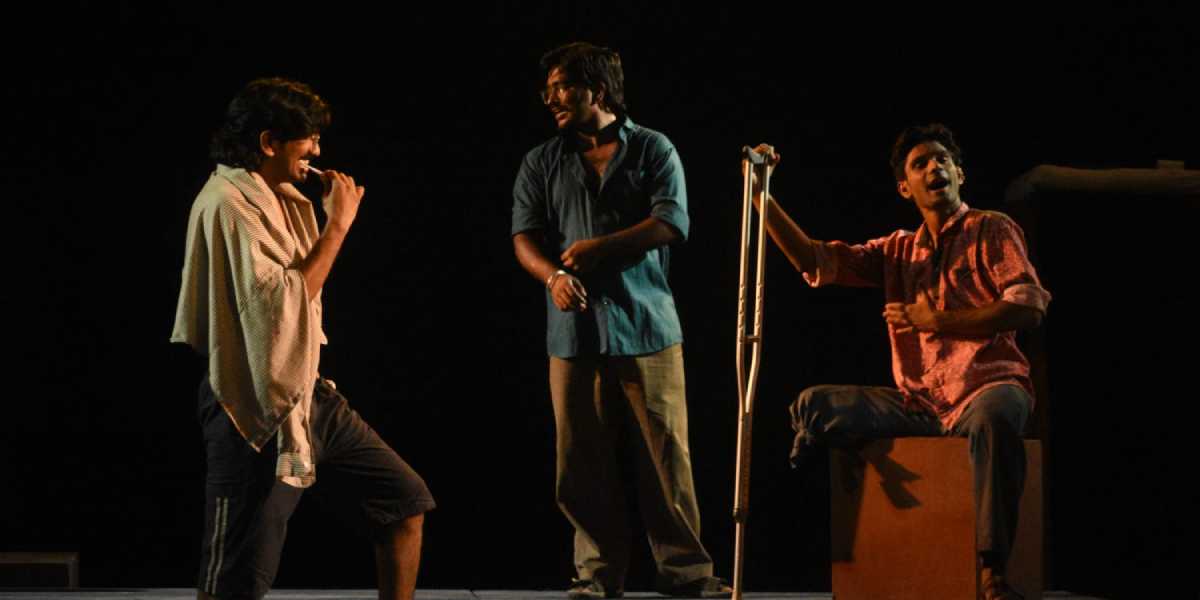
A scene from the play, Holi, staged at the University of Hyderabad.

Synopsis: A clash broke out after ABVP activists objected to the staging of a 57-year-old play, ‘Holi’, saying some parts of it offended Hindu sentiments. SFI and Ambedkar Students Association workers prevented the ABVP from disrupting the play, staged in partial fulfilment of the course. Several students were injured in the clash.
Several students were injured in a scuffle between the members of the ABVP, and SFI and Ambedkar Students Association (ASA) over the staging of a 57-year-old play in the University of Hyderabad on Monday, 4 May.
The clash started after ABVP activists took up the mantle of protecting their religion and objected to the staging of Holi, a play written by Marathi writer Mahesh Elkunchwar in 1969. The SFI and ASA threw a security ring to prevent the BJP-affiliated students’ union from disrupting the performance at the GB Hall.
Fists were thrown, bottles flew, and chairs flung as violence broke out, resulting in injuries to several students.
Also Read: Amidst drama at HCU, students screen BBC documentary on campus
Kaustubh Tawani, a third-year student of Direction at the Department of Theatre Arts, said the play was his final academic production, staged in partial fulfilment of his course.
“This was my final academic production, and I was directing the play,” he told South First. “The play was being performed under the department, and a disclaimer was already given that the content belongs to the writer.”
Playwright Elkunchwar is one of the most decorated figures in the Marathi theatre. Holi unfolds inside a hostel. Nine young men find their Holi holidays cancelled by the principal. A cultural programme replaces it, and attendance is compulsory, and a fine will be slapped on those skipping the event. The boys rage, bond, turn on each other, and ultimately destroy one among them. The play ends in a tragedy.
Archana C, Dramaturge of the production and an alumna of the department, described the work. “The play is essentially about gang politics, which reflects the kind of dynamics that exist on Indian campuses, though without an intellectual backing.”
Elkunchwar’s work has received the Sangeet Natak Akademi Award and the Saraswati Samman. Holi has been staged thousands of times across five decades.
Tawani said he spoke to Elkunchwar directly. “Mahesh Elkunchwar told me that there has never been such a ruckus or objection earlier.”
The faculty had approved the script and the production, the students said. The performances, two in total, formed part of the academic evaluation for third-year students.
During the first performance on Sunday evening, ABVP members objected to certain dialogues. They approached Tawani. They asked him to remove portions of the script. He was also threatened.
“They demanded that certain dialogues be removed. Why should I? Who are they to tell me to cut parts of a published work? Who gave them that authority?” Tawani asked.
The specific lines ABVP flagged involved a character named Temur telling another that Indian culture has no room for tea and that he will be made to drink cow urine instead.
Other characters then question the properties of cow urine. A separate line has Temur remark that Goddess Saraswati herself speaks through another character.
Archana pointed to a detail that she said the ABVP had missed. “They did not watch the entire play. On the first day, ABVP members came, watched part of a scene, and then left. So they do not know the play in its entirety,” she told South First.
Tawani’s reading of the lines runs along the same lines. “As a Hindi speaker, I understand this as a metaphor to indicate that someone is knowledgeable. But they interpret it as an insult to the deity. It is simply a metaphor, a basic literary device.”
He went further: “I am a Hindu myself, I come from a Hindu family. Who gave them the right to dictate what I can or cannot present?”
The production team told ABVP what it could not do. “We told them that the play is not written by us, it is a classic text, and this is an academic exercise, a final-year graduation production that is part of our examination. We cannot censor someone else’s work, especially that of a noted writer,” Archana said.
ABVP responded with a warning. They said they would not allow the second show.
Students submitted complaints to the Vice-Chancellor and the Registrar. The department reviewed the situation and decided the second performance would go ahead.
Both sides spent the intervening hours preparing.
The production team anticipated trouble.
“We had already informed security about threats circulating on social media, including WhatsApp messages calling for disruption. With the support of our teachers, we also wrote to the administration and security in advance,” Archana said.
By the time the second performance began around 7 pm, students from SFI, ASA and other organisations had gathered alongside security at the main entrance to ensure the play ran smoothly. The hall filled. The doors closed. The production started.
At around 7:30 pm, ABVP members gathered outside the hall.
“They were mobilising and insisting on entry,” Asika, Secretary of SFI HCU Unit, told South First. “By then, the theatre was already full, and the crew had decided that no one would be allowed in after the play had begun.”
Archana addressed the question of why ABVP was not let in directly. “The point is, they came in the middle of the show. If they had come at the beginning, it would have been different. Anyone arriving after the play starts is not allowed inside because it disrupts the audience. It is the normal practice.”
What followed was not a protest at one entry point. Archana said ABVP attacked from all sides of the venue. Stones hit the windows. Members attempted to break open the ladies’ green room through a backdoor. Student organisations including SFI and ASA, alongside security personnel, held the main door and stopped them from entering.
“They then started attacking the students standing there. They beat up students, threw beer bottles, and hurled objects, including chairs,” Asika said. “One suffered a head injury, and another sustained facial injuries and required stitches.”
Asika did not escape unharmed. “When they threw bottles, the lights in our area were shattered, and glass was scattered everywhere. Some of it hit my head as well.”
Slogans, including “goli maro salo ko (shoot them),” were shouted during the attack, students alleged.
Eventually, police intervened.
“Midway through the show, they (ABVP activists) arrived and created a disturbance. Despite this, the show was completed successfully. The audience was not injured, and the actors were not harmed,” Archana said.
After the show, police escorted the faculty, students and their family members out of the hall.
On the day BJP won a state it long coveted, its student wing @ABVPVoice stormed an auditorium at the University of Hyderabad(@HydUniv) , and attacked students staging a play.
The play, Holi, was a final exam production, approved by faculty, scheduled for two nights.
ABVP… pic.twitter.com/TmlTYoHJ2E
— Sumit Jha (@sumitjha__) May 4, 2026
Siva Palepu, ABVP’s union president at the University of Hyderabad, disputed the version that portrayed his organisation as the aggressor.
He described the ABVP protest outside the hall as peaceful and said SFI members blocked entry, preventing even the Gachibowli SHO and police personnel from going inside.
“If any group has concerns, it is the responsibility of the university administration to pause the event for some time and resolve the issue,” he told South First. “If the protest was peaceful, what was the need to block entry at the gate?”
He also raised a question about the cast. “A few participants were from outside. Around three to four people were from outside, and the director was also from outside.”
Archana answered this directly. The cast size for Holi runs to around 20, which is large for a student production. First- and second-year students were occupied with their own semester work and could not be cast. Tawani put out a casting call.
“I work in Hyderabad. I know Kaustubh, saw the poster, spoke to him, and joined the production. In the same way, two or three others who are not currently linked to the campus also joined the play,” she said. “However, those who came from outside are not aligned with any political group. They are simply actors who joined the production.”
Tawani also addressed the outsider claim. He is a student of the department, not an outsider, a fact his institution can verify. He said he presented the original, published the script when challenged and refused to alter it.
ABVP’s Palepu, meanwhile, stood his ground. “We believe this reflects an anti-dharma agenda, allegedly backed by a section of the faculty. When Hindu sentiments and the cultural ethos of the campus are challenged, ABVP karyakartas peacefully raised their voice.”
He said ABVP would meet the Vice-Chancellor and Registrar and raise the question of how the play received permission from faculty and administration, given the earlier objections.
Palepu acknowledged that freedom of expression exists. But he drew a line. “Provoking or targeting one religion is not freedom.”
ABVP is making an allegation against SFI
The specific lines that triggered the objection come early in the play. ABVP shared the Hindi text of the exchanges it found objectionable. Here they are, in full, with translation.
[वसंत और ठाकुर आते हैं।] (Vasant and Thakur enter.)
वसंत: अरे भईया, चाय पिलवाओ कोई दी! इस संस्कृति वाले ने हमारा भेजा चाट लिया होगा भैंचो!
(Vasant: Hey brother, get someone to serve tea! This so-called “culture” fellow must have eaten my brain! bhenc..)
रंजीत: तब तो ठाकुर ही पिलाएगा!
(Ranjit: Then Thakur will have to serve it!)
तेमूर: भारतीय संस्कृति में चाय की गुंजाइश नहीं है। वो गोमूत्र माता का मूत्र पिलाएगा!
(Temur: There is no place for tea in Indian culture. He will make you drink cow urine instead!)
ठाकुर: तुम क्या जानो, गोमूत्र की क्या-क्या प्रॉपर्टीज़ हैं?
(Thakur: What do you know about the properties of cow urine?)
वसंत: सो तो आदमी की पिसाब में भी होती हैं! पीते हो?
(Vasant: Those properties are present in human urine, too! Do you drink that?)
भैंचो एक जना पिए तो तुम संस्कृति वाले कैसे होगे, मूत्र पिया; और सब जने मिलके पीते होंगे तो कहें जश्न किया!
(If one person drinks it, that makes you cultured? You drank urine. And if everyone drinks it together, you call it a celebration!)
अरे सारे बा संस्कृति! एक साले जे संस्कृति वाले और हुणे वो बदुवाले! दोबारों में मिलके जिन्दगानी को सड़ाके रख दिया भैंचो!
(What nonsense culture is this! These so-called cultured people and those corrupt ones have together ruined life!)
तेमूर: आईख्वाह! देवी सरस्वती बोल रही है इसके मुँह से!
(Temur: Wow! Goddess Saraswati herself speaks through his mouth!)
[गोपाल कृष्ण समझाते हैं।] (Gopal Krishna intervenes.)
तेमूर: आओ गोपाल कृष्ण महाराज!
(Temur: Come, Gopal Krishna Maharaj!)
रंजीत: मेरी एक अभिलाषा है! दो-चार यूनिवर्सल मंत्री पकड़, दो-चार यूनिवर्सल बरसों की परत चढ़े मीडिया लोग पकड़, और सालों को टांग करके एक-एक के चटाई पर चार-चार लातें जमाऊँ!
(Ranjit: I have one wish. Catch a few ministers, catch a few media people layered with years of influence, hang them upside down, and land four kicks on each of them!)
गोपाल: एक भूल-सुधार। लातें जमा चुकने के बाद सबके पीछे पत्तलास…
(Gopal: One correction. After you have finished kicking them, behind everyone… (trails off))
Read one way, these lines show hostel boys in 1969 mocking a classmate for his cultural conservatism. The dialogue belongs to characters the play does not endorse. By the final act, those same boys push another student to suicide while the conservative character, the one they ridiculed throughout, stands as the only voice that tells them to stop.
ABVP read it differently. Palepu argued that the mockery of cow urine, the use of the names Gopal Krishna and Saraswati in irreverent contexts, and the general framing constitute an attack on Hindu belief, not a portrait of fictional bullies in a 1960s hostel.
“There are dialogues in Hindi. One character says there is no place for tea in Indian culture and that people will make you drink cow urine,” Siva said. “We believe this reflects an anti-dharma agenda, allegedly backed by a section of the faculty.”
Tawani held his ground. “Just mentioning cow dung does not make it anti-religious. I am a Hindu myself. Who gave them the right to dictate what I can or cannot present? If their sentiments are hurt, they can choose not to watch the play.”
He added, “If they have an issue with the content, they should take it up with Elkunchwar. I even have his email.”
Archana framed it as a failure of context. “What seems to have triggered ABVP are certain dialogues referring to Sanskriti and Brahmanism. However, these were taken out of context.”
The exchange pointed to something larger than a disagreement over dialogue. It pointed to the question of who gets to interpret a work of art inside a university, and what tools they reach for when interpretation alone fails to satisfy them.
The synopsis on the poster does not mention religion. It describes the play as an exploration of the directionless explosion of suppressed energy among youth. It frames the story around caste: the rebellion is led by those with social capital and caste privilege, while the most vulnerable pay the price.
Students who backed the production described it as anti-Brahminical in theme, one that interrogates caste-based patriarchy. ABVP described it as a provocation against Hindu belief and culture.
Both groups read the same play. Both came away with entirely different accounts of what it said.
The evening left two students with injuries. Complaints have been filed with university authorities. Students said a formal police complaint would be lodged. ABVP said it will meet university leadership. The university has not issued a public statement.
What sits at the centre of this incident is not new, and it is not specific to Hyderabad. It is the question of who holds authority over what a student can perform, present, or examine inside a university. It is the question of whether an academic evaluation requires protection from political pressure. It is the question of where legitimate grievance ends and organised disruption begins.
Tawani put it plainly. “Most importantly, this was an examination. They tried to intervene in and disrupt an academic evaluation.”
He built something over months. His department sanctioned it. His professors approved it. On the night it mattered, people arrived outside the doors and tried to take it apart.
The play ended anyway.
South First tried to reach the University of Hyderabad’s comments. If received, the article will be updated.
(Edited by Majnu Babu).



