

Published Mar 12, 2026 | 12:00 PM ⚊ Updated Mar 12, 2026 | 12:00 PM

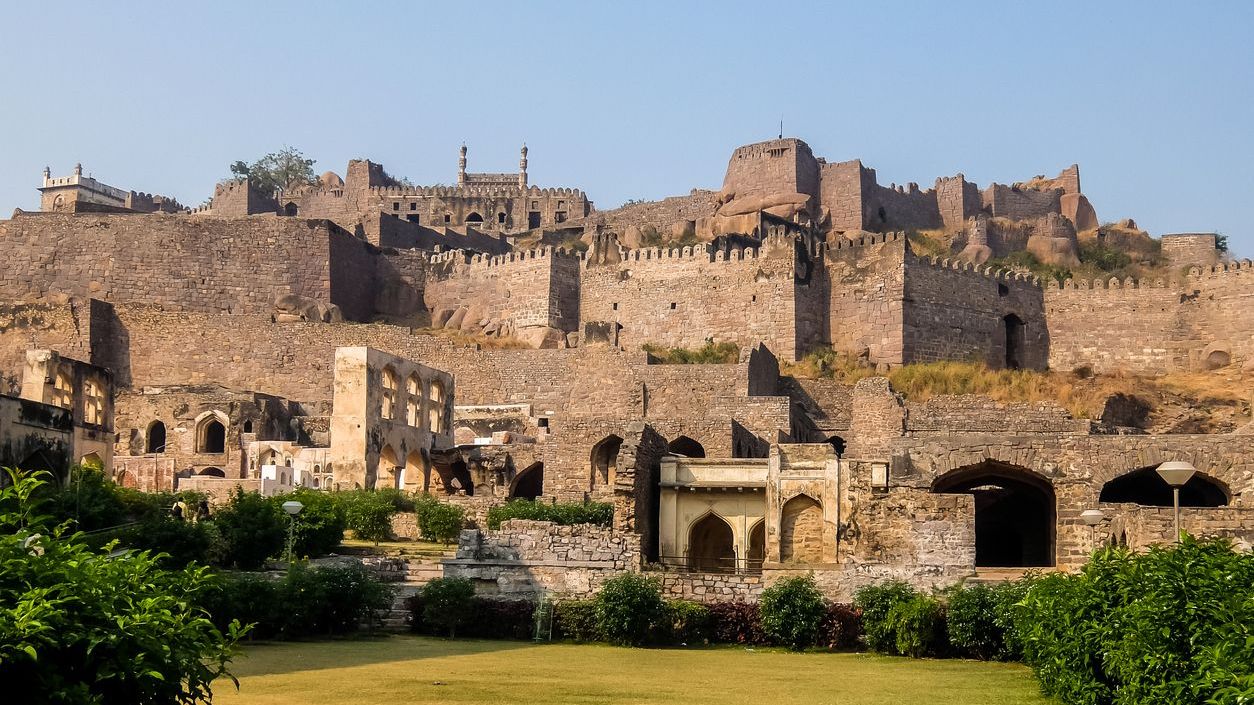
The roots of the Qutub Shahi dynasty in Hyderabad is in Iran. (iStock)
Synopsis: The war imposed on Iran by the United States and Israel, and the brutal carnage they have been carrying out for the past two weeks, have caused deep anxiety. The distress becomes even greater because of the intimate relations that Iran has with Telangana and Hyderabad. Moreover, the impact of the war will affect the lives of people across the wrold, including price rises and food shortage.
Even when unknown people suffer, the human heart trembles with pain. Even if they are strangers, when hundreds and thousands fall victim to massacres, one inevitably feels sympathy for them and anger toward those who unleash such carnage and devastation.
When people with whom we have at least some acquaintance — those with whom we have historical and cultural connections — are in distress, when they are subjected to inhuman massacres, expressing sympathy for them and condemning those who perpetrate such atrocities becomes, at the very least, a human obligation.
The war imposed on Iran by the United States and Israel, and the brutal carnage they have been carrying out for the past two weeks, have caused deep anxiety. This is not merely because it is an unjust and aggressive war. Our distress becomes even greater because of the intimate relations that Iran has with Telangana and Hyderabad.
I have been sipping Irani chai for more than five and a half decades. I have been studying the role of Iran in world history and in the geopolitics of West Asia. I have also been reading and writing about the influence of Iran on the history of Hyderabad. In this context, it becomes necessary to discuss the adverse consequences that this present war will inevitably have on all of us.
The arrogant and unjust war being waged by the United States and Israel against Iran cannot be dismissed as something happening four thousand kilometres away, in some distant land with which we have nothing to do.
Iran — formerly known as Persia — has centuries-old ties with Telangana. We have many kinds of connections with Iran. These include not only historical, cultural, and linguistic relationships but also many links that may lead to a situation where we will inevitably have to experience some of the consequences of this war.
As residents of Hyderabad and Telangana, we must necessarily think about Iran, about the unjust war being waged against it, about the lives being destroyed there, about the property being devastated, and about the culture being shattered.
Historically, the relationship between Hyderabad and Persia is profound. The roots of the Qutub Shahi dynasty, which unified the Telugu land after the fall of the Kakatiyas and established the vast Golconda empire, lie in Persia. Until the nineteenth century, Persian served as the official court language first in the Qutub Shahi kingdom and later in the Asaf Jahi state.
In those days, modern transport facilities had not yet developed, and Persian merchants who arrived at Machilipatnam by ship through sea routes travelled across the Telangana region to reach Golconda. The diamonds, pearls, steel, and handloom textiles of the Golconda kingdom entered world markets through Persia as their gateway.
When Muhammad Quli Qutub Shah thought that the capital at Golconda was becoming too cramped and decided to build a new capital on the southern bank of the Musi River, the city that immediately came to his mind as a model for its design was Isfahan in Persia.
When Hyderabad was being constructed, the city layout, gardens, royal avenues, buildings, and recreational spaces all followed Iranian architectural patterns. The Qutub Shahi prime minister, Mir Momin Astarabadi, himself was Persian. He designed Hyderabad as a continuation of Persian culture.
During the sixteenth and seventeenth centuries, many Persian scholars, architects, poets, and administrators came to Hyderabad. Persian, Urdu, Hindustani, and Telugu languages mingled with one another. Words such as bazaar, darwaza, bagh, mehfil, and daawat, as well as revenue jargon — which have blended into Hyderabadi Dakhni speech and even into Telugu — are originally Persian.
Iranian cuisine, along with adaptations and additions, particularly Irani chai, became an inseparable part of Hyderabad’s food and beverage culture.
In the nineteenth and twentieth centuries, as well, owing to disturbances and economic problems in certain regions of Iran, migrations to Hyderabad increased.
These connections with Iran did not remain confined merely to the city of Hyderabad; they spread throughout the entire Hyderabad state. Until my early youth, there were many Irani hotels in Warangal. Of the four Irani cafés at Hanumakonda crossroads, two were truly under Iranian influence.
In the Kohinoor Hotel and Jawahar Café, there used to be large portraits of Reza Shah Pahlavi until 1979. After the Islamic Revolution of 1979, those places were taken by portraits of Ayatollah Khomeini. In a sense, beneath the photographs of Iranian leaders, our daily tea, bun-maskas, and Osmania biscuits continued.
It was a time when narrow questions, such as why the portrait of a foreign head of state should hang in a local hotel, had not yet arisen. Though Khomeini’s rule had an anti-American imperialist stance after the overthrow of Reza Shah’s pro-American dictatorship, discussions used to take place in Iranian hotels in Hanumakonda and Tarnaka, and in the Osmania campus, about the religious obscurantism and dogmatism that also existed within that regime.
Not only in the 1970s and 1980s but even by the 1990s, Iran had not yet become as distant from us as it seems today. In 1997 or 1998, when I intended to write an article in The Economic Times about Hyderabadi Irani chai and wished to learn about Iran–Hyderabad relations, I went directly to the Iranian Consulate in Banjara Hills.
The Iranian officials there received me warmly and kindly, offered hospitality and information, and even gifted me a book written by Dr Sadiq Naqvi titled The Iran–Deccan Relations.
After the death of Ayatollah Khomeini in 1989, and under the leadership of Ali Khamenei, Iran has over the past three decades transformed into a militarised, religiously fundamentalist state.
On the one hand, there have been religiously arrogant attacks on women and dissenting voices; on the other hand, except for news of the remarkable films being made by Iranian cinema directors amid extremely oppressive and harsh conditions, we have not heard much about Iran.
Yet there remained a certain degree of sympathy because, while running a religiously authoritarian regime, Iran was also standing up against American imperialist attacks, opposing Israel — which imperialism had planted like a stake beside it — and supporting the Palestinian people’s aspiration for freedom.
For several years now, the sinister alliance of the United States and Israel has been conducting propaganda claiming that Iran is pursuing a nuclear weapons programme. Alongside this, the United States has been issuing threats that it must be given the authority to inspect that programme and has been imposing sanctions on Iranian trade.
Twenty years ago, when the United States attacked Iraq, its rulers made exactly the same claims. They said Iraq was manufacturing weapons of mass destruction, that if it were not stopped, the world would face danger. On that pretext, the American military invaded and devastated Iraq.
President Saddam Hussein was arrested, subjected to a sham trial, and executed by hanging. Later, independent organisations and researchers who investigated Iraq, and eventually even American government agencies themselves, declared that there was no evidence whatsoever that Iraq had attempted to manufacture weapons of mass destruction.
In other words, on the basis of a blatant lie, the American military and ruling classes invaded a sovereign country, killed thousands of people, destroyed its resources, and killed its president.
The same approach that was taken toward Iraq is now being applied to Iran. In fact, this story of oil-hungry aggression began seven decades ago. Since 1953, when prime minister Mohammad Mossadegh — who had been democratically elected and had nationalised the oil industry — was overthrown through a military conspiracy with the help of the CIA, American imperialists have had their eyes fixed on Iran’s oil reserves.
The plunder that continued unhindered under the rule of Reza Shah Pahlavi was halted by the Islamic Revolution. From that moment onward, the United States has been engaged in a single effort: To remove that regime and install its own puppet government.
Israel, its proxy in West Asia, added its anti-Islamic hostility to that sinister project. As the proverb says, “the buffalo belongs to the one who holds the stick.”
With the military power purchased with trillions of dollars, with propaganda machinery built on lies, and with sycophants ranging from Arab sheikhs to India’s Modi, the United States and Israel are destroying an ancient civilisation, society, and culture called Iran.
The devastation taking place there is one aspect; the global consequences that will arise from this war are another. Donald Trump and Benjamin Netanyahu, who are carrying out this illegal war, will remain safe enough. Arms-manufacturing corporations will swell their coffers. Oil-producing countries and oil supply companies will reap enormous profits.
However, people across the world, including us in distant Telangana, will have to bear adverse impacts on our lives, livelihoods, and security. Today or tomorrow, the prices of crude oil, petrol, and diesel will rise. As transportation costs increase, the prices of all goods will rise overall. Not only will petrol and diesel prices increase, but if the war continues, supply itself may be disrupted.
Already, the price of domestic LPG cylinders has increased by ₹60, and the price of commercial cylinders by ₹115. Commercial cylinder users include hotels, restaurants, and industrial establishments; therefore, adverse effects have already begun.
Across the country, hotels, restaurants, and the entire food industry are approaching the brink of collapse. In Hyderabad city alone, there are more than 40,000 hotels and tiffin centres and more than 10,000 paying-guest hostels that are writhing under the axe-blow of these LPG price increases.
If the war continues further, not only will prices rise, but supply itself may stop. As a result, the livelihoods of workers and employees dependent on these industries may be endangered.
Those who, the moment the word “war” is heard, overflow with patriotism, particularly American patriotism or Israeli patriotism, and turn into frenzied supporters, should pause for a moment and think: whose war is this? For what purpose is it being fought? Who will suffer its consequences? Who will reap its benefits?
War, war hysteria, and the rulers who silently cooperate with war must be opposed.
(Views are personal.)


