

Published Dec 10, 2025 | 10:31 PM ⚊ Updated Dec 11, 2025 | 4:38 PM

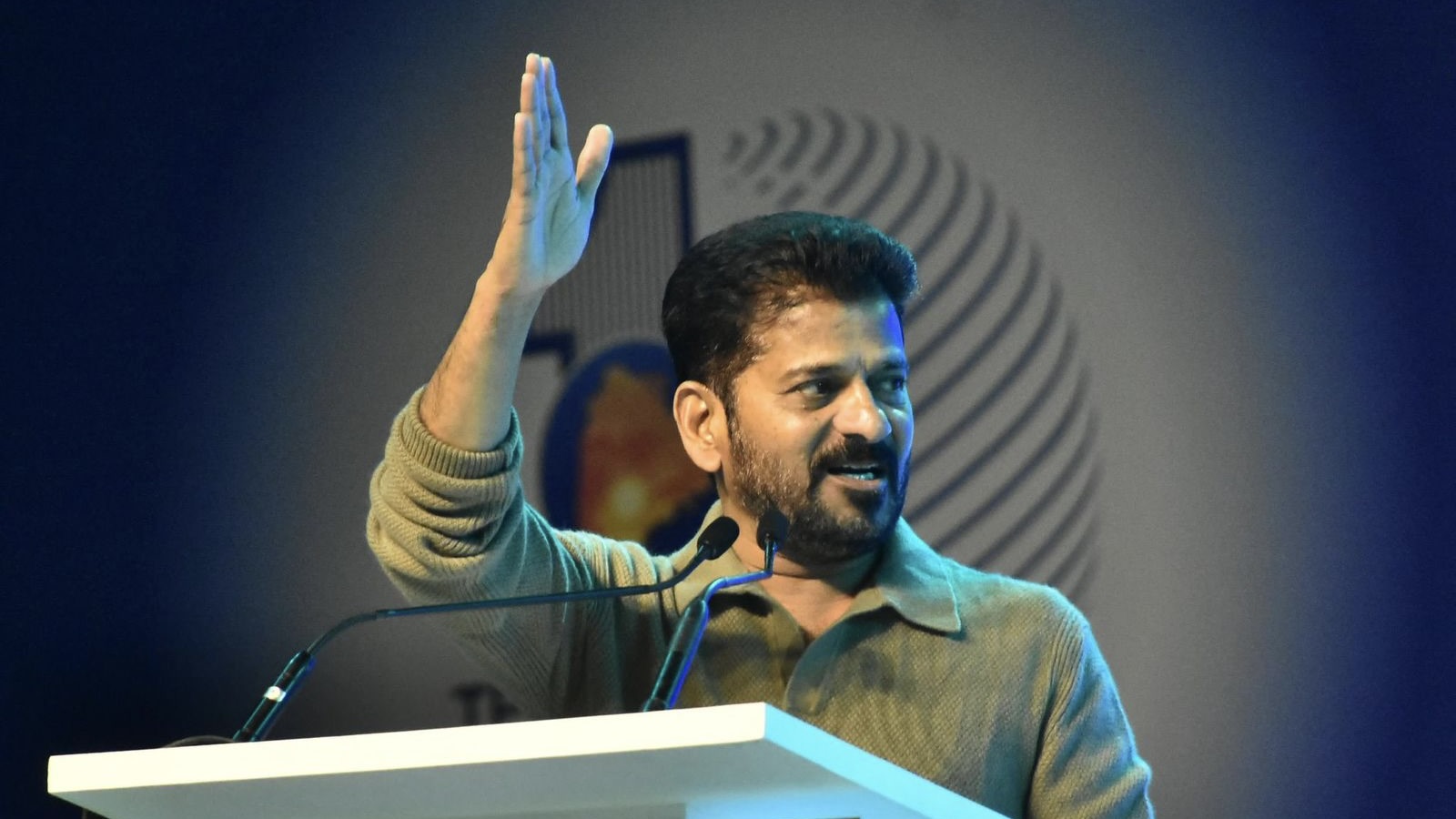
Telangana Chief Minister A Revanth Reddy.
Synopsis: The Telangana government has unveiled its Telangana Rising Vision Document 2047, outlining a plan to transform the State into a $3 trillion economy through inclusive growth, social justice and strong environmental safeguards. The roadmap prioritises human capital, innovation and balanced regional development, with major investments proposed in education, skills, women’s empowerment, advanced manufacturing, clean energy.
The Telangana government on Tuesday, 9 December, unveiled the “Telangana Rising Vision Document 2047” at the Rising Global Summit held in Bharat Future City on the outskirts of Hyderabad.
The document lays out an ambitious roadmap aimed at making the state a $3 trillion economy by the time India marks 100 years of independence, contributing 10 percent to the nation’s projected $30 trillion GDP under the Union government’s Viksit Bharat initiative.
“This is not a document drafted behind closed doors; it captures the aspirations of our people,” Chief Minister A Revanth Reddy said while releasing the document, which reads like a pledge anchored in social justice, environmental stewardship and equitable access to opportunity for every citizen.
“We are investing in the future so that our women, youth, farmers and marginalised communities can compete with the best in Germany, Japan and Singapore,” he added, urging stakeholders to join the “journey”.
At its core, the Vision Document rests on three mutually reinforcing pillars: human capital; productivity and innovation; and investment and savings.
These are to be operationalised through 10 strategic thrusts aligned with the innovative CURE (Core Urban Region Economy)-PURE (Peri Urban Region Economy)-RARE (Rural Agriculture Region Economy) model.
The framework seeks to ensure balanced regional development, attract deep investments and entrench transparent governance.
Economically, the goals are bold: taking Telangana’s Gross State Domestic Product (GSDP) from a projected baseline of $1.2 trillion by 2034 to $3 trillion by 2047 by accelerating productivity across sectors. It also sets an interim target of a $1.2 trillion economy by 2034.
The document envisions a structural shift, with the services sector—already contributing 65 percent of GSDP—rising to 70 percent, powered by high-value domains such as IT, financial services, logistics, tourism and creative industries, together expected to generate nearly $1.9 trillion.
Industry and agriculture, which now account for 17–18 percent each, are expected to stabilise at 15 percent, with a sharper focus on advanced manufacturing, clean mobility, life sciences, semiconductors and agri-food processing geared for exports and functional foods.
The Vision Document proposes sweeping investments in education, skilling and healthcare to create a globally competitive workforce and realise its long-term vision.
It aims to dismantle entrenched social barriers such as caste discrimination through integrated initiatives like Young India residential schools, where students from all backgrounds live and learn together. Each school will receive ₹200 crore to build inclusive, world-class facilities that nurture unity and excellence.
Addressing gaps in the Right to Education Act, which experts say lacks skill-based learning, the government has launched a Skills University, alongside a dedicated Sports University to nurture Olympic-level athletes.
“India, with 140 crore people, has not won an Olympic gold. That’s why we conceived this sports university,” Revanth added.
Women’s empowerment stands out as a flagship commitment. The goal is to create one crore women millionaires by 2047, backed by universal high-quality schooling, digital literacy, entrepreneurship support and financial freedom. Starting with early education, the plan steers girls into knowledge-driven sectors, ensuring they lead in innovation and enterprise.
Youth and farmers also receive focused attention. Farmers are set to evolve from cultivators to processors, brand owners and exporters through advanced technologies, organic agriculture and integration with global value chains.
The innovation engine is set to fire on all cylinders through major ecosystem boosters: the Telangana Scientific Return Programme to bring back global researchers; EduCities as next-generation learning hubs; and frontier technology missions to translate cutting-edge research into commercial enterprises.
Every district will be linked to this innovation economy, strengthening total factor productivity and ensuring no region is left behind. Growth is tiered, with Hyderabad and urban clusters as global tech hubs; peri-urban regions hosting medium-scale manufacturing; and rural Telangana powering agritech, livestock, forestry, handicrafts, cultural industries and eco-tourism.
A sweeping infrastructure overhaul is planned, with mega-projects such as the Musi River rejuvenation, a dry port, a greenfield highway to Bandar Port, the Regional Ring Road, Ring Rail and high-speed bullet train corridors. The Telangana Clean and Green Energy Policy 2025 aims to accelerate renewable energy expansion, boost local manufacturing and fast-track net-zero ambitions while reducing climate risk.
Governance reforms lean on a digital leap through T-Fiber and the SPEED (smart, proactive, efficient and effective delivery) framework, backed by special funds to attract global investments.


