


Published Mar 21, 2026 | 12:53 PM ⚊ Updated Mar 21, 2026 | 12:53 PM

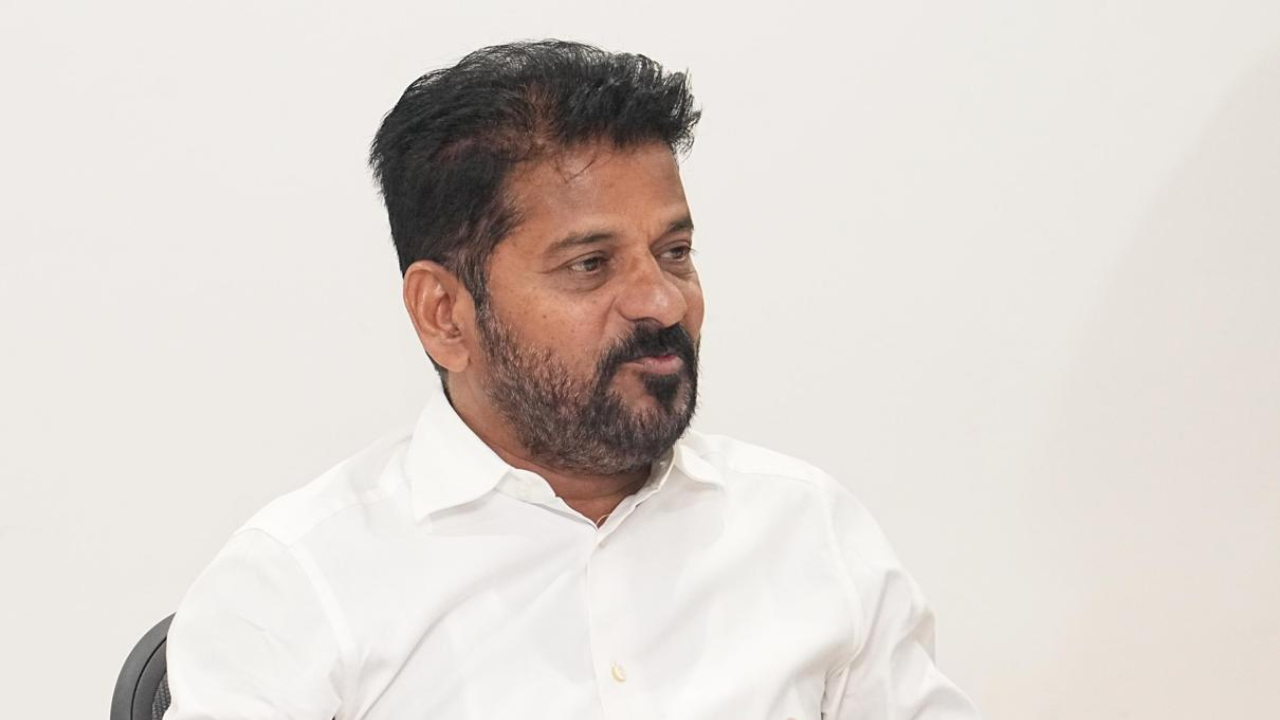
Telangana Chief Minister Revanth Reddy. Credit: x.com/revanth_anumula
Synopsis: Telangana’s 2026-27 Budget projects a ₹3.24 lakh crore outlay with a headline surplus, but beneath the optimism lies mounting debt, risky reliance on central grants, and volatile tax revenues. Public debt is set to cross ₹5.62 lakh crore, guarantees add hidden liabilities, and welfare schemes consume borrowed funds—raising serious concerns about fiscal sustainability and resilience.
Telangana’s Budget for 2026-27 projects a total outlay of ₹3,24,134 crore with a headline revenue surplus of ₹6,857.76 crore. On paper, it looks like a turnaround. But on closer look, it reflects an aggressive borrowing spree, ballooning public debt, heavy dependence on uncertain central devolutions, and revenue projections that appear wildly optimistic given last year’s massive shortfalls.
The fiscal deficit is set to climb to ₹58,458.71 crore, public debt will cross ₹5.62 lakh crore (29% of GSDP), and off-budget guarantees stand at ₹3.01 lakh crore. This is seen as less a prudent roadmap and more a high-stakes gamble on central largesse and buoyant tax collections that have repeatedly disappointed.
The detailed estimates of revenue and receipts for 2026–27 for Telangana state, as stated in the budget documents, raise important questions about the sustainability and quality of Telangana’s fiscal strategy, even as the government projects robust growth in revenues.
Though the estimates project a picture of expanding revenues and fiscal confidence, the details point to a soft underbelly. Overdependence on a few buoyant but volatile tax sources, optimistic projections of central grants, and sustained reliance on debt collectively raise concerns about fiscal resilience.
Telangana’s cumulative public debt is projected to approach ₹5.62 lakh crore by the end of 2026-27, rising from ₹5.03 lakh crore in the 2025-26 fiscal. The state budget aims to raise roughly ₹60,000 crore in fresh debt. The government stated it is keeping debt within the 30 percent Gross State Domestic Product (GSDP) limit, but it is no consolation.
2023-24: ₹3,98,655 crore (27% of GSDP)
2024-25: ₹4,47,493 crore (28%)
RE 2025-26: ₹5,03,905 crore (28%)
BE 2026-27: ₹5,62,363 crore (29%)
The ₹5.62 lakh crore figure for FY 2026-27 excludes off-budget borrowings. When off-budget liabilities—loans raised by state corporations and special purpose vehicles (SPVs)—are included, Telangana’s total debt burden would go up significantly.
As on 28 February 2026, outstanding guarantees total ₹3,01,835 crore. Of this, ₹86,309 crore are SPV loans serviced by the government, ₹1,55,434 crore are SPV loans serviced by SPVs themselves, and ₹60,092 crore are non-guaranteed but still contingent.
These are essentially hidden debt. If even 10 percent of these guarantees are invoked in a bad year, the fiscal deficit would balloon by another ₹30,000 crore overnight. The budget is silent on any reduction plan.
For 2026-27 fiscal alone, public debt is projected to rise to nearly ₹80,000 crore, indicating that a substantial portion of the state’s fiscal operations is still being financed through loans. While borrowings are a normal part of fiscal policy, the scale and persistence of reliance suggest underlying structural imbalances between revenue generation and expenditure commitments.
The estimates for revenue and receipts show total revenue receipts projected at about ₹2.41 lakh crore for 2026–27, a significant jump from the revised estimates of ₹2.03 lakh crore for 2025–26. While this suggests optimism about economic momentum, the underlying assumptions appear uneven and, in some cases, overly ambitious.
A major concern is the heavy reliance on tax revenues, particularly State GST (SGST), sales taxes, and excise. SGST alone is expected to contribute over ₹52,000 crore, while taxes on sales and trade and state excise together form another substantial chunk. Such dependence on consumption-based taxes makes revenue projections vulnerable to economic slowdowns and fluctuations in demand.
Equally striking is the volatility reflected in revised estimates for 2025–26. Several revenue heads—especially stamps and registration fees—have seen sharp downward revisions from budget estimates before rebounding again in 2026–27 projections.
Non-tax revenue, often seen as a more stable source, remains relatively modest in comparison. Though projected to increase to around ₹35,700 crore, much of this comes from “miscellaneous general services,” which lacks transparency and predictability.
Another area of concern is the expectation of a steep rise in grants-in-aid from the Centre, projected at over ₹24,000 crore—more than double the revised estimate for 2025–26. This increase raises questions about the realism of assumptions, especially given past trends of volatility and dependency on central transfers.
Accounts 2024-25: ₹27,050.25 crore
BE 2025-26: ₹29,899.77 crore
RE 2025-26: ₹29,471.19 crore
BE 2026-27: ₹33,181.64 crore (+12.6% over RE)
Grants-in-Aid:
RE 2025-26: ₹11,161.45 crore (slashed from BE of ₹22,782.50 crore)
BE 2026-27: ₹24,166 crore (more than doubled)
This is being seen as the most glaring red flag. In 2025-26, the revised estimate for grants was literally halved. The Centre cut devolutions, possibly due to lower tax collections nationally or performance-linked conditions.
Yet, the 2026-27 budget assumes not only full recovery but a massive additional ₹13,000 crore. If the Finance Commission award or GST compensation does not materialise at this level, the entire revenue surplus of ₹6,857 crore will evaporate and turn into a deficit.
Then, of course, the welfare rollout, a politically sensitive area. The welfare schemes can never be cut and on the other hand, they keep increasing year after year. In 2026-27, it is estimated that they would devour ₹1,45,591 crore:
Rythu Bharosa: ₹18,000 crore
Cheyutha: ₹14,861 crore
Power Subsidy: ₹14,000 crore
Indiramma Houses: ₹5,500 crore
Rajiv Yuva Vikasam: ₹5,800 crore
And several more.
These schemes are now being funded on borrowed money.
In a nutshell, if expectations turn upside down, the budget, it is feared, would be all thunder and no rain. If central grants do not materialise at ₹24,166 crore (as happened last year), the revenue surplus disappears and the fiscal deficit could cross ₹70,000 crore.
By 2027-28, interest payments could easily touch ₹24,000-25,000 crore, crowding out development spending. At 29 percent of GSDP and rising, Telangana is approaching the point where fresh borrowing will be needed just to roll over old debt.
The government has chosen to protect welfare schemes at the cost of fiscal space for long-term infrastructure. Past budgets have seen huge RE-to-actual shortfalls. The grandiose ₹1.45 lakh crore welfare roll out may see cuts when cash flow tightens.
The budget projects revenue growth of 18 percent and central funds doubling while conveniently forgetting that the same assumptions collapsed in 2025-26.
Public debt is marching towards ₹5.62 lakh crore, guarantees are at ₹3 lakh crore, and every new rupee of spending is financed by fresh borrowing. The revenue surplus is real only if the Centre cooperates fully and the economy booms.
If either falters – and history suggests both have faltered before – Telangana will be left with no option but to resort to deeper cuts and borrow even more.
(Edited by Amit Vasudev)


