


Published Jan 06, 2026 | 4:14 PM ⚊ Updated Jan 06, 2026 | 4:14 PM

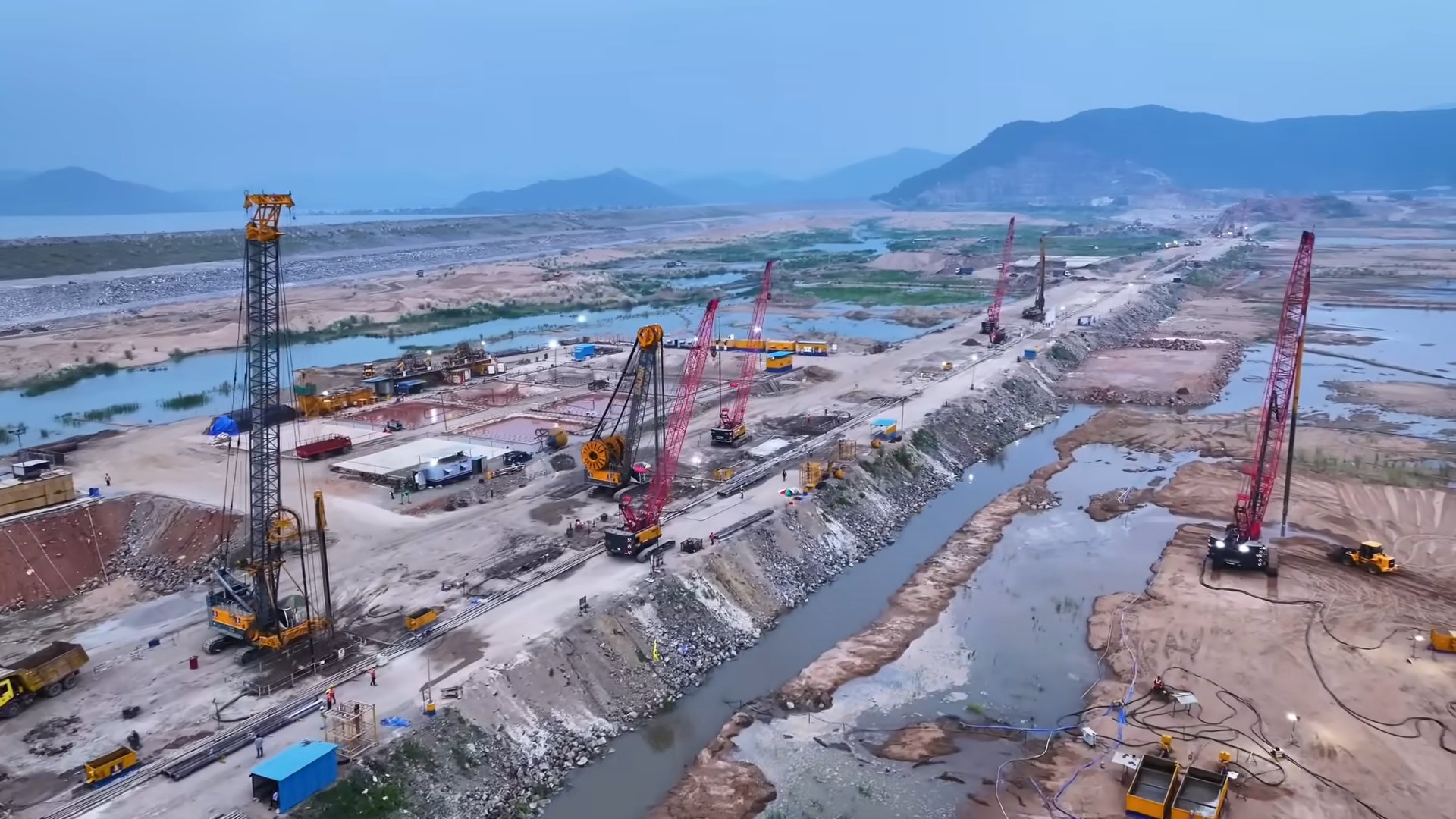
Polavaram Project. Credit: x.com/IndiaInfra02
Synopsis: Telangana has vowed to block Andhra Pradesh’s proposed Polavaram–Nallamala Sagar link project, citing violations of the Godavari Water Disputes Tribunal award and interstate norms. The Supreme Court urged dialogue or a civil suit, adjourning the case to 12 January. While Telangana hardened its stance, Andhra Pradesh CM Chandrababu Naidu struck a conciliatory note, calling for unity and cooperation between the Telugu states.
The Telangana government has reiterated its uncompromising opposition to the proposed Polavaram–Nallamala Sagar link project, asserting that it would stop the project “at any cost” as it violates interstate water-sharing norms and the Godavari Water Disputes Tribunal (GWDT) award.
Even as Telangana hardened its stand, Andhra Pradesh Chief Minister N Chandrababu Naidu struck a conciliatory note, calling for unity between the two Telugu states and asserting that the Godavari has ample water for multiple projects.
Weighing in on the escalating dispute, the Supreme Court advised both States to explore amicable resolution through dialogue or mediation, or alternatively pursue a comprehensive civil suit under Article 131 of the Constitution.
A bench comprising Chief Justice of India Justice Suryakant and Justice Joymalya Bagchi heard Telangana’s writ petition alleging that Andhra Pradesh was illegally attempting to construct the Polavaram–Nallamala Sagar project in violation of norms.
Senior advocate Abhishek Manu Singhvi and Telangana Advocate General Sudharshan A Reddy appeared for Telangana, while senior advocates Mukul Rohatgi and Jaideep Gupta represented Andhra Pradesh.
Singhvi argued that Andhra Pradesh was attempting to divert 200 TMCFT of water illegally under the guise of utilising flood waters, in clear violation of the GWDT award. He said Telangana’s allocation in the Godavari basin was 968 TMC and any such diversion would undermine the State’s rightful share. He also pointed out that the CWC had already directed that works should not proceed without approvals and objected to tenders being called despite the absence of clearances.
Andhra Pradesh countered that no construction was underway and that surveys and tenders were only meant for preparing pre-feasibility and detailed project reports. The Court noted that objections of riparian States must be considered and ultimately suggested three options: filing a civil suit, allowing the Centre’s High Power Committee to examine objections, or attempting a negotiated settlement, and adjourend the case to 12 January.
Telangana Irrigation Minister N Uttam Kumar Reddy declared that the Telangana government would not accept the construction of Polavaram–Nallamala Sagar link project proposed by Andhra Pradesh under any circumstances.
Speaking to media persons at the State Legislative Assembly on Monday, 5 January, he said the project was a “blatant violation” of the 1980 GWDT award and established interstate water-sharing norms.
Dismissing claims made by Bharat Rashtra Samithi (BRS) leaders, including former minister T Harish Rao, Uttam Kumar Reddy clarified that a letter being cited as evidence of Central Water Commission (CWC)’s approval for the project was merely an internal communication sent for information purposes.
“It was not an approval by the CWC in any form,” he said, accusing the BRS of deliberately creating confusion among the public over Telangana’s water rights.
He added the Telangana government had officially written to all relevant authorities opposing the project, including the Godavari River Management Board (GRMB), the Polavaram Project Authority, the CWC, the Union Ministry of Environment and Forests, and the Union Ministry of Jal Shakti. He claimed that these institutions had concurred with Telangana’s objections, pointing to the CWC’s letter dated 4 December as clear evidence.
Uttam Kumar Reddy also disclosed that Telangana had moved Supreme Court to protect its interests. He noted that objections to the project had not come from Telangana alone but also from Maharashtra and Karnataka, strengthening the State’s case that the proposal violates interstate norms. Reddy said he would personally attend the next hearing and that the State would once again seek a stay on the project. A special meeting of legal experts would also be convened within two days to finalise strategy.
The minister credited the present Congress government with successfully halting works on the Rayalaseema Lift Irrigation Scheme, asserting that such projects were stopped only after Congress came to power in Telangana.
Against this backdrop of sharp resistance from Telangana, Andhra Pradesh Chief Minister N Chandrababu Naidu sought to de-escalate tensions, without directly referring to the Polavaram–Nallamala Sagar or Rayalaseema Lift Irrigation Scheme controversies.
Speaking at the World Telugu Conference, which concluded on Monday, 5 January, on the outskirts of Guntur, Naidu said his goal was to find a permanent solution to interstate water disputes between the two States.
He stressed that the progress of the Telugu people was possible only if Andhra Pradesh and Telangana worked together. “If there is unity, issues can be resolved easily. There should be no animosity between the two States,” he said, emphasising that Telugu identity transcended political boundaries.
Asserting that Godavari has abundant water, Naidu said there would be no scarcity even if multiple projects were constructed on it. He recalled that after bifurcation, he had never objected to Telangana constructing the Kaleshwaram project on the Godavari. Clarifying that the World Telugu Conference was not a political platform, he refrained from delving into specific disputes, choosing instead to underline the importance of unity.
Reiterating that he had no objection to Telangana utilising Godavari waters, Naidu said his larger vision was to resolve water issues across the country through river interlinking, from Ganga to Cauvery. He pointed out that the Krishna–Godavari interlinking had already been completed in Andhra Pradesh and called for further interconnections of rivers within the State. “My lifelong mission is only one — both Telugu States should cooperate and move forward together,” he underlined.
(Edited by Amit Vasudev)


