

Published Dec 05, 2025 | 2:06 PM ⚊ Updated Dec 05, 2025 | 2:06 PM

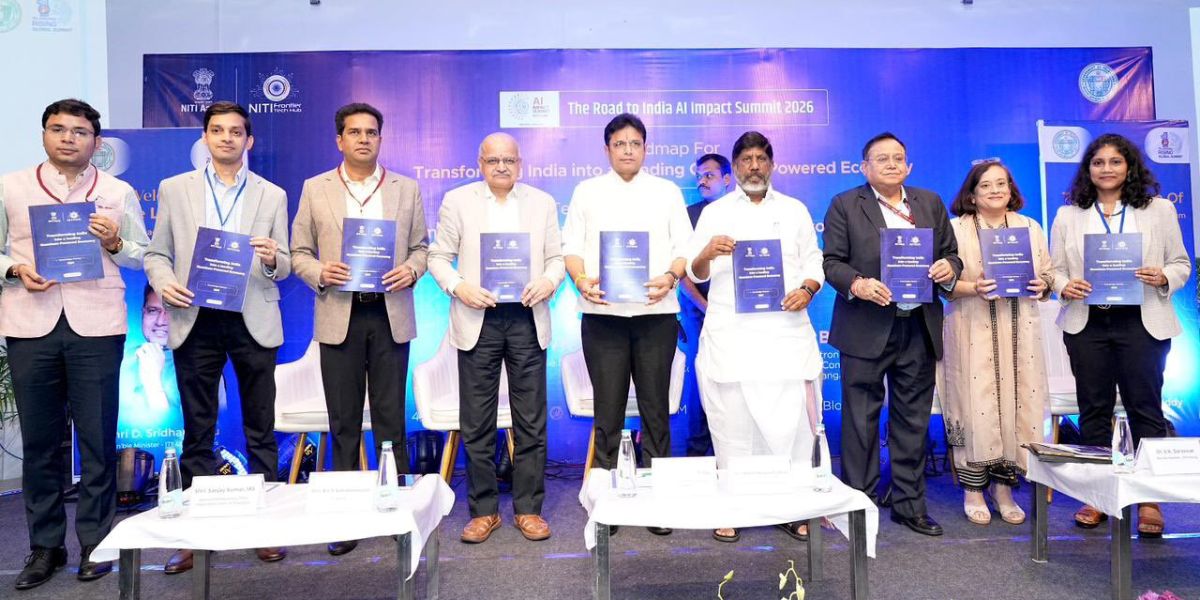
The Telangana government unveiled its ambitious plan to turn Hyderabad into India’s first-ever “Quantum City”.
Synopsis: The Telangana government unveiled its plan to turn Hyderabad into India’s first-ever “Quantum City” and lay down the tracks for a full-fledged ecosystem in quantum computing, communication, sensing, and cryptography. For Telangana, the quantum strategy could be the wind in the sails of its digital economy, which already punches above its weight by contributing over 10 percent to India’s IT exports.
The Telangana government unveiled its ambitious plan to turn Hyderabad into India’s first-ever “Quantum City” and lay down the tracks for a full-fledged ecosystem in quantum computing, communication, sensing, and cryptography.
The high-profile launch on Thursday, 4 December, drew a clutch of policymakers, tech titans, and academic heavyweights, signalling that India’s quantum moment is knocking at the door.
Information Technology and Industries Minister Duddilla Sridhar Babu set the ball rolling, focusing on the disruptive potential of quantum technology. “Quantum technology holds the power to be as transformative as electricity and the internet were in earlier eras,” he said, underscoring its ability to rewrite the rules of computing, secure communications, and precision sensing.
Positioning the Telangana Quantum Strategy (TQS) as more than a state playbook, he called it a “directional roadmap for India’s engagement with quantum science and technology.”
Anchored in the state’s ambitious “Telangana Rising 2047” vision of becoming a $3 trillion economy, the TQS puts its money where its mouth is: Boosting research infrastructure, beefing up cybersecurity, accelerating life sciences breakthroughs, and building a deep talent bench.
Its core building blocks include advancements in quantum computing for hyper-complex simulations, quantum communication for foolproof encryption, quantum sensing for ultra-precise medical and navigation applications, and quantum cryptography to stay a step ahead of lurking cyber threats.
Adding muscle to the state’s push is NITI Aayog’s “Roadmap for Transforming India into a Leading Quantum-Powered Economy,” developed with IBM and an expert council from industry and academia.
Released under NITI Aayog’s Frontier Tech Hub, the document outlines a national game plan of positioning India as a global exporter of quantum tech and weaving quantum capabilities into artificial intelligence, biotechnology, materials science, national security, and digital infrastructure.
According to officials, by 2047, the roadmap envisions quantum technology becoming the secret sauce across national missions, turbo-charging everything from drug discovery and climate modelling to secure communications.
Built on four pillars — speeding up Research and Development (R&D), fast-tracking commercialisation, expanding the workforce, and wooing industry investment — the roadmap pitches initiatives ranging from new research facilities and specialised education to lab-to-market pipelines and global standard-setting partnerships.
To walk the talk, Telangana rolled out a set of measures. First up: a Centre of Excellence (CoE) in Quantum Technologies at IIIT-H, poised to serve as a national lighthouse for cutting-edge research, prototype validation, and high-end skilling. The CoE aims to knit academia, industry, and government into a single fabric, moving seamlessly from qubit theory to real-world quantum products.
“Quantum isn’t just about business or economic advancement; it’s vital for enhancing our capabilities in computing, communications, and cybersecurity,” said Deputy Chief Minister Mallu Bhatti Vikramarka, adding that Hyderabad, with its strong infrastructure and digital talent, is well placed to spearhead India’s quantum charge.
To keep industry and government singing from the same hymn sheet, Babu institutionalised “Industry Day” — weekly interactions between top officials and business leaders, bolstered by monthly consultations with ministers to iron out bottlenecks and lay out sector-wise growth paths. Together, these moves underscore Telangana’s ambition to build a “full quantum value chain — from lab research to real-world applications,” as Vikramarka put it.
For Telangana, the quantum strategy could be the wind in the sails of its digital economy, which already punches above its weight by contributing over 10 percent to India’s IT exports. If all goes to plan, the state hopes to nurture 10,000 quantum-trained professionals and hundreds of startups.
Quantum tech promises to turbocharge pharmaceutical R&D through faster drug simulations, sharpen financial sector risk modelling, and give Hyderabad’s “Quantum City” a gravitational pull for global talent and foreign investment.
(Edited by Muhammed Fazil.)


