

Published Apr 12, 2026 | 6:03 PM ⚊ Updated Apr 12, 2026 | 6:03 PM

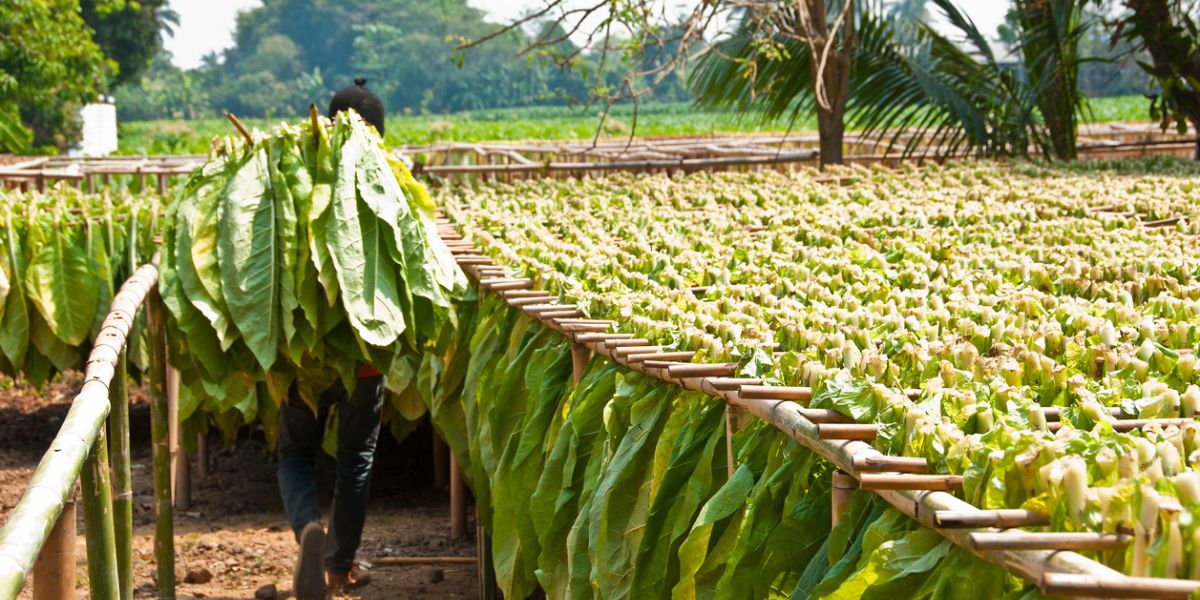
Drying tobacco leaves. (iStock)
Synopsis: The Telangana government has rolled out a ₹54.90 crore plan for the 2025 beedi leaf season, promising a steady income stream for tribal communities. A key aspect of the scheme is the uniform procurement rate of ₹3,300 per Standard Bag. This latest order is in continuation of a series of earlier decisions.
The Telangana government has rolled out a ₹54.90 crore plan for the 2025 beedi leaf season, promising both a steady income stream for tribal communities and a tighter grip on a trade long dogged by middlemen.
With the issuance of Government Order (GO) Rt No.37 on 10 April, the state has given the green light for full-scale implementation of the Beedi Leaf Scheme across 30 districts and 37 forest divisions.
The Telangana Forest Development Corporation Limited (TFDC) has been appointed as the government’s sole agent for procurement and trade. By doing so, the state hopes to streamline operations, ensure fair pricing, and bring transparency through e-portal auctions, effectively cutting out the middlemen who once had the last laugh.
This latest order is in continuation of a series of earlier decisions, including the appointment of TFDC as the nodal agency in 2024, the formation of an advisory panel to fix rates, and the approval of auction conditions earlier this year.
Recommendations from the Principal Chief Conservator of Forests ultimately sealed the deal, paving the way for what officials describe as a calibrated and consistent policy initiative.
A key aspect of the scheme is the uniform procurement rate of ₹3,300 per Standard Bag (SB), with each bag containing 1,000 bundles of 50 leaves, adding up to a staggering 50,000 leaves. The state has set its sights high, targeting the collection of 1,22,000 Standard Bags, or roughly 6.1 billion leaves.
The numbers tell a story of scale and spread. The Bhadradri Circle leads the pack with 47,300 S.Bs across 40 units, followed by the KTR Mancherial Circle with 38,500 S.Bs. Kaleshwaram Circle is not far behind with 32,900 S.Bs. Smaller allocations have been earmarked for Basara, Rajanna, and Charminar circles. The ₹54.90 crore outlay has been split with an eye on both recovery and welfare.
A lion’s share — ₹4,102 lakh — is expected to be recouped through auction proceeds, while ₹1,388 lakh is earmarked as non-reimbursable expenditure.
Collection costs alone account for over ₹4,000 lakh, directly tied to payments made to leaf pluckers. Operational expenses such as transport, staffing, and monitoring form another significant chunk. The government has also factored in insurance coverage for workers and storage facilities, a safety net that had long been missing.
According to officials, from data-entry operators and godown keepers to field-level forest staff, the scheme casts a wide net in terms of employment. Facilitation charges have been structured to incentivise the staff on the ground, ensuring the machinery runs like a well-oiled engine even in remote forest areas, the sources said.
For thousands of tribal and forest-dwelling families, the beedi leaf season is more than just a harvest; it is a lifeline. In districts like Bhadradri-Kothagudem and Mancherial, the seasonal collection provides crucial income during lean agricultural months.
By guaranteeing a fixed rate and eliminating exploitative intermediaries, the government aims to put more money directly into the hands of collectors. With the current targets, payouts to pluckers alone are expected to cross ₹40 crore, injecting much-needed liquidity into rural economies.
The scheme also doubles as a job generator. From plucking and bundling to transportation and storage, it creates a ripple effect of temporary employment. The introduction of the TG Beedi Leaf Management Information System (BLMIS) further ensures real-time tracking and accountability, plugging loopholes that once led to leakages, the sources said.
Beyond economics, the scheme walks a fine line between utilisation and conservation. Beedi leaves, sourced from naturally occurring Abnus (tendu) trees, are collected under regulated conditions to prevent overharvesting. By restricting operations to notified forest and government lands, the state tries to protect ecology.
Operationally, the scheme must contend with tight timelines, unpredictable weather, and the logistical challenge of coordinating across 37 forest divisions. Timely payments to collectors will be crucial; any delay could take the sheen off an otherwise promising initiative.
What sets this scheme apart is its continuity. By largely retaining last year’s pricing and administrative framework, the government has sent a clear signal of stability. The provision allowing TFDC to raise working capital loans also ensures that cash flow hiccups do not derail operations.
With the season already underway, the onus is seen as resting on the forest department and TFDC to hit the ground running. Mobilising manpower, setting up logistics, and ensuring smooth auctions will be key to translating policy into practice. For tribal communities, the stakes could not be higher. If executed well, the scheme could be a shot in the arm—putting money in pockets, dignity in labour, and order in a trade that once operated in the shadows.
(Edited by Muhammed Fazil.)


