

Published Feb 20, 2026 | 8:00 AM ⚊ Updated Feb 20, 2026 | 8:00 AM

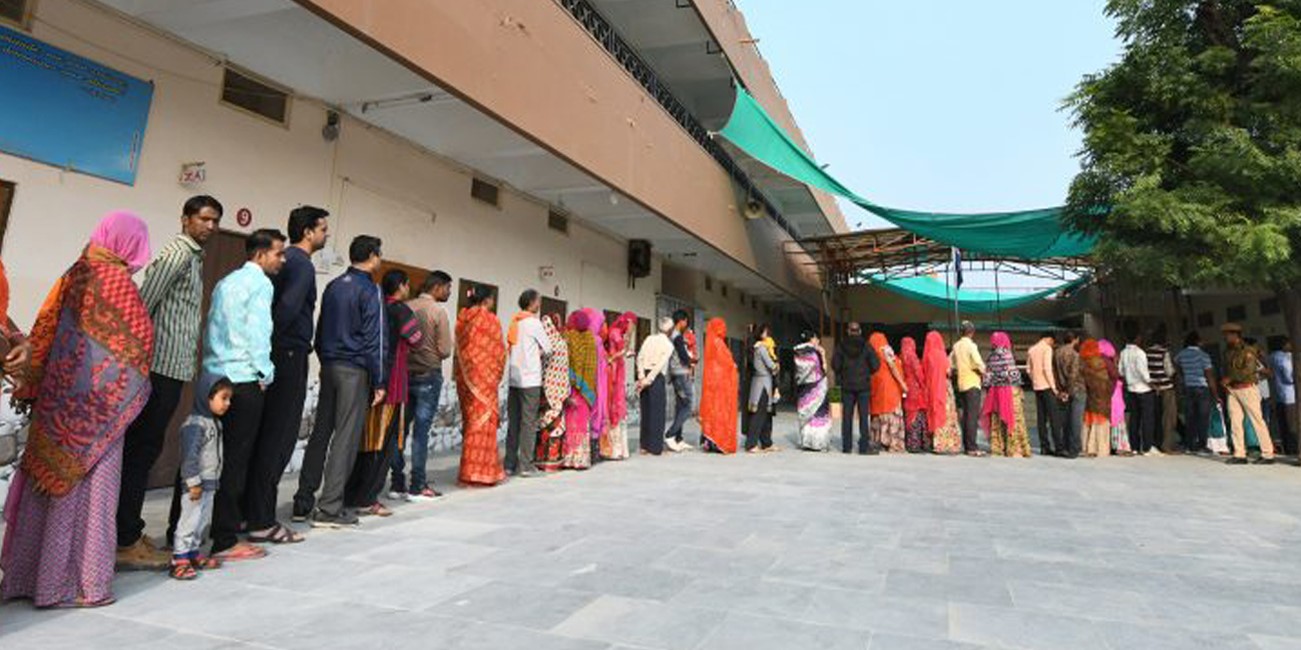
File photo of voters in Telangana. (Supplied)
Synopsis: Following the municipal body elections in Telangana, political parties have been engaged in horse-trading and alliances with others, even those whom they abused before the elections, for securing mayoral posts. By such actions, all people’s representatives, the ruling classes, and even the constitutional election commissions together are making a mockery of the word democracy.
Ordinarily, in a weekly column, there is hardly ever an occasion to write on the same subject for a second consecutive week. However, in the matter of the municipal elections in Telangana, many more issues have arisen that demand continuation of last week’s column, written before the elections.
Hence, I have no option but to return to the same subject once again.
Last week, we discussed preparations for the electoral process, the enormous flow of money, liquor and material inducements in the elections, the violence and the unprincipled alliances unrelated to party ideologies, and questioned whether this could be called democracy.
Within a week, the elections have been completed. Candidates from various parties have won as corporators. Thereafter, another process has also been completed — these “people’s representatives,” having secured “public mandate,” however illegally, elected the chairpersons and vice-chairpersons of their respective municipal bodies.
It is based on who gets elected as chairpersons and mayors that it is decided which party controls the respective municipal institutions.
From the moment the initial results were declared, statistics, details and analyses have been pouring in about how many wards each party won, how many divisions they secured, and the percentage of votes they obtained.
Based on these figures, each party claimed victory for itself, arguing that even if the opponent appears to have won more seats numerically, morally it has suffered defeat, and alleging conspiracies by the rival party.
According to initial estimates based on the count of corporators and divisions, the ruling Congress secured the chairperson and mayor posts in 74 municipalities and four corporations. Similarly, it was estimated that the BRS would secure 17 municipalities, the Forward Block one municipality, and that in 24 municipalities and three corporations no party had a clear majority.
While the 74 municipalities and four corporations with clear majorities for Congress, and the 17 municipalities with clear majorities for BRS, are one matter, the real political drama unfolded in the 24 “hung” municipalities and three corporations where no party had a clear majority. These hung municipal bodies have become the touchstone of our democracy.
A “hung” situation means, for instance, that in Bellampalli, which has 34 seats, no party secured the required 18. There, Congress and BRS won 14 seats each. Unless either party garners the support of four more members, neither can form the administration. The BJP won one seat, and others won five seats. If four among these six extend support either to Congress or to BRS, that party will capture the Bellampalli municipality.
At least, there exists a situation where four additional seats are required to cross the winning line. But even more bizarre is the case of Kesamudram municipality, where out of 16 seats, Congress won eight and BRS won eight. Unless at least one member from one party defects to the other side, the election of the chairperson cannot be resolved. Naturally, the ruling party has a greater opportunity to induce such defections.
In the corporations, too, the situation is no different. In Kothagudem, which has 60 seats, no party secured the required 31. Congress and CPI won 22 seats each.
For either of these two parties to independently secure the mayoralty, they would need to draw nine members in total from BRS — which won eight seats — from BJP and CPI(M) — which won one seat each — and from others who won six seats.
Alternatively, the two could arrive at a mutual agreement. In fact, looking at the situation 10 days earlier, the main dispute in this corporation was over seat sharing between those two parties. These are parties that had broken their two-year-old alliance in the entire state for a couple of seats.
That means an alliance broken yesterday can be shamelessly revived today — on no basis other than hunger for power.
In Nizamabad corporation, out of 60 seats, and in Karimnagar corporation, out of 66 seats, the BJP secured 28 and 30 seats respectively, falling short by three in Nizamabad and four in Karimnagar. Unless it draws members from Congress, BRS, AIMIM or others to fill that gap, the BJP — despite being the single largest party — will have to sit in Opposition.
There is yet another twist. Not only the elected representatives in these municipal bodies, but also the MLAs and MPs of the constituencies to which these municipal bodies belong, become ex officio members.
Although technically they must be registered as local voters, if the ruling party so desires, it can manipulate these ex officio votes and convert an unfavourable municipal body into a favourable one.
Here lies the most crucial test for Indian democracy. For decades, it has been repeatedly proven that in Indian parliamentary electoral politics, parties, ideologies, commitments, loyalties — even basic shame and decency — hardly matter; what matters are lust for power, expectation of reward, greed for benefit, selfishness and opportunism.
The Telangana municipal elections now provide a magnificent opportunity to prove this once again.
In such a situation, candidates who realise that their vote has become extraordinarily precious — capable of altering the future and overturning the fortunes of parties — sit atop a hill.
If they demand even a monkey from the hilltop, the party aspiring to form government is ready to fetch it to secure that vote.
Accordingly, that “people’s representative” jumps from one branch to another like a monkey. To call this frog-hopping politics democracy is an insult to the very idea of democracy.
If one does not wish to call it frog-hopping, some call it horse-trading. Others have sarcastically asked, why call them horses — what if they are donkeys?
Although comparing these opportunists to frogs, monkeys, horses, or donkeys insults those poor, voiceless creatures, it is even more perverse to regard such valueless, ideologically uncommitted “people’s representatives,” ready to shift loyalties wherever money and power beckon, as symbols of democracy.
To make this frog-hopping democracy “more democratic,” political parties competed in organising detention-camp style resort politics to prevent their candidates from jumping to the other side; seizing their phones and confining them in resorts with all luxuries; attempting to buy councillors and corporators through bargaining; kidnapping, obstructing and assaulting rival party representatives; misusing the police machinery by the ruling party to arrest opposition representatives and keep surveillance on their movements; offering vice-chairperson posts, two crore rupees, expensive cars, contracts, and so on — such “courteous and democratic measures.”
Does anyone reading news of these developments not feel ashamed to call this democratic politics? The political parties that failed to engineer such deals, along with newspapers and channels supporting them, describe these as “unethical alliances.”
However, does morality remain anywhere in our politics? In many municipalities, which party joined hands with which, who voted for yesterday’s enemy, how much money changed hands, what posts were offered, and what contracts promised might never fully come to light.
A BJP MP voted for BRS, whom he had abused until yesterday. BJP felt no shame in allying with Congress in one municipality and with BRS in another. In one place, a “people’s representative” elected on a BRS ticket defected to Congress, secured BJP support, and became chairperson.
After all this horse-trading concluded and the elections ended, Congress’s tally of municipalities rose from 74 to 92. That means in at least 18 municipalities, illegal and unethical alliances were certainly forged. BRS had to remain content with 18.
BJP and Forward Block secured one municipality each, and an independent candidate won one municipality. Three remain postponed. In the three hung corporations, Congress, through Chanakyan manoeuvring, gave one to CPI and retained two for itself.
In short, most of the candidates whom voters elected as their “representatives” reversed everything within a week — the party name under which they contested, the ideologies they proclaimed, whom they abused, and whom they praised to secure the people’s votes. When all that is overturned, how can the votes cast for them remain intact? How do they continue as representatives of those people?
Asking such fundamental questions is forbidden in this parliamentary democracy. Elections alone are reduced to the definition of democracy, and no matter how illegal, irregular, inverted or violative of basic democratic principles they may be, people are made to believe that this is democracy. It is a grand deception that has been enacted upon the people for decades.
Overall, all political parties, all people’s representatives, the ruling classes, and even the constitutional election commissions together are making a mockery of the word democracy! Such is the great achievement of seven and a half decades of Indian parliamentary representative democracy!
(Views are personal.)


