

Published Jan 21, 2026 | 11:50 AM ⚊ Updated Jan 21, 2026 | 11:50 AM

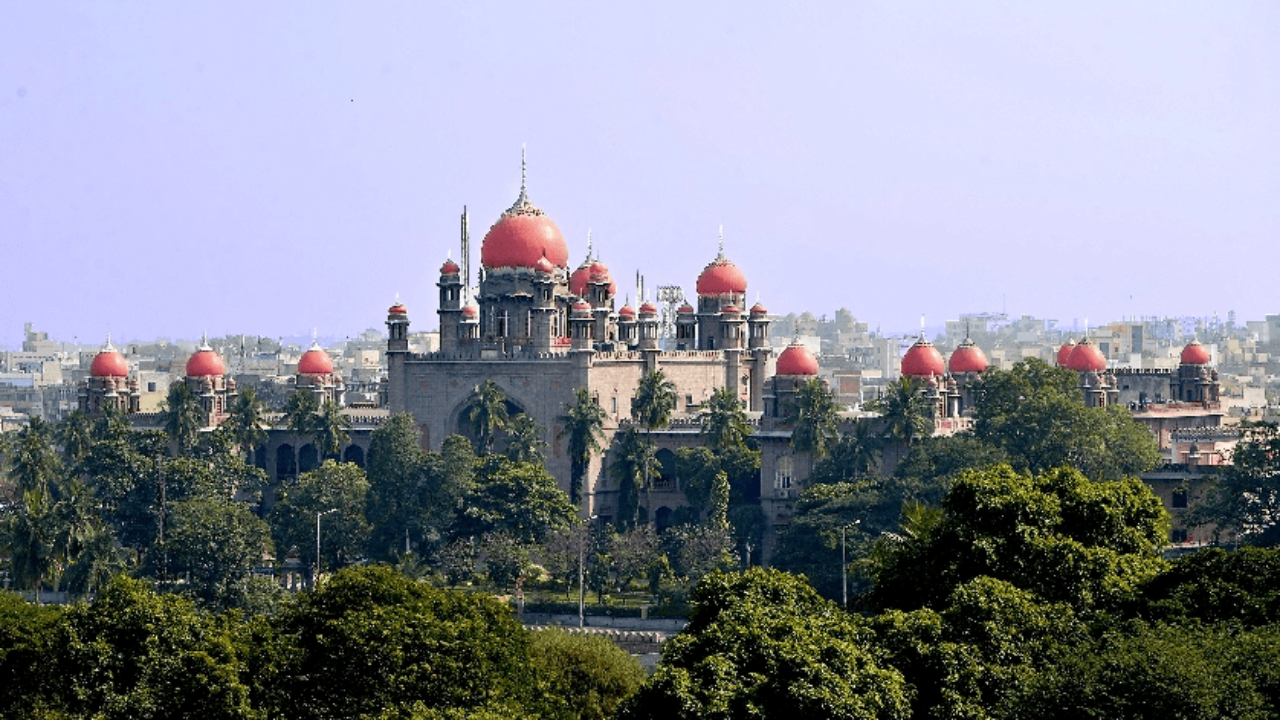
The Telangana High Court. (Official website)
Synopsis: The Telangana High Court initiated suo motu contempt against Special Chief Secretary CV Anand for permitting ticket price hikes for Chiranjeevi’s ‘Mana Shankara Vara Prasad Garu’, defying prior orders. Justice NV Shravan Kumar mandated 90-day prior notification for future hikes, citing arbitrary governance. The ruling underscores recurring executive defiance, judicial intervention, and mounting tensions over cinema pricing, transparency, and public accountability.
The Telangana High Court on Tuesday, 20 January, took serious note of what it described as repeated and deliberate violations of its earlier orders and initiated suo motu contempt proceedings against Special Chief Secretary (Home) CV Anand for clearing an increase in cinema ticket prices for the Chiranjeevi-starrer Mana Shankara Vara Prasad Garu, despite clear judicial directives barring such approvals.
Justice NV Shravan Kumar, while hearing a petition that challenged the government’s decision to permit enhanced ticket prices, also laid down a crucial guideline with wider ramifications for the film industry and the state administration. The court ruled that any proposal to increase cinema ticket prices in future must be notified at least 90 days prior to a film’s release, thereby giving sufficient opportunity for scrutiny and public challenge under Section 7A of the Telangana Cinemas Regulation Act, 1955.
The ruling is aimed squarely at injecting transparency into a process that the court observed had increasingly become opaque and arbitrary. It also reflects the growing friction between the judiciary on one side and the state administration and sections of the Telugu film industry on the other, over what has emerged as a recurring practice of last-minute ticket price escalations that have triggered political storms and widespread public resentment.
The contempt notice follows a government memo issued by CV Anand on 8 January, which permitted an additional ₹50 hike for single-screen theatres and ₹100 for multiplexes for a period of seven days following the film’s release on 12 January. The petitioner, Dachepally Chandra Babu, an advocate from LB Nagar, contended that this decision amounted to a direct breach of the High Court’s 9 January order, which had stayed a similar price-hike memo issued for Prabhas’ The Raja Saab, released on 10 January.
Justice Shravan Kumar observed that during the hearing related to The Raja Saab, the government had failed to disclose the existence of the Mana Shankara Vara Prasad Garu memo, a lapse the court described as not merely inadvertent but a “wilful violation” demonstrating a lack of candour and due diligence. The judge came down heavily on the administration for approving the hike without undertaking even a basic verification of the film’s budget, production costs, or financial particulars, terming the decision a blatantly arbitrary exercise of power.
Directing the court registry to issue the contempt notice, Justice Shravan Kumar warned that such repeated infractions could not be tolerated and stressed that all future decisions relating to ticket price revisions must conform strictly to the provisions of the 1955 Act, lest the state should invite further judicial action. The court made it clear that continued disregard for statutory safeguards and court orders would only deepen the constitutional crisis surrounding administrative accountability.
This is not the first occasion on which the High Court has had to step in. On 9 January, the court had stayed the ticket hike granted for The Raja Saab, openly expressing displeasure over the government’s apparent indifference to earlier assurances given on the floor of the Assembly by state ministers that such hikes would not be allowed.
A similar scenario played out in December 2025, when the court suspended a price hike for Nandamuri Balakrishna’s Akhanda-2 and initiated contempt proceedings—though those proceedings were later stayed by a division bench. Collectively, these cases point to a pattern in which executive memos appear to routinely override judicial directions, intensifying debates over governance and respect for the rule of law.
The broader controversy over cinema ticket pricing in Telangana has its roots in the bifurcation of Andhra Pradesh in 2014, which left the newly formed state without a clearly articulated and unified policy framework for cinema regulation. Under the Telangana Cinemas Regulation Act, ticket prices are capped according to theatre classifications—generally ₹120 to ₹150 for multiplexes, with lower ceilings for single-screen cinemas.
However, producers of big-ticket films have frequently sought temporary relaxations, arguing that premium pricing during the opening week is essential to recover ballooning production costs and maximise revenues.
Producers maintain that star-led ventures featuring actors such as Chiranjeevi, Prabhas, or Allu Arjun involve investments running into ₹200–₹300 crore or more, particularly when released during lucrative festival windows like Sankranti, making higher ticket prices a commercial necessity. Critics, however, argue that these justifications cannot override statutory caps or compromise consumer interests.
The issue acquired added sensitivity in late 2024 following a tragic stampede at the premiere of Pushpa 2 in Hyderabad, which resulted in the death of a woman and injuries to several others. In the aftermath, Chief Minister A Revanth Reddy categorically declared in the Assembly that no benefit shows or ticket price hikes would be allowed during his tenure, citing concerns over public safety and affordability.
Despite this unequivocal assurance, successive memos permitting ticket hikes continued to surface, prompting allegations of double standards and internal discord within the government. Cinematography Minister Komatireddy Venkat Reddy sought to distance himself from the approvals, stating on 10 January that such files had never reached his desk after the Pushpa 2 incident and that he had explicitly instructed officials not to entertain such requests.
The incident snowballed into a major controversy. BRS leader T Harish Rao derided the unfolding situation as a “suspense thriller” unfolding within the Secretariat, raising pointed questions about whether some “unconstitutional force” was operating behind the scenes.
Accusing the Congress government of favouritism and hinting at possible “commission rackets”, Rao alleged that the administration’s conduct was driven by arrogance and vendetta, and warned that it risked inflicting long-term damage on the Telugu film industry.
(Edited by Amit Vasudev)


