


Published Mar 04, 2026 | 8:37 AM ⚊ Updated Mar 04, 2026 | 8:37 AM

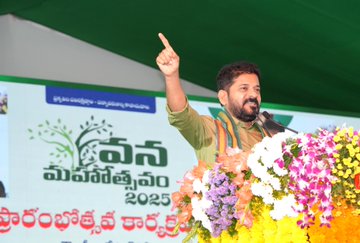
Chief Minister Revanth Reddy.
Synopsis: Telangana Chief Minister A Revanth Reddy unveiled an ambitious 99-day action plan to ensure participatory governance, technology-driven monitoring, and enhanced accountability across the state. The plan seeks to integrate elected local body representatives into governance implementation.
Telangana Chief Minister A Revanth Reddy on Tuesday, 3 March, unveiled an ambitious 99-day action plan —“Praja Palana–Pragati” — intended to ensure participatory governance, technology-driven monitoring, and enhanced accountability across the state.
He rolled out the programme at a district collectors’ conference held in Hyderabad. It is scheduled to run from 6 March to 12 June, and is designed as a multi-tiered public outreach and administrative reform exercise.
The plan seeks to integrate elected local body representatives into governance implementation. The chief minister directed that ward members, sarpanches, municipal ward members, chairpersons, corporators and mayors be made active stakeholders in the execution of the programme.
To ensure clarity of roles and accountability, the government will organise one-day intensive training programmes at district headquarters, equipping these representatives with operational clarity on their responsibilities.
The action plan unfolds in five clearly demarcated phases, each escalating in scope and administrative involvement. It begins at the Village Level through Gram Sabhas on 2 April, followed by the Mandal Level on 16 April, the Constituency Level on 2 May, and the District Level on 22 May, before culminating at the State Level in June.
This layered progression is intended to ensure that feedback and implementation challenges are captured at each administrative tier.
The Planning Department has been designated as the nodal agency to oversee the programme. A dedicated mobile application has also been developed to facilitate real-time monitoring, data capture and performance tracking.
The 99-day agenda has been organised around ten themes: Cleanliness and Efficiency, Health, Road Safety, Welfare, Child Safety and Anti-Drugs measures, Farmer Welfare and Agriculture, Education, Youth and Sports, Women’s Welfare, and Environment. The government describes them as a comprehensive governance canvas aimed at addressing both systemic deficiencies and emerging social challenges.
A significant thrust of the programme is the deployment of technology. The chief minister has ordered the implementation of facial recognition technology for beneficiaries of government schemes. He cited the recent removal of three lakh ineligible names from the Aasara pension scheme following the introduction of such technology as evidence of its effectiveness.
The move marks a decisive shift towards biometric authentication as a safeguard against duplication and fraud in welfare delivery.
The government is also pushing aggressively for renewable energy adoption under the Environment theme. The electricity department has been directed to undertake awareness campaigns in every village on the benefits of solar pump sets for agriculture and the income-generating potential of linking rooftop solar installations to the grid.
The strategy not only aligns with environmental sustainability goals but is also aimed at strengthening long-term energy security and augmenting rural incomes.
Road safety is another major component of the action plan. Under a citizen-participatory model, the Transport Department will launch a dedicated WhatsApp number enabling the public to report potholes and accident-prone zones. This crowdsourced data is expected to trigger swift maintenance responses and precautionary interventions, effectively turning citizens into real-time contributors to public safety oversight.
Responding to concerns from the farming community, the chief minister acknowledged operational issues surrounding the Urea app and directed officials to streamline it to make it more farmer-friendly. He has also emphasised the need for on-field demonstrations to educate farmers on the benefits of Nano Urea, thereby encouraging efficient fertiliser usage and improved crop productivity.
The chief minister wanted optimisation of existing infrastructure by ensuring that all 35 government medical colleges function as primary referral hubs for Primary Health Centres, Community Health Centres and other local health institutions. The objective is to leverage advanced medical equipment and specialist manpower available at these colleges for wider public benefit, thereby strengthening the referral chain and improving access to tertiary care.
On women’s safety and child welfare, the chief minister issued stringent directions, holding school and college managements accountable for any instances of ganja consumption, drug usage or e-cigarette presence on their campuses. All private and corporate educational institutions have been mandated to appoint qualified psychologists alongside subject and physical education teachers.
The government is also moving towards regulating student and working professional accommodation facilities. All working women’s hostels, boys’ hostels and girls’ hostels in urban centres are to be registered, and strict oversight mechanisms are to be enforced. The initiative seeks to enhance safety and accountability for young people living away from their families.
In the agricultural sector, the Agriculture Department has been tasked with conducting systematic soil testing and advising farmers on crop suitability based on soil health metrics, prevailing market demand and the benefits of crop diversification. The larger objective is to steer farmers towards more sustainable, climate-resilient and market-linked farming practices that enhance profitability.
On waste management, the administration has ordered strict enforcement measures against the dumping of garbage and construction debris along the Outer Ring Road (ORR) and its service roads. Fines and criminal cases have been authorised against violators, while the ORR agency itself has been warned of accountability for lapses in oversight.
The chief minister also addressed operational concerns in welfare schemes such as the Mid-Day Meal programme, directing that bills of implementing agencies be cleared every month without delay. He has called for a comprehensive action plan to ensure consistent provision of nutritious meals to schoolchildren.
(Edited by Muhammed Fazil.)


