

Published Feb 08, 2026 | 1:50 PM ⚊ Updated Feb 08, 2026 | 1:50 PM

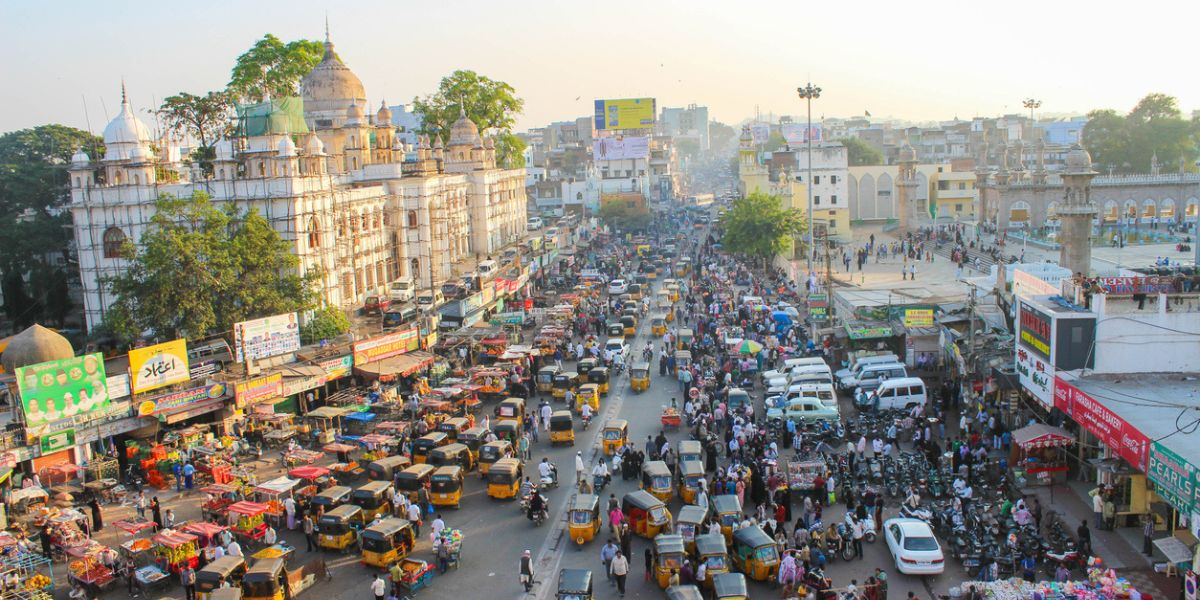
Busy traffic in Hyderabad. (iStock)
Synopsis: The Telangana government is reportedly moving ahead with the plan to split the GHMC into three separate corporations. The stated aim is to ensure sharper governance and faster civic response in a city that has long outgrown its old municipal seams. However, beneath the administrative logic lies a hard political edge. Congress strategists see it as a way to consolidate gains.
The Telangana government is set to pull the curtain down on the Greater Hyderabad Municipal Corporation (GHMC) and ring in a new civic order soon after the council’s term ends on 10 February.
According to sources, the GHMC — among the largest corporations in the country by size and headcount — will be split into three separate corporations. The stated aim is to ensure sharper governance and faster civic response in a city that has long outgrown its old municipal seams.
The new civic avatars are likely to be named Hyderabad, Cyberabad and Malkajgiri Corporations.
Once the trifurcation orders are issued, elections must be held within six months. The deadline is August 2026. That leaves political parties with a long, hot summer to fight it out ward by ward.
Hyderabad’s expansion over the past decade has been relentless. To keep pace, the government had folded 27 municipalities within the Outer Ring Road (ORR) into GHMC. The result was a civic giant — its area ballooning from about 650 sq km to over 2,000 sq km, and its population touching 11 million.
The merger created a municipal behemoth. Now, it will be divided into three corporations. The trifurcation, officials argue, is the cure. Smaller corporations, they say, mean quicker decisions and closer oversight. “Service delivery becomes nimbler. Accountability improves,” one official source said, pointing to sanitation, water supply and town planning as early beneficiaries.
The civic redraw mirrors recent changes in policing. The expansion of the Hyderabad Police Commissionerate, the rechristening of Rachakonda as Malkajgiri, and the proposed Future City Commissionerate for the southern corridors are part of the same playbook. Municipal limits will be aligned with police jurisdictions to improve coordination and avoid working at cross-purposes.
Under the plan, Hyderabad Corporation will cover the historic core. This includes the Old City, traditional commercial centres, Abids and Secunderabad, all under the Hyderabad Police Commissionerate. It is the city’s cultural heart — crowded, colourful and politically sensitive.
Cyberabad Corporation will take charge of the west and southwest. This is Hyderabad’s growth engine. HITEC City, IT campuses, glass-and-steel offices, gated communities and malls define this zone. Falling under Cyberabad and the proposed Future City police limits, it runs on tech jobs, start-ups and soaring real estate.
Malkajgiri Corporation will span the eastern flank, including Uppal, LB Nagar, Habsiguda and other dense suburbs. Affordable housing projects, metro lines and swelling middle-class neighbourhoods drive growth. The area will align with the Malkajgiri Police Commissionerate.
With the GHMC council about to dissolve, the government is putting stopgap arrangements in place to keep the city ticking. Officials have been told to ensure there are no hiccups in tax collection, garbage clearance or road maintenance.
However, beneath the administrative logic lies a hard political edge.
For the ruling Congress, led by Chief Minister A Revanth Reddy, the split is also a calculated political gamble. Party strategists see it as a way to consolidate gains.
The Congress had already redrawn the map in 2024-25 by pulling peripheral municipalities into GHMC. That move is thought to have diluted BRS and BJP pockets in the core city, as semi-urban voters have joined the new corporations. Welfare schemes — free bus travel for women, farm subsidies — found a receptive audience there.
Breaking one large corporation into three is meant to sharpen that edge. Cyberabad’s IT-savvy middle class can be wooed with infrastructure and mobility. Malkajgiri’s aspirational families with housing and urban services. In the old city, Congress hopes to navigate the terrain with the quiet support of ally AIMIM in Muslim-majority areas like Charminar.
The party is understood to be planning to roll out welfare to targeted sections in need the most for reaping electoral benefits.
The strategy is simple: Divide the turf to blunt city-wide narratives. In the unified 2020 GHMC polls, BRS won 56 seats and BJP 48. Those numbers now risk losing their bite.
The BRS, unsurprisingly, cries foul. Leaders describe the move as unscientific and authoritarian. MLC Dasoju Sravan Kumar accused the government of trampling the 74th Constitutional Amendment, bypassing the State Election Commission and outsourcing delimitation work. The party alleges an ulterior land agenda — control over high-value, revenue-rich zones to fuel loans and patronage. “This is not decentralisation. It’s political greed,” Sravan argued.
The BJP, too, is sharpening its knives. It calls the trifurcation a conspiracy to “gift” one corporation to AIMIM, sweetened by lucrative real estate prospects.
As Hyderabad races toward global city status, its civic map is being redrawn with heavy political ink. The trifurcation may promise better governance, but it also opens a new front in Telangana politics.
(Edited by Muhammed Fazil.)


